The 2026 global water conflict report, compiled by UNU-INWEH and the Pacific Institute, records 420 water-related incidents in 2024 alone — nearly four times the 2020 figure — and issues a structural verdict: the world is not managing a crisis but an insolvency.
From Crisis to Bankruptcy: Why the Word Change Is the Story
In 1992, the Dublin Principles declared water a finite and vulnerable resource — an acknowledgment so modest it took another three decades to produce consequences. Thirty-four years later, in August 2026, the United Nations University Institute for Water, Environment and Health and the Pacific Institute formalised what the Dublin delegates had preferred not to say plainly: the world has not mismanaged a crisis but drawn down a finite account until the balance turned negative. The word they chose was bankruptcy.
The distinction is not semantic. A crisis implies a temporary deviation from a recoverable normal. Bankruptcy, as UNU-INWEH defines it, means water use has exceeded renewable inflows and safe depletion limits — the debt has outrun the income, and there is no version of emergency management that restores the prior equilibrium.
Kaveh Madani, the institute's director and lead author of the 2026 report, put it without qualification: "Normal is gone for much of the world." For basin-dependent states, those four words carry the weight of a structural verdict.
The institutional gap this opens is serious. Emergency management frameworks are architected around the assumption of return — restore supply, reduce demand, bridge the shortfall, recover the baseline. Insolvency management is a different discipline entirely, and the machinery for it does not yet exist at scale.
The Pacific Institute's conflict chronology recorded 420 water-related incidents in 2024 alone, nearly four times the 2020 figure, with 785 total incidents across the five-year period surpassing the entire previous decade's count of 620. Those numbers are not a trend line approaching a threshold. They are the ledger of a system already operating past its limits.
Four Hundred and Twenty: Reading the Global Water Conflict Chronology
The Pacific Institute has tracked water-related violence since 1930. Its database is not a think-tank abstraction — it is a ledger, updated by event, categorized by type. In 2024, it recorded 420 incidents — a record, and nearly four times the annual figures from 2020, when the same database was already being called alarming.
The five-year arithmetic is worth holding separately. Between 2020 and 2024, the Institute logged 785 incidents total, surpassing the entire previous decade's count of 620. The compression matters as much as the volume.
Between 2022 and 2024 alone, water-related conflicts rose 78 percent — not a gradual curve but an acceleration of the kind that historically precedes institutional failure, because the institutions were calibrated for a slower problem.
The typology is not academic. The Pacific Institute classifies each incident as a trigger, a weapon, or a casualty of war: scarcity ignites violence, water is used to coerce or kill, or infrastructure is destroyed as a military act. The category determines competence — a trigger event falls to development agencies and ministries of agriculture; a weapon falls to international humanitarian law; a casualty falls to military doctrine and reconstruction budgets.
Sorting the 420 correctly is not pedantry. Misclassify them and you send the wrong institution to the wrong fire.
The near-quadrupling since 2020 has a structural implication that linear policy responses cannot absorb. Exponential curves do not wait for the next five-year plan. The number 420 is already a past data point — the 2025 ledger is still being written.
The Transboundary Fault Lines: Nile, Indus, and the Plains That Are Eating Themselves
The Indus Waters Treaty was signed in 1960, brokered by the World Bank, dividing the basin between India and Pakistan with the careful optimism of an era that had not yet modelled a two-degree world. It is now identified as the primary geopolitical flashpoint for 2026. The treaty allocated rivers; it did not allocate the glacial melt those rivers depended on.
Downstream, the arithmetic is simpler and crueller. Ethiopia's Grand Ethiopian Renaissance Dam is a load-bearing fact in the Nile basin — not a negotiating position, not a grievance, a structure holding water that Egypt and Sudan have priced into their national survival. Negotiations continue.
The dam is full. Ask the small question first: who is the borderland here, and who is the empire?
The domestic fracture is harder to photograph than a dam. In Isfahan, farmers have been protesting government water-extraction policy — the kind of internal dispute that transboundary diplomacy consistently ignores until the protests become something that requires a different word. When the state itself becomes the upstream actor against its own agricultural communities, no treaty framework applies.
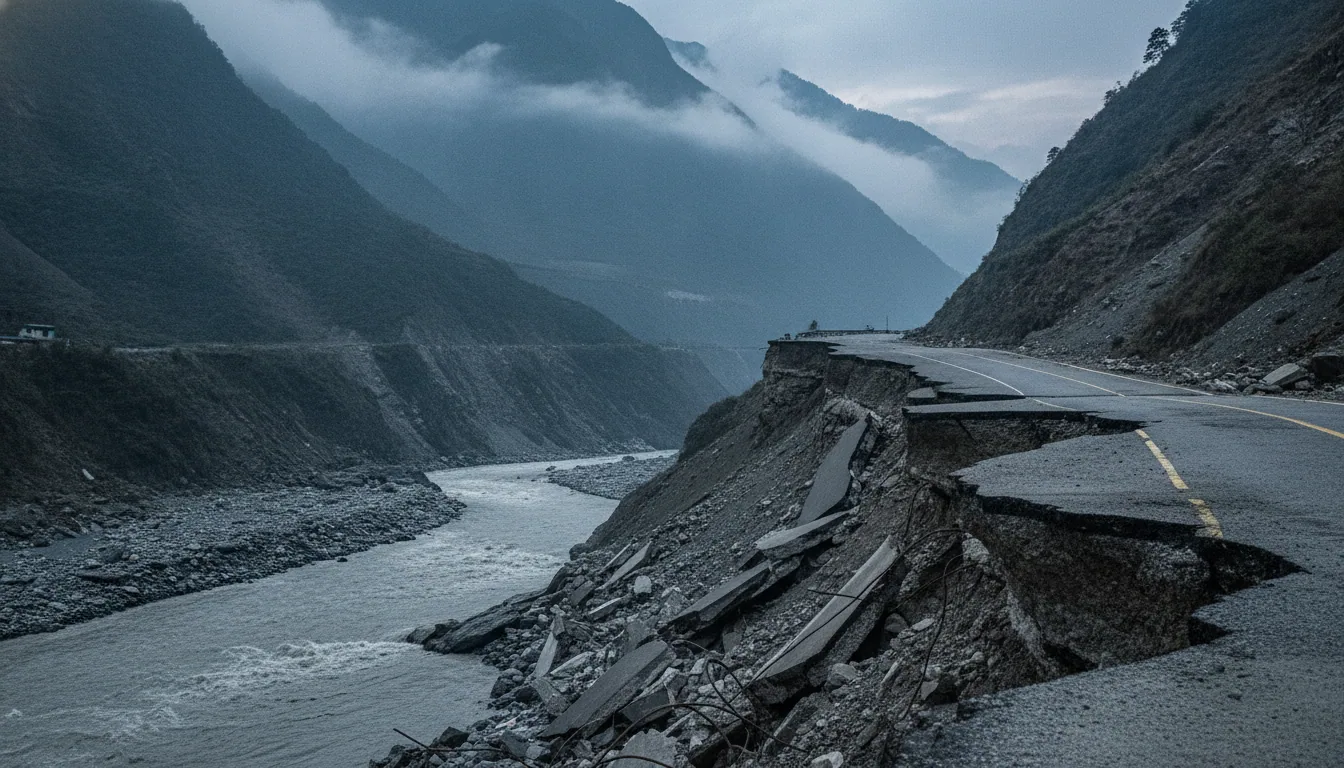
Geology eventually issues its own verdict. By late 2025, nearly 700 sinkholes had opened across Türkiye's Konya Plain, the surface collapsing into the void left by extracted groundwater. Tehran province is subsiding 20 centimetres annually.
This is not a policy failure in the usual sense. This is the earth auditing withdrawals that no one formally recorded as debt.
The practical consequence for anyone reading a transboundary water map in 2026 is this: the fault lines are not where the treaties drew them. They run under the plains, through the ministries that issue extraction permits, and along the riverbanks where downstream governments have based their population arithmetic on water that an upstream neighbour now controls.
Misclassify them and you send the wrong institution to the wrong fire.
The Daily Arithmetic: What the Numbers Look Like at Ground Level
Start with what the figures actually describe. One in four people on earth, 2.1 billion by the WHO and UNICEF count, have no safely managed drinking water at home. Four billion experience scarcity on a seasonal or chronic basis.
The second number is the more honest one: it captures the households that have water until they do not, the well that fills in spring and fails in August, the arithmetic of intermittency that no summit communiqué photographs.
One thousand children under five die every day from water-related disease. UNICEF has held that figure steady across several reporting cycles. The steadiness is not reassurance.
It is a policy verdict: the number is not falling because the conditions producing it are not changing, and the conferences that convene to address it are not, structurally, designed to change them.
The hidden labour cost sits alongside the mortality count and rarely shares a headline with it. Women and girls spend an estimated 250 million hours each day collecting water, the UNESCO figure from the 2026 World Water Development Report. That is not a welfare statistic.
It is the mechanism by which water scarcity produces gender inequality before any other factor intervenes — the girl who does not attend school because the standpipe is four kilometres away, the woman whose working day is structured entirely by the distance to water.
The projection that 2.3 billion people may face scarcity risk by the end of 2026 is a soft figure, the sources acknowledge as much. The direction it points is not soft. The arithmetic compounds: more people, less water, and the daily count of the cost that does not appear in the summit photograph.
The Institutional Response: Water Compacts, Colorado, and the Limits of a Good Communiqué
The World Bank's answer to bankruptcy is a compact. Fourteen countries in 2026 are operating under new Water Compacts designed to attract private investment into national water systems — a shift, quiet but structural, from the public-utility logic that built most of the infrastructure now failing. The load-bearing question is not whether the money arrives.
It is who sets the terms when it does, and whether a water system governed by return on investment prices the same populations differently than one governed by the premise that taps should work.
The Colorado River agreement being finalised in 2026 will serve 40 million people and is, by the measure of American hydro-politics, a genuine achievement. It will also be tested immediately by a river that has not read the agreement. The hydrology of the Colorado is not recovering; the compact distributes a diminishing asset and calls the distribution a solution.
Southern Europe now discovers what it once called a southern-hemisphere problem. The region is warming faster than the global average, producing chronic scarcity in states that exported the assumption that rivers were someone else's emergency.
Water ecosystems are valued at $58 trillion — roughly 60 percent of global GDP — and underpin approximately 1.7 billion jobs worldwide. These figures appear in the economic case for action, assembled with considerable care after the window for comfortable action had already narrowed.
The communiqué will say the parties shall act. Watch whether it says shall or should. The difference between those two words is the difference between a compact and a photograph of people who once sat in a room together.
What to Watch Before the Next Report Is Filed
Three markers. They are checkable, near-term, and the Pacific Institute's record of 420 documented conflicts in 2024 makes them non-optional.
Read the Colorado River agreement's final text word by word. If the allocation language says shall, someone accepted a binding obligation. If it says should, the document is decorative, and the dispute will return before the next report is filed.
Watch the GERD trilateral. A resumed technical session between Ethiopia, Sudan, and Egypt before the end of Q4 2026 signals that diplomatic runway still exists. Its absence signals the opposite, and the basin knows the difference between a postponed meeting and an abandoned one.
On the Indus, the one datum that would change the read entirely is a formal suspension or formal reaffirmation of the 1960 treaty by either India or Pakistan before year-end. Silence is not stability there; it is accumulation.
420 global water conflicts in a single year is not a trend line awaiting a response. It is the response, already given, to sixty years of inherited assumptions.