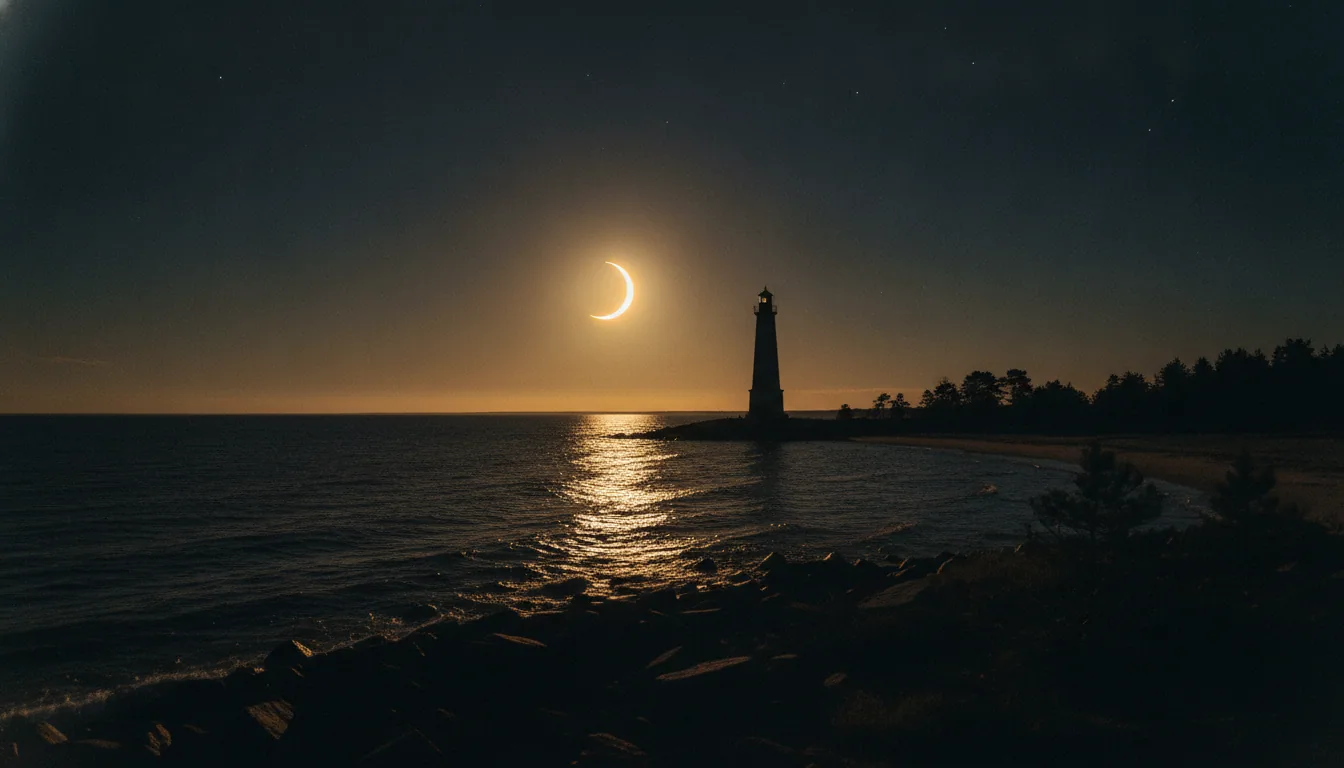
On March 3, 2026, the Moon will perform its most famous disappearing act, only to reappear in a costume it shouldn't, by all rights, be wearing. This is the total lunar eclipse, often called a "Blood Moon," a 58-minute window where our satellite drifts into the deepest part of Earth's shadow. But here is the strange part: instead of vanishing into the blackness of space, the Moon will begin to glow with a deep, haunting copper-red.
For those of us in Estonia, this particular March event will happen while the Moon is tucked safely below our horizon, meaning we'll be watching the spectacle via livestreams from the Pacific. However, 2026 is a year of celestial compensation. What we miss in March, the universe pays back in August with a dramatic partial solar eclipse and a lunar event of our own. To understand why any of this matters, we have to look at the physics of a shadow that refuses to be dark.
The Physics of a Red Shadow
Think about a shadow for a moment. Usually, it is a simple absence—a place where light cannot reach. If you stand in the shadow of a building, you are in the dark. So, when the Earth moves directly between the Sun and the Moon, the Moon should, logically, go pitch black. It doesn't.
The reason lies in the thin, fragile envelope of gas we call our atmosphere. To the Sun's light, our atmosphere isn't a solid wall; it's a lens. As sunlight hits the edge of the Earth, the gases in the air act like a gauntlet. They grab the short, blue wavelengths of light and scatter them in every direction (this is why the sky looks blue during the day). But the longer, redder wavelengths—the stubborn ones—pass through this gauntlet almost entirely unbothered.
We call this Rayleigh scattering. It's the same effect that paints a sunset orange. During a total lunar eclipse, the Earth is essentially experiencing every sunset and every sunrise on the planet simultaneously, arranged in a perfect ring. That ring of filtered, red light is bent inward by our atmosphere and projected onto the face of the Moon.
Now hold that thought, because the Moon isn't just a passive screen; it's a mirror reflecting the health of our own planet. The exact shade of red we see—whether it's a bright, bruised orange or a dark, charcoal crimson—depends entirely on what is floating in our air. If there have been recent volcanic eruptions or large-scale forest fires, the extra dust and ash make the shadow darker and more somber. Every eclipse is a visual experiment where the atmosphere, not the astronomer, holds the pen.
Fifty-Eight Minutes in the Umbra
On March 3, the geometry of the solar system will be particularly precise. The Moon will enter the umbra—the darkest heart of Earth's shadow—and stay there for exactly 58 minutes. This duration isn't random; it's a result of the Moon's specific trajectory as it cuts a path through the circle of our shadow.
This nearly hour-long window is a gift for photographers and scientists alike. It is long enough to let the eyes adjust and notice the subtle shifts in tone as the Moon moves deeper into the shadow's core. While this event belongs primarily to the Pacific Ocean, North America, and East Asia, it serves as a reminder of the clockwork precision of our corner of the galaxy.
For those of us in Estonia, our turn for a "Blood Moon" won't come until the night of December 31, 2028. There is something poetic about the idea of ringing in a new year under a crimson moon, and for that, we can afford to be patient. Geography is a stubborn thing; we only ever see half the sky at once, and on that March night, we simply happen to be on the wrong side of the ball.
August 12: When the Day Turns Cold
However, do not let the March disappointment fool you. August 2026 is when the real show arrives for Estonia. On August 12, at approximately 20:53, the light over Tallinn and the rest of the country will turn... wrong. It won't be the darkness of night, but a strange, metallic silvering of the world.
At this moment, the Moon will bite into the Sun, covering between 80 and 84 percent of its surface. This is a significant partial solar eclipse, a rarity for our latitudes. Because it happens so close to sunset, the Sun will be low on the horizon, making the choice of your viewing spot critical. A single tall building or a dense row of trees to the west could completely erase the event from your view.
Now, a word of caution that I cannot stress enough: even when 84 percent of the Sun is covered, the remaining 16 percent is more than enough to cause permanent, painless retinal damage in a fraction of a second. Looking at this with the naked eye is not an act of bravery; it is an act of foolishness. To see this safely, you need certified eclipse glasses or a telescope with a proper solar filter.
If you find yourself craving the full experience—the "totality" where the birds go silent and the stars come out at noon—you will need to travel. The path of total darkness will sweep across Greenland, Iceland, and Spain. But even from an Estonian beach, watching a silver sliver of the Sun sink into the Baltic is a memory worth making.
August 28: Our Own Lunar Encounter
Just two weeks after the Sun's disappearing act, the Moon returns for an encore. On August 28, a partial lunar eclipse will be visible directly in the Estonian sky. Unlike the solar event, this requires no filters or special equipment. You only need to look up.
During this event, we will see the curved edge of the Earth's shadow slowly creeping across the lunar plains. It is a moment of profound perspective. When you see that curve, you aren't just looking at a dark patch; you are looking at the physical proof of the shape of the world we live on.
We still don't know exactly what color the shadow will be that night—that will be determined by the dust and winds of the coming months. But whether it is a pale rose or a deep rust, it remains a free ticket to the greatest show in the universe. We spend so much of our lives looking at the screens in our pockets; 2026 is a year that asks us, quite insistently, to look at the much larger screen above our heads.