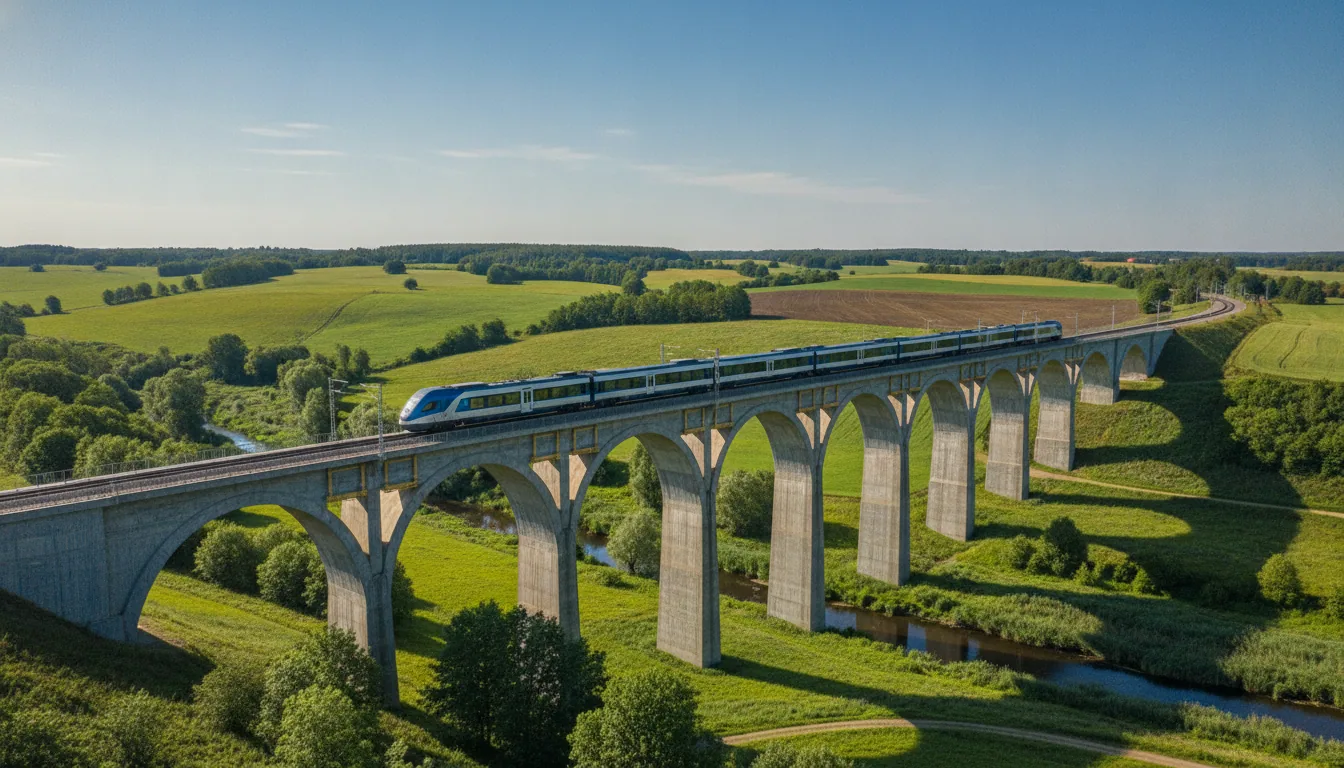
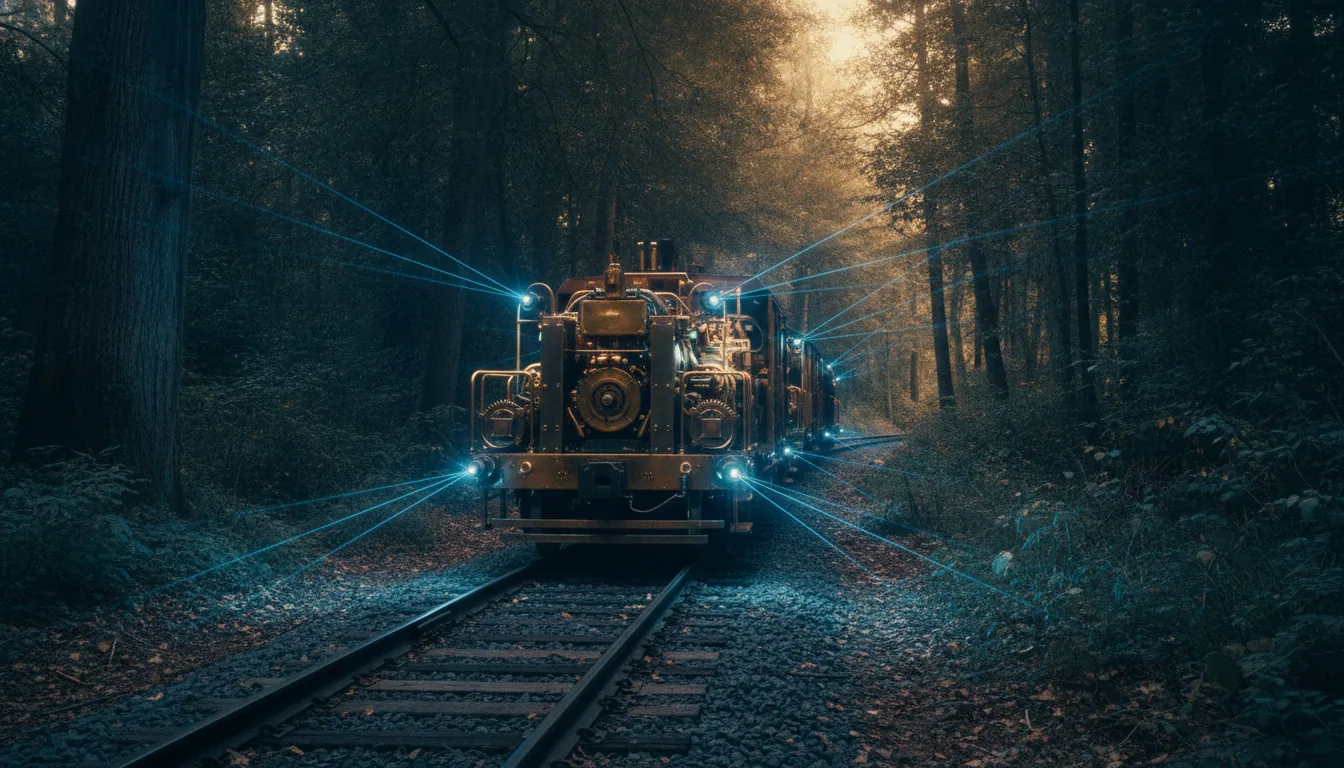
Estonia's rail network is being transformed into a data-driven system in which LiDAR technology and laser scanning build a precise digital twin of the physical infrastructure. The result is a railway that detects faults in real time, improves safety, and accelerates connections with Europe — laying the foundation for intelligent north-south logistics.
The steel has been lying across the Estonian landscape for decades, crossing marshes and pine forests in near-total silence. A few times a week something heavy runs over it. A technician walks the line, looking for a skewed nail or a rotted sleeper before the next train comes. The system works. It also depends entirely on someone noticing the problem before the problem notices anyone.
Here is the question: what if the steel itself could see?
The Rail Network as a Giant Scanner: New Eyes for the Iron Spine
A railway behaves like a giant scanner once you integrate laser sensors and data analysis directly into the physical layer of the steel infrastructure. Think of it as a metal spine hundreds of kilometres long, lying silently across the landscape for decades. To the naked eye it is a completely blind system — one that requires constant human attention just to keep functioning.
That is changing. AS Eesti Raudtee and Rail Baltica are turning Estonia's infrastructure into a living data-collection system that never sleeps. Rail Baltica is the main protagonist here, because it is a greenfield project. It does not have to wrestle with steam-age leftovers or adapt obsolete solutions to new demands.
This is an ambitious leap into the trans-European transport network that connects us with Poland, the Baltic states, and Finland. We are no longer talking about ballast and steel alone, but a system where data drives every maintenance decision and every operational choice. Call it a new nervous system grown into what was once inert material — turning a passive spine into a forward-looking organism.
Every millimetre of new track is, from the very start, part of a vast digital network. We are not building just a transport corridor but an intelligent data carrier that can diagnose itself. That shift redefines what a railway is supposed to do.
The 1870 Inheritance and the Quiet Revolution of the Gauge
Estonia's railway story began in 1870, when the first steam locomotive moved along the line from Paldiski through Tallinn and Narva toward St Petersburg. It was not merely the opening of a new transport route — it was a geopolitical statement cut directly into the ground. The 1,520-millimetre gauge chosen then locked us into eastern logistics for decades.
That number is a kind of systemic code, still dictating movement today. When the line extended through Tartu and Valga toward Riga, the gauge stayed fixed, unquestioned. It decided that our trains could roll smoothly in one geographic direction only, while lines running west operated to a different rhythm entirely.
Rail Baltica is a radical, unexpected turn in that long history. It brings the European standard gauge to Estonia: exactly 1,435 millimetres. At first glance, the 85-millimetre difference looks like a minor technical footnote buried in an old set of drawings.
In practice it is a thorough and irreversible change of language. Our infrastructure will now speak the same technical and economic tongue as Berlin, Warsaw, and Paris. We are no longer a distant technological island, cut off from the rest of the world by a different rail architecture.
We are not simply swapping steel on sleepers. We are shifting the country's strategic centre of gravity. The old east-west axis is giving way to a new north-south orientation — moving Estonia from the periphery of Europe into its natural, unbroken circulatory system.
A World Built from Light: How LiDAR Creates the Digital Twin
To build a genuine digital twin of a railway, you have to convert the physical world into bits. That is where LiDAR enters — a device that fires millions of laser pulses per second and probes its surroundings like an invisible hand made of light. The returning echoes tell us, to millimetre precision, where a rail sits or where a noise barrier stands, turning distances into exact mathematical reality.
Those billions of reflections gather into point clouds — think of a dense, sparkling data fog that covers every centimetre of the infrastructure. To turn that fog into something an engineer can actually use, the points are typically converted into 3D surface models.
Here is the tricky technical problem that specialists call building a "watertight" model. Because a laser beam cannot see through objects, algorithms must fill the gaps using the surrounding geometry. It is like a digital plaster cast: every crack has to be filled before you get a continuous surface.
No scanner is perfect. There are always blind spots that a technician must check and supplement. At that stage, manual interpolation is used to correct the inaccuracies the algorithm leaves behind. That is a reminder that even the cleanest digital world still needs a human eye as its guardian and creator.
Fast rail is a catalyst that does not only detect technical faults on the track — it creates a physical layer for the free flow of ideas.
The Meeting-Maximisation Machine: Why We Need 249 km/h
The number 249 kilometres per hour conjures a streamlined nose pushing almost silently through the forests of Pärnumaa. But it is more than a technical specification or a promise of a shorter journey. It is social and economic fuel that makes a country move differently.
A city has historically been a machine for maximising encounters. The denser and faster people collide with one another, the more creative sparks fly. Rail extends that machine across hundreds of kilometres, compressing Tallinn, Pärnu, and Riga into a single virtual space.
Researchers Geoffrey West and Luís Bettencourt found that when a city's population doubles, innovation increases by roughly 2.15 times. That is a network effect: the whole is always greater than the sum of its parts. Every person in a dense, well-connected network becomes statistically more creative.
Fast rail turns distant points into one living data organism. When the space-time around us contracts, a mathematics that favours interaction over isolation takes over. That is the real reason behind every bolt and every bit.
From Data to Safety: AS Eesti Raudtee and the Invisible Infrastructure
In 1870, maintaining the railway meant physical strength and a sharp eye. A trackworker had to spot a skewed nail or a rotted sleeper before a locomotive rumbled over it. The role of AS Eesti Raudtee has since become something far more subtle and far larger in scale.
They no longer maintain steel alone — they manage a vast data stream. The company ensures the smooth operation, maintenance, and efficient and safe management of rail traffic. Unlike the historical monopoly, the infrastructure owner must now guarantee fair competition for both freight and passenger operators.
It is like conducting an orchestra where freight trains and express services must share the same stage without disturbing each other. The guiding score is the national transport development plan, which sets the strategic targets for years ahead. That plan demands a precision only a digital twin can provide.
When you have a millimetre-accurate model of every rail and every switch, safety becomes a predictable quantity. Where we once waited for a problem to appear, we now aim to catch it first, through laser scanning and data analysis. The best infrastructure is the kind whose existence a passenger never once has to think about.
The Unknown Horizon: What We Still Don't Know About Our Railway
Every new technology is like a more powerful lens: it opens a view onto a new world while leaving the edges still blurred. We talk about scanning the track in real time, but we do not yet know precisely at what level of precision that digital confidence actually ends. Can the system catch the microscopic shifts that develop in steel at high speed, or will those remain for a technician to find?
That ocean of data raises a second question: who else could use this view? If the railway is scanning the surrounding landscape continuously, those laser eyes might also serve foresters or agriculture. But we have no clear model yet for sharing that geospatial data with other sectors.
All this brilliance carries a hidden cost we are only beginning to calculate. We do not yet know the exact energy consumption of laser scanning and massive data processing compared to traditional methods. The digital world feels weightless; server farms need real and heavy fuel.
We are building our new world bit by bit, trusting that it will be more precise and safer than the one before. But the blind spots in even the best LiDAR equipment remind us that nature cannot be fully boxed in. We still do not know where the railway, as a giant scanner, will ultimately lead us.