
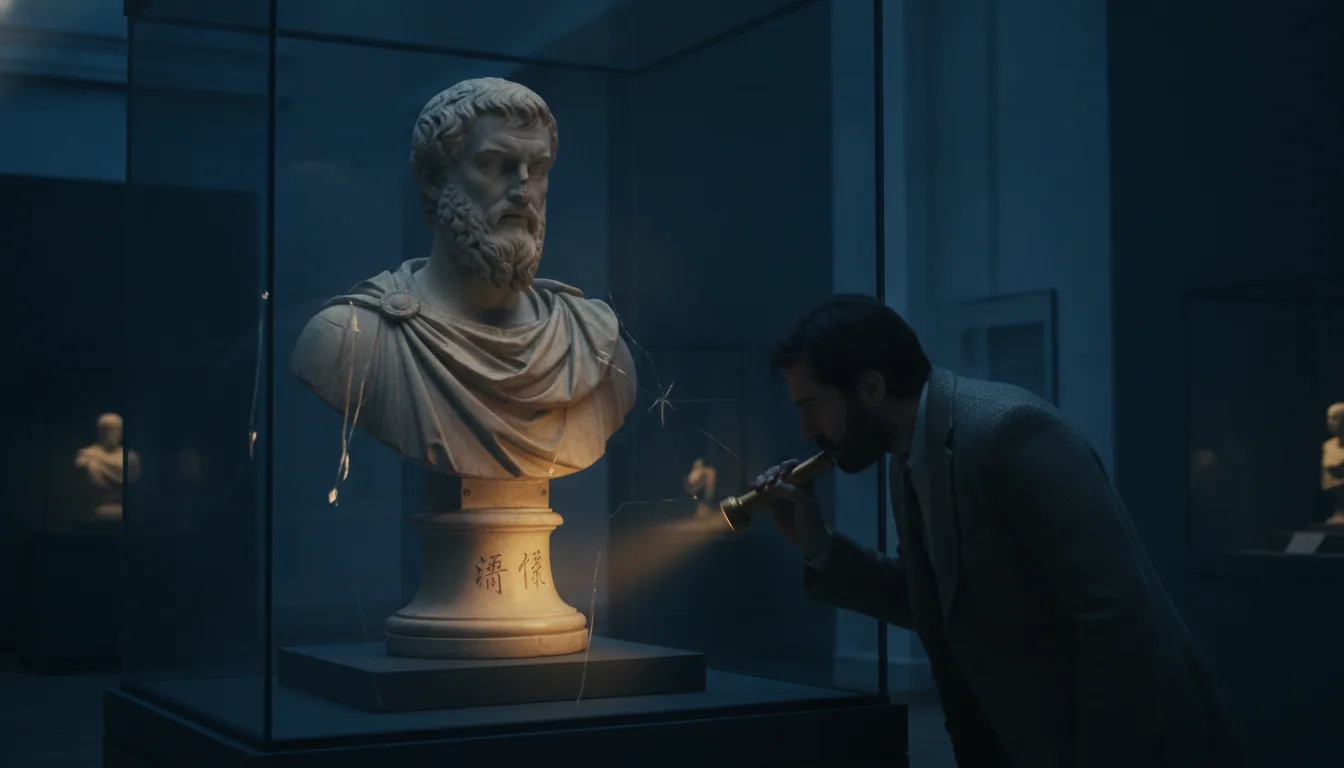
China's pseudo-history movement, anchored in a Beijing organization founded in 2019, claims that Aristotle was a medieval fabrication, the Sphinx was poured from modern concrete, and English is a dialect of Mandarin. The arguments come not from the internet fringe but from tenured professors at major Chinese universities.
"The word heart comes from Chinese"
Someone is trying to tell you that the English word heart derives from the Mandarin hede. That yellow is a corruption of yeluo. That the Sphinx is not four and a half thousand years old — it was poured from modern concrete, at some unspecified point in the relatively recent past, to deceive the world. And that Aristotle never existed at all; the ancient Greeks, in this account, had their philosophy chiseled into stone sometime in the medieval period, working backward to obscure a more fundamental truth: that civilization began in China, and everything else is a copy.
Here is the strange part. These claims do not come from anonymous posts on a message board. Zhai Guiyun, vice-president of the World Association for the Promotion of World Civilization Studies, published the English-from-Mandarin argument as sober academic fact. Professor Huang Heqing at Zhejiang University put his name to the concrete pyramids. Professor Du Gangjian at Hunan University proposed what he calls the "Out-of-Hunan" theory — that all of humanity originated not in Africa, where a century of genetics, fossils, and archaeology has placed our origins with considerable confidence, but in Hunan province, China.
Not the absurdity of the claims, but their institutional packaging — that is the detail that should stop you cold.
A Beijing address for an old idea
The World Association for the Promotion of World Civilization Studies was founded in Beijing in 2019. Its name sounds like an interdisciplinary conference. Its practice has been to systematically challenge the antiquity of Western civilization.
To understand why, you have to understand what Chinese history means to China. The written record begins with the Shang dynasty, around 1700 BC — deep enough to be legitimately ancient, old enough that questions of civilizational primacy carry real weight. When Western civilization is presented as older, or as the root from which modernity grows, it touches something that is not merely scholarly in China: it touches national identity and state power, two forces that have been intertwined there for over two thousand years.
The movement has its own vocabulary for what it opposes: Xīfāng wěishǐ lùn — the theory of Western pseudo-history. In this framing, the ancient Greeks did not build a civilization and record it. Medieval scribes invented them, retroactively, to erase China's primacy. For the people making these arguments, this is not conspiracy theorizing. It is the correction of a historical injustice.
That distinction matters. It tells you something about how these ideas spread — and why they are genuinely difficult to dislodge.
Correcting the record does not stop the spread. Sometimes it accelerates it.
The economics of indignation
On Bilibili, China's dominant video platform, videos explaining that Aristotle never existed collect millions of views. The comment sections are often uniformly certain: the West has simply stolen what China built. The claim lands not as a proposition requiring evidence but as confirmation of something the audience already suspects.
Now hold that thought, and consider the algorithmic landscape. TikTok's Chinese domestic version, Douyin, is known to push educational content to young users. The international TikTok optimizes for emotional engagement. The result is that pseudo-historical narratives can reach Western audiences faster than the careful, conditional academic corrections that follow them — because corrections do not generate the hot satisfaction of a revealed injustice.
Researchers at Tallinn University's CUDAN Open Lab have been studying exactly this asymmetry. The question they are asking is not simply whether people believe these claims. It is something harder: how does platform economics quietly reshape the way large populations understand the past, without anyone noticing the shaping?
History as a loaded weapon
The British journalist Sebastian Milbank has drawn a line between China's current information posture and the Opium Wars of the nineteenth century — what the Chinese Communist Party calls the "Century of Humiliation," roughly 1839 to 1949, when China was weakened, carved up, and treated as a subordinate civilization by Western powers. The wound is real. The history is real.
What the pseudo-history movement does is reach into that genuine wound and extract from it a license to invert everything.
Jaan Kaplinski — the Estonian poet and cultural thinker — once observed that Chinese culture has traditionally required the new to grow organically from the old, that continuity is not just valued but constitutive of identity. The irony of this movement is that it severs exactly the connections it claims to protect. It does not grow from tradition. It replaces tradition with a mirror-world designed to win an argument. That is not cultural confidence. It is a traumatic response dressed up as one.
What Tallinn is watching
Tallinn University researcher Mila Oiva has found that Chinese and Russian disinformation narratives spread through strikingly similar patterns — not as facts, but as feelings. The unit of transmission is not the claim but the emotion: a mixture of shame and pride, wounded dignity and the warm release of vindication. Traditional fact-checking arrives after the feeling has already settled. The algorithms, meanwhile, reward engagement, not accuracy.
Digital humanities researchers are therefore looking less at the claims themselves and more at the networks that carry them — where they originate, how they jump between platforms, which communities amplify them, and where they land next. It is tracking fire rather than arguing about whether fire is hot.
Beijing closes the tap — and the questions that remain
In 2025, China quietly shut down several nationalist social media accounts associated with the pseudo-history movement. The official explanation was that they represented a "negative trend" damaging social cohesion. Draw your own conclusions about what that means.
What this suggests is that the Chinese state's relationship to this movement is not simple sponsorship. Nationalism is tolerated — encouraged, even — until it threatens China's international academic standing. At which point, the tap turns.
Whether this was a grassroots movement that grew beyond its handlers, or a sanctioned experiment that ran its course, is not something that gets decided in public. The people who know are behind closed doors in Beijing.
We still don't know. And that, honestly, is the thing worth sitting with — because what we do know is that the shaping of collective memory is a core strategy of twenty-first century power, and pseudo-history of this kind does not disappear. It adapts. It waits. It finds the next platform, the next wound, the next algorithm that rewards feeling over fact.
The Sphinx stands in the same place it always has. The evidence for its age — geological weathering, stratigraphic context, ancient inscriptions, references in texts written three thousand years ago — is not hidden. It is just less emotionally satisfying, in a world of short videos, than the image of a civilization that had everything taken from it and is finally getting the story straight.