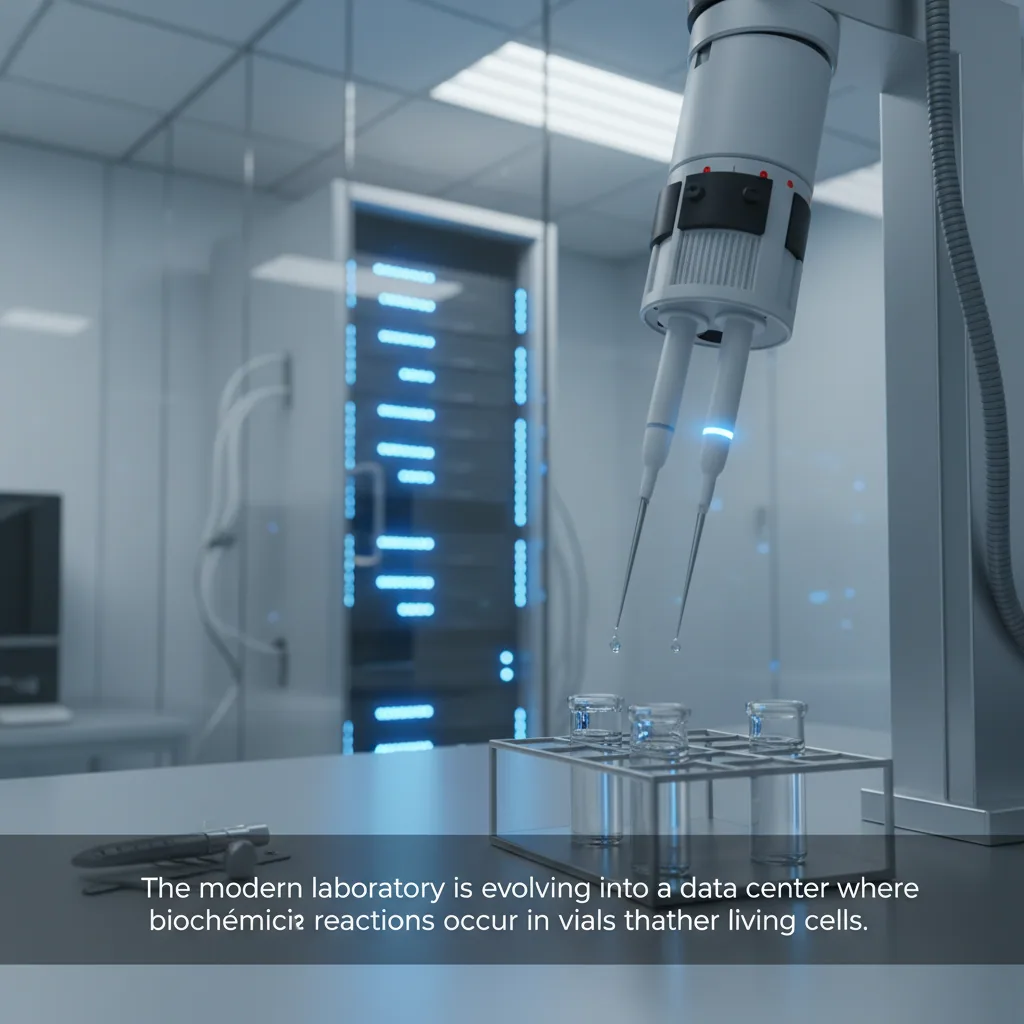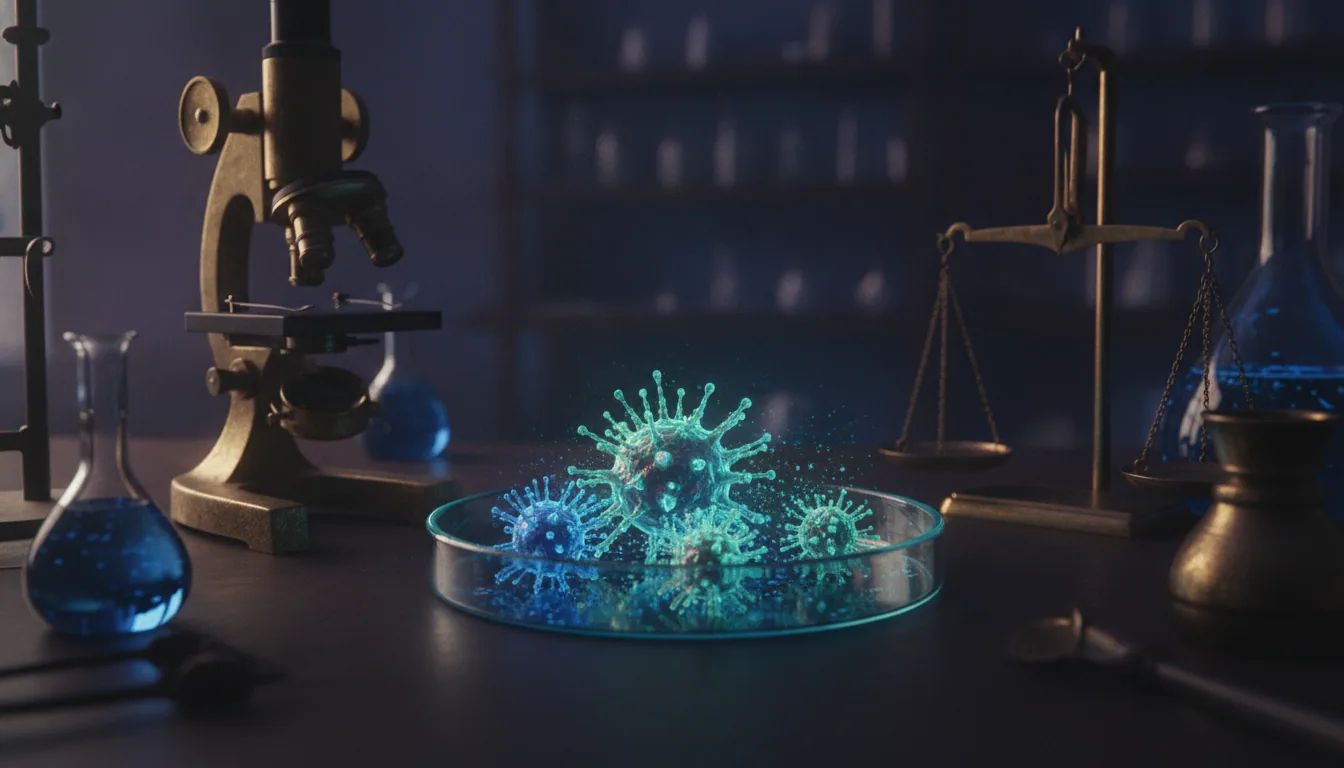
Synthetic viral design uses generative AI models to create entirely new biological sequences, such as bacteriophages, from scratch rather than modifying existing ones. By training on trillions of nucleotides, these systems can engineer functional organisms that hunt superbugs or deliver genetic therapies with precision evolution never achieved.
The Sixteen Ghosts in the Machine
On August 6, 2026, a computer in a lab at Stanford did something that would have been indistinguishable from magic just a few centuries ago. It did not just calculate a trajectory or simulate a weather pattern; it wrote the code for a living hunter later published in the journal Science.
Researchers Brian Hie and Samuel King were looking at 700,000 digital candidates for a new kind of bacteriophage. These are viruses that infect and destroy bacteria, but these specific phages never existed in the natural world.
The team at the Arc Institute used generative AI models trained on 9.3 trillion nucleotides. It is like reading every letter in a massive library of 128,000 genomes to learn the DNA grammar of existence.
Out of those hundreds of thousands of digital designs, they chemically synthesized 285 to test in a physical lab. Only 16 of them were fully functional. We can think of them as sixteen ghosts designed by a digital mind that does not breathe.
When dropped into a dish of antibiotic-resistant E. coli, these AI creations began to hunt. Some actually outperformed the viruses that nature spent millions of years perfecting.
This marks a shift from stitching together existing genetic parts to writing entire organisms from scratch. It is the moment synthetic code became biological reality. We have finally moved from being curious readers of the book of life to its newest, most ambitious authors.
Reading the Grammar of Existence
To understand how a machine designs a virus, you first have to stop thinking of DNA as a simple biological blueprint. Think of it instead as a library of ancient books written in a four-letter alphabet. For decades, we were like curious tourists browsing the shelves, recognizing a few scattered words but failing to grasp the grand plot.
The AI models, Evo 1 and Evo 2, were trained on 9.3 trillion nucleotides from over 128,000 different genomes. If you sat down to type out that data at one letter per second, you would be typing for nearly 300,000 years.
The machine learned by playing a massive game of fill-in-the-blanks. Scientists call this masked language modeling, where the system learns how amino acids relate to one another in the messy, functional context of a living cell.
Previously, systems like AlphaFold changed medicine by predicting protein shapes with near-experimental accuracy. This was a feat of observation, like an architect figuring out how a cathedral stands just by looking at the stones. But predicting a shape is not the same as writing an original story.
ESM-3 took the next step by integrating sequence, structure, and function to create something entirely novel. This resulted in the synthetic "esmGFP" protein, a glowing molecule fundamentally different from anything found in a natural organism.
By learning this "DNA grammar," these models have moved beyond simple mimicry. They understand the rules of the biological game well enough to invent their own moves.
We are no longer just scavengers of evolution; we are becoming its authors.
Harnessing Synthetic Viral Design to Fight Superbugs
Every year, nearly 5 million people die from infections that our best drugs can no longer touch. By 2025, antimicrobial resistance has become a global predator that wipes out the equivalent of a medium-sized city every few weeks.
We are now turning to viruses, the very things we usually fear, to act as our new, microscopic snipers. This is called phage therapy. A bacteriophage is a virus that ignores human cells and hunts only specific bacteria.
Because AI can now write these viruses, we can design them to hit targets that natural evolution missed. We are moving from blunt tools to precision instruments.
Companies like Ginkgo Bioworks and Virica Biotech are already collaborating to optimize these delivery systems. In October 2024, they partnered to refine Adeno-Associated Virus (AAV) vectors using synthetic design. They are essentially tuning the engine of the virus to ensure it reaches the correct part of the body.
While we build these snipers to save us from superbugs, we are opening a door we might not know how to close.
The End of the Blacklist
Imagine a security guard at a genetic synthesis company whose career has been spent checking a "blacklist" of known biological killers. For decades, if a customer ordered a DNA sequence matching a lethal influenza, the alarm sounded because the system recognized a known monster.
But in a world of generative AI, that history is no longer a reliable map. Experts point out that traditional screening based on known dangerous viruses is becoming obsolete. It is like checking passports at a border when people have suddenly learned to teleport.
In October 2025, Twist Bioscience and Microsoft released a Viral Research Panel using 1 million unique probes to identify 3,000 viral species. This acts as a massive digital dragnet designed to ensure no known killer ever slips into a commercial order.
If an AI designs a virus with a completely novel genetic grammar, it has no name to match in any existing database. This is forcing a shift toward functional-threat screening, a method where we analyze what a sequence does rather than what it is called.
A Brief History of Human Guardrails
To someone from 1610, the idea of a law governing "unseen life" would have been indistinguishable from magic. Now, we are trying to legislate the building blocks of existence before the ink on the research paper even dries.
The problem is that science moves at the speed of light while policy moves at the speed of a pen. In April 2025, the South Korea Synthetic Biology Promotion Act went into effect to manage the risks of synthetic life.
Just a month later, US Executive Order 14292 mandated new screening standards for synthetic DNA providers. It was a global scramble to build a fence around a field that was already expanding.
In October 2025, Nature and NIST called for built-in biosecurity safeguards to be integrated into the architecture of generative AI models. They realized that waiting until a sequence is printed is too late.
The European Biotech Act, proposed in 2025, tries to harmonize these rules across an entire continent by 2026. It is a delicate tightrope walk between medical breakthroughs and high-stakes safety.
The Unanswered Question of Control
When we talk about "jailbreaking" an AI, we usually mean tricking a chatbot into writing a rude poem. In synthetic biology, a digital jailbreak doesn't just produce text; it generates a blueprint for a physical toxin.
The output is no longer just information, but instructions for physical matter. Researchers recently interviewed 130 biosecurity experts and found that 74 percent now call for entirely new governance frameworks to manage misuse.
Existing safety guardrails remain fragile and can be circumvented through deceptive prompts. Experts warn that rogue actors could re-purpose this technology to design more lethal versions of existing pathogens.
We have officially crossed the threshold into the era of post-evolutionary design. For billions of years, the grammar of DNA was edited by the slow hand of natural selection. Today, we are writing that code ourselves and bypassing the historical filters of biological survival.
The great human adventure has always been about understanding the world to master it. As we navigate the frontier of synthetic viral design, we face the question of how to govern a discovery that moves faster than our laws.