
Rewriting the Steppe: Kazakhstan’s Bold Experiment to Bring Back the Tiger
In 2026, the first tigers were released into Kazakhstan’s Ile-Balkhash Nature Reserve, marking the return of a predator absent for seventy years. The project uses genetically similar Amur tigers to replace the extinct Caspian subspecies, aiming to establish a self-sustaining population of fifty tigers by 2035 and restore the regional ecosystem.
One step out of the gate, seven decades of waiting
On July 31, 2026, a tiger named Umit took a single, cautious step out of her enclosure. She didn’t hear the applause of the gathered delegation; she only heard the wind of the Ile-Balkhash Nature Reserve and the dry rustle of grass beneath her paws. Here is the strange part: that one step ended a silence that had lasted nearly three-quarters of a century.
The last time a striped predator roamed this landscape was 1948. Since then, the tiger has been a ghost in Kazakhstan, a memory found only in old textbooks and local folklore. That silence was finally broken by a single paw print in the dust.
Umit, whose name means "hope" in Kazakh, now carries a GPS collar that tracks her every movement through the brush. But we aren’t just tracking a cat; we are watching the first heartbeat of a resurrected ecosystem.
The genetic bridge: Can we rewind history?
The Caspian tiger didn’t just fade away; it was systematically erased, finally declared extinct in the 1970s. For a long time, we believed that chapter of natural history was permanently closed. Then came the genetics.
When researchers compared the DNA of Caspian tiger remains kept in museums with their living relatives, they found something startling. The Amur tiger (often called the Siberian tiger) is a near-identical match. In the long, complex manuscript of their genetic code, the difference is essentially a single "letter"—one nucleotide.
Now hold that thought. There are fewer than 600 Amur tigers left in the wild, making each one more valuable than gold. Why risk them here? Because an ecosystem without its apex predator is like a mechanical clock with the mainspring removed. You need that tension to keep the other parts moving in balance.
Building the stage: 37,000 trees and a river delta
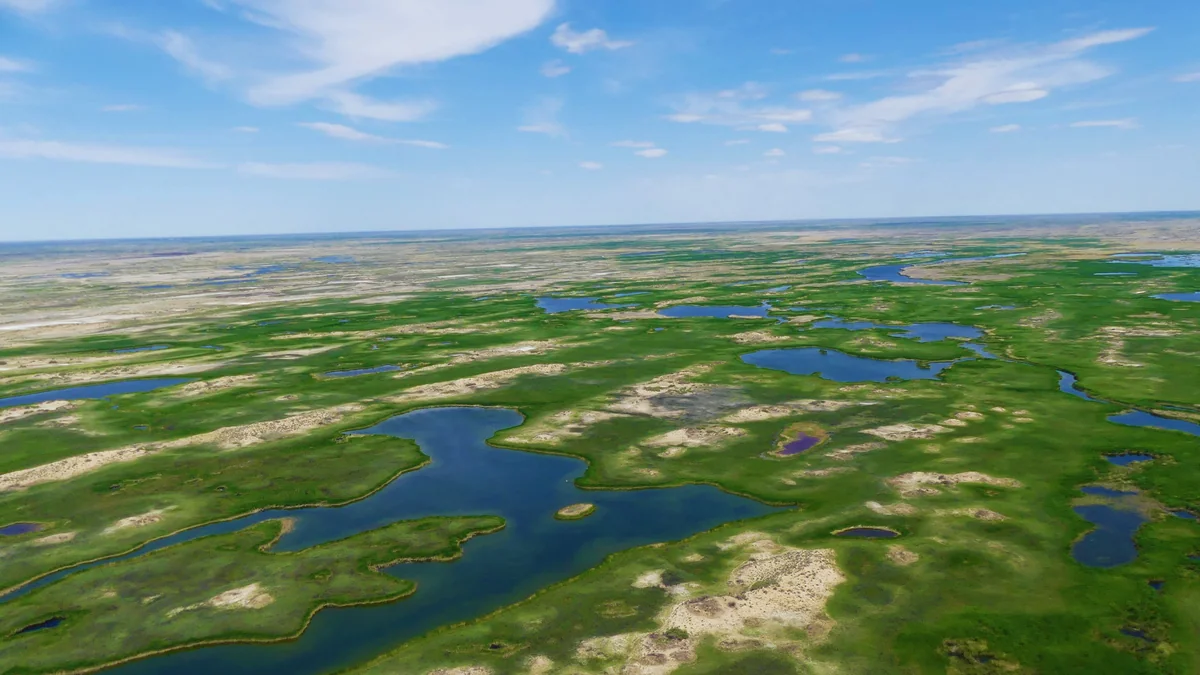
Releasing a tiger is a grand finale, but the rehearsal took ten years. The Ile-Balkhash Nature Reserve is a vast territory, a place where the Ili River delta fights back against the encroaching semi-desert.
For a tiger, the only thing that matters is the tugai—the thick, tangled riverside thickets where they can vanish. Decades of livestock grazing and water diversion had nearly destroyed these hideouts. To fix it, scientists and locals have spent years planting 37,000 tugai trees.
These aren’t just for scenery. They are the infrastructure of a hunt. Without those new groves, Umit would have been like a tenant moving into a house with no roof and no walls.
How to build a wilderness restaurant
Imagine opening a world-class restaurant in the middle of a wasteland. You have the star chef, but no suppliers, no kitchen, and no ingredients. A tiger cannot survive on scenery alone; it needs a dynamic food chain.
To stock this natural pantry, conservationists have already introduced 205 Bukhara deer and over a hundred kulans—the wild donkeys of Asia. They are the foundation. If there are too many deer, they overgraze the riverbanks until the soil crumbles into the water. The tiger’s job is to keep the deer moving, allowing the vegetation to thicken and the river to stay its course.
The "heavy artillery" from the East
Not all tigers are created equal when it comes to survival. In 2024, two tigers named Bodhana and Kuma arrived from a sanctuary in the Netherlands. They are healthy, but they grew up accustomed to the mild European climate and the presence of humans.
That is why, in May 2026, the "heavy artillery" arrived from Russia’s Khabarovsk region. These are four wild-born tigers, including two cubs named Turan and Ussuri. These animals are graduates of the hardest school on Earth; they know how to survive a brutal winter and how to hunt in the wild.
This is the first time in history we have tried to replace an extinct subspecies with another in a wild environment. How the captive-born and the wild-born will mix—or if they will—is something we still don’t know. That, honestly, is the best part of the adventure.
The digital shepherd
Umit’s satellite collar is her invisible shepherd. It beams data to researchers 24 hours a day, creating a real-time map of her life. The safety of the project relies on a strict "five-kilometer rule": a digital fence.
If the algorithm detects a tiger moving too close to a local village, a warning system triggers immediately. It is a high-tech solution to the ancient problem of co-existence. The data travels from space to the ground faster than a tiger can stalk through the brush.
Algorithms offer a sense of security, but a predator’s unpredictability can never be fully written into code. We are testing the limits of how technology and the wild can intertwine.
Looking toward 2035
What we see today at Ile-Balkhash is merely the prologue. The World Wildlife Fund (WWF) and the Kazakh government hope that by 2035, fifty tigers will be prowling these reeds.
The true test won’t be the release; it will be the winters. It will be the hunger. We are using genetics to try and correct a mistake made decades ago, setting a precedent for how we think about lost species.
For now, the project remains an open question. But as the sun sets over Lake Balkhash, the reeds are no longer empty. The striped rulers are back, and for the first time in seventy years, the landscape feels complete. Whether they stay is up to the tigers—and our ability to keep the stage ready for them.