
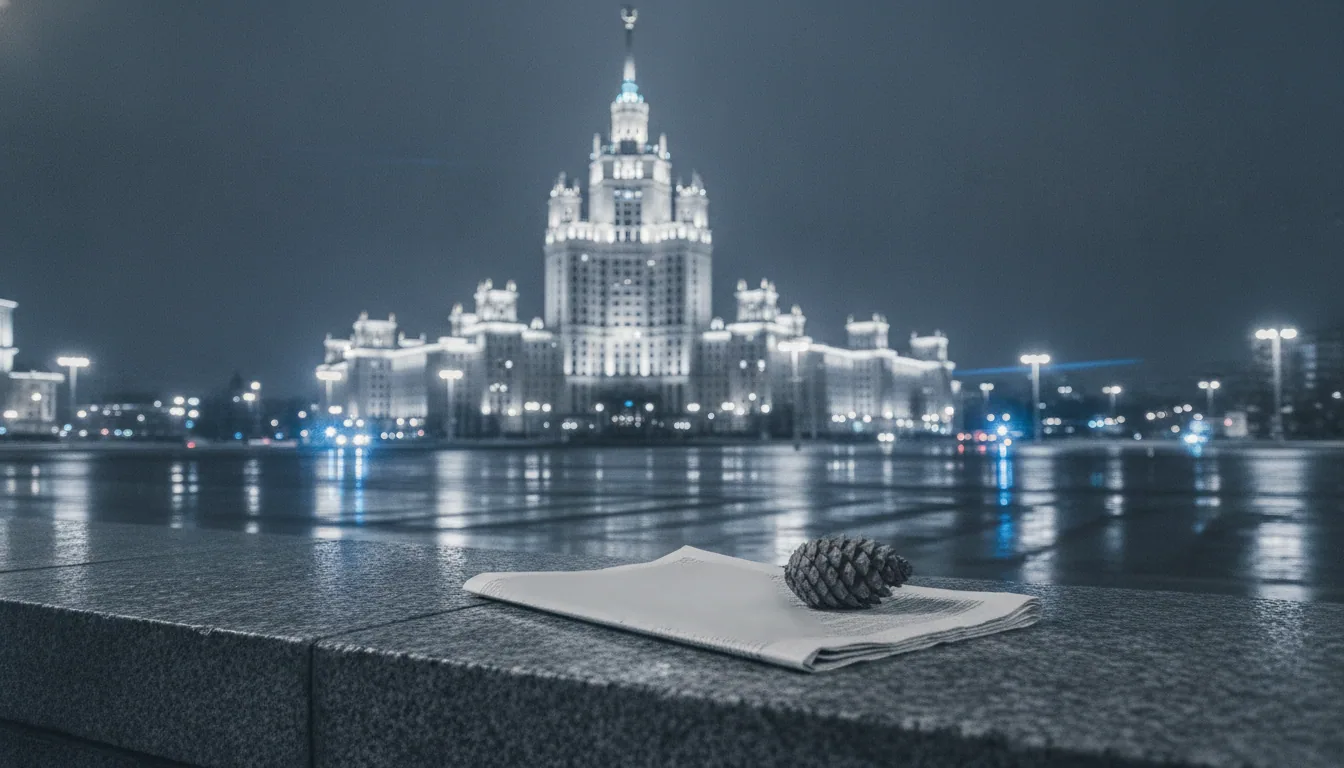
On August 1, 2026, an improvised explosive containing one kilogram of TNT detonated at the Balzi Rossi restaurant in Moscow’s Kudrinskaya Square skyscraper. The blast targeted a birthday celebration for Colonel-General Alexander Chaiko, killing three people and wounding twenty-one, highlighting systemic failures in Russian elite security.
In April 2023, a gold-painted burst was handed to a military blogger in a St. Petersburg café; the statue was not art, but a shell for an improvised explosive. It was a prototype for the "gift-assassination," a model designed to prove that the most secure points of the system were porous. The 2023 St. Petersburg precedent is a lazy comparison, however—Kudrinskaya represents a shift from the fringe to the very foundation of the nomenklatura.
The Kudrinskaya Square skyscraper is one of Moscow’s "Seven Sisters," built to proclaim the eternity of an empire at a time when stone was meant to replace terrified men, yet on the evening of August 1, 2026, it proved that no facade can hide a structural rot. At 19:55, the restaurant at the foot of the tower became the latest evidence that the elite’s sense of immunity is a fiction. A security guard stopped a woman carrying a gift box at the threshold; the detonation occurred exactly there.
The Western wires reported an "explosion" or an "incident." The original scene reports are colder: one kilogram of TNT, packed with steel ball bearings. This is the physics of a kinetic cloud, designed not to move the masonry of a Stalinist fortress, but to clear the entrance of flesh and bone.
I have heard the promise of a sealed perimeter before—Beslan in 2004, and Moscow in 2024. I called the 2024 security tightening wrong at the time, believing the internal filters had finally closed; I say so before I tell you that this failure is systemic. The state reflexively blamed a gas leak for the first hour—a standard bureaucratic delay used to buy time while a narrative is manufactured.
Ask the small question first: who is the borderland here, and who is the empire? When the front line moves from the map to the marble foyers of luxury restaurants, the empire has become its own borderland. The elite are the load-bearing walls of this regime—everything else is decorative molding—and if they cannot protect a birthday table, the structure is in trouble.
The target was Colonel-General Alexander Chaiko, head of the Russian Aerospace Forces, celebrating his 55th birthday among fifty members of the military’s spinal cord. Outside, armored cars and Rosgvardiya units waited. The threat, however, did not come from the street in an exchange of fire; it arrived as a package that no amount of armored glass could stop.
The chef, Carmine Alfieri, later noted that the staff was safe and the kitchen remained intact. This is a surreal, quintessentially Moscow detail—the insistence on the facade of normalcy while forensic teams are still collecting fragments of the courier fifteen meters from the epicenter. In a blast, biology ends and mechanics take over.
The use of a female courier to lull the checkpoints is a recorded tactic. It failed on Saturday for the same reason it succeeded in reaching the door: the system is oriented toward the grand geopolitical map, leaving the threshold unguarded. Security in such a state is often just decorative trim masking a crumbling foundation.
The noise of the armored vehicles that descended on Kudrinskaya Square is the regime’s instinctive response to a loss of control. When the state cannot prevent an attack, it replaces prevention with visible force, turning a luxury storefront into a temporary war zone. The official communiqué used the phrase likvidatsija posledstvii—the liquidation of consequences—a term that always sounds better than the inability to protect one’s own generals.
This follows a ledger of failures: Kirillov in 2024, Moskalik in 2025, and Davydov in June 2026. Each assassination is a bloody re-examination that the security structures continue to fail. In the fourth year of war, when state control should be at its zenith, a kilogram of TNT moves through Moscow as easily as a standard post-parcel.
Ignore the official statements about "heightened measures." Watch one concrete marker instead: the next leadership shuffle within the Russian Aerospace Forces. If Chaiko is replaced or "reassigned" in the coming weeks, the moral verdict has been rendered. It will mean the attack achieved its political aim, proving that the generals are now moving targets in the heart of their own capital.