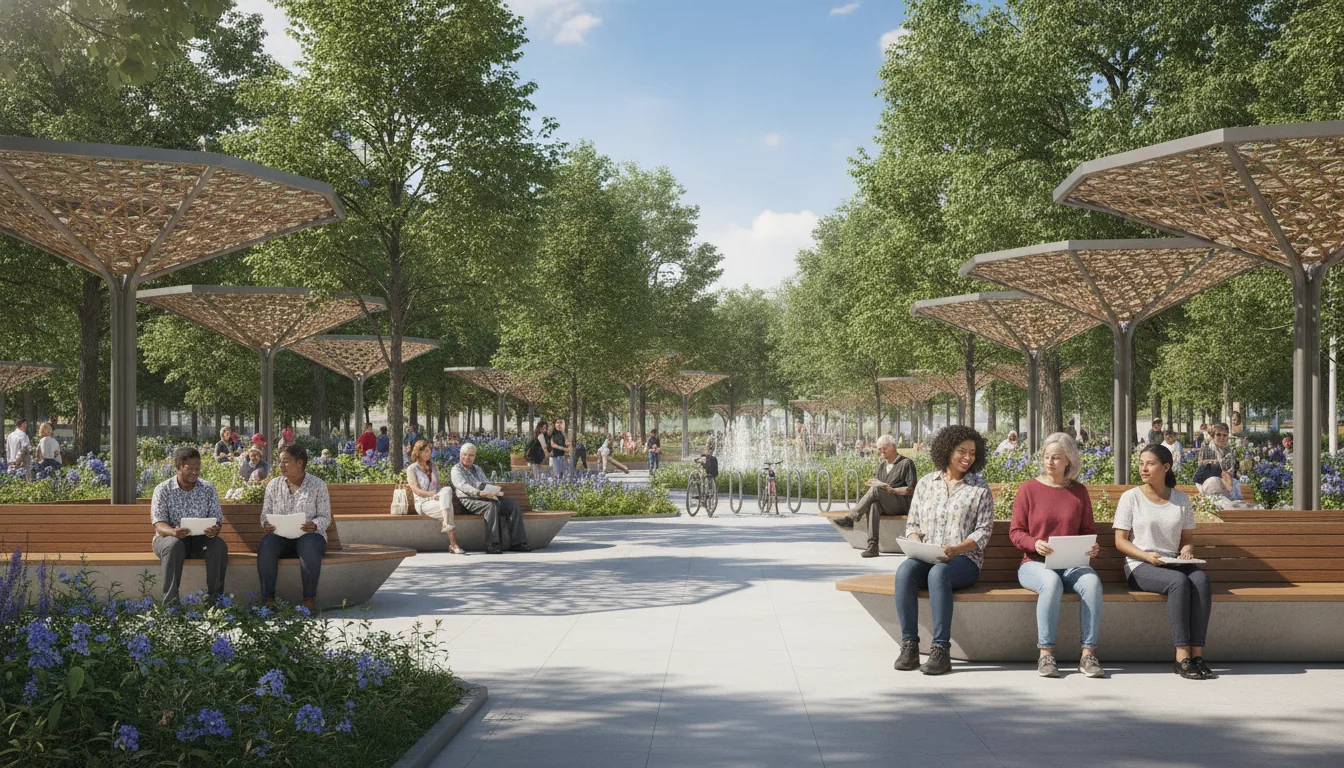
Public cooling networks and nature-based infrastructure are essential tools for reducing mortality during extreme heatwaves. Cities like Barcelona provide climate shelters within a ten-minute walk, ensuring that vulnerable residents without private air conditioning can access safe temperatures regardless of their income level or housing situation.
The urban heat social divide is a structural reality where income levels dictate internal body temperatures, leaving low-income residents trapped in neighborhoods that retain heat long after sunset. While wealthier citizens can afford private climate control, those in dense urban blocks often face life-threatening conditions.
Right now, a resident in Barcelona is never more than a ten-minute walk from a climate shelter. This is not a marketing slogan, but a functioning network of schools, libraries, and parks designed to keep the human body at a safe temperature. Providing a cool space within a ten-minute walk is a lever because it measurably reduces mortality among residents who cannot afford private climate control.
The city’s focus is on neighborhoods like El Raval, where dense masonry and narrow streets create localized heat traps. In these blocks, residents often face extreme heat risk without the financial means to install or run private air conditioning. Barcelona is responding by installing specialized urban awnings and opening public buildings as cooled retreats for those who need them most.
Designing for the most vulnerable residents creates a floor for everyone else. The catch is that this requires reclassifying public space as a vital health asset rather than a municipal luxury. Despair is just procrastination with better PR, and Barcelona is proving that the heat divide can be bridged with clear-eyed engineering.
The Math of Mortality: Why 0.3 Degrees Matters
Estonia’s average temperature has risen by 0.2 to 0.3 degrees Celsius per decade, consistently exceeding the global average. While a fraction of a degree feels negligible on a home thermostat, it represents a massive, sustained shift in our local climate’s energy balance.
The number of days exceeding 30 degrees Celsius in Estonia has increased by approximately nine days per year over the last six decades. We are witnessing the arrival of "tropical" conditions that our northern infrastructure was never designed to manage. This is not a matter of personal comfort; it is a measurable change in environmental risk.
On average, 36 people die prematurely every year in Estonia’s five largest cities specifically due to heatwaves. During the extreme 2010 heatwave, mortality in Estonia spiked by 31 percent, resulting in 191 excess deaths according to the University of Tartu Health Institute. Measuring excess mortality provides an honest scorecard for our city planning, moving us from vague fear to precision engineering.
Mustamäe and the Physics of the Heat Trap
The data shows a dangerous trend for residents of Lasnamäe, Mustamäe, and Väike-Õismäe. In these districts, the urban heat island effect transforms Soviet-era planning into a thermal trap that holds onto solar radiation long after the sun sets. Dark asphalt surfaces and a lack of tall vegetation prevent these neighborhoods from cooling down at night, creating significant thermal inequality.
The anatomy of a heat island is simple physics. Heat is felt most acutely because dark surfaces and vehicle exhaust turn neighborhoods into heat traps. Vladimir Svet has identified these districts as critical hotspots where high asphalt density prevents air circulation and cooling.
Providing a cool space within a ten-minute walk is a lever because it measurably reduces mortality among residents who cannot afford private climate control.
This shift in temperature does more than just make humans uncomfortable. Landscape architects note that Tallinn’s urban environment is becoming more suitable for synanthropic animals like rats and foxes. These species thrive in the stable, artificial warmth provided by our concrete infrastructure, a change driven by how we build our walls and pave our streets.
Tallinn’s 2035 strategy aims to increase the green factor in sensitive districts to combat this. While planting flowers feels green, only tall trees and permeable surfaces that replace dark asphalt actually move the needle on cooling a neighborhood. Investing in shade and permeable surfaces is not a cosmetic upgrade, but an essential piece of climate infrastructure.
Mapping the Urban Heat Social Divide: The Segregation of Shade
In a high-tech office in Noblessner, the air is a constant 22 degrees. A few kilometers away in Lasnamäe, a pensioner sits in a fifth-floor apartment where the thermometer has hit 29 degrees. The urban heat social divide means your income level effectively dictates your internal body temperature during a crisis.
Professor Tiit Tammaru has mapped how this climatic pressure is hardening our social geography. His research shows that while the technology sector reduces ethnic separation, it grows the gap between rich and poor residents. High-income workers cluster in the city’s greenest zones, while low-wage workers remain trapped in dense, asphalt-heavy districts.
These areas are defined by high asphalt density and a lack of tall vegetation, turning the "mäed" into traps. For an elderly resident living alone, the lack of shade is a health risk that the wealthy can bypass with better insulation or location. Addressing this cooling gap is a policy choice that determines who survives the summer.
Vulnerability Beyond the Thermometer: Schools and Seniors
Historically, Estonian schools were designed to capture every available watt of solar warmth, but today that architectural legacy is a liability. SEI Tallinn is monitoring classroom data to quantify how heat degrades student concentration and long-term learning outcomes. Thermal stress creates a systemic disadvantage that compounds over every hot school day for students in uncooled buildings.
Pärnu’s map reveals a structural mismatch where intense heat islands overlap with neighborhoods housing high densities of elderly residents. In the 1970s, these districts represented the peak of modern efficiency, but today they function as thermal traps. During extreme heatwaves, ambient air outside provides no relief for residents in poorly insulated Soviet-era blocks.
Energy poverty is a mechanical reality for residents who cannot afford air conditioning or the expensive renovations required to fix the building envelope. Retrofitting these massive blocks to prevent summer overheating requires significant capital that many apartment associations do not have. Jevgeni Ossinovski has questioned how the city can protect the public interest by ensuring that cooling assets remain accessible to all residents.
The Solution Roadmap: From Project KNOWING to Tallinn 2035
The roadmap to cooling Tallinn is currently being mapped by Project KNOWING (2022-2026). This Horizon Europe initiative models the next decade of heat impacts on our health and infrastructure with mathematical precision. This data is necessary to address the 36 premature heat deaths occurring annually in Estonia’s largest cities.
The primary lever in the Tallinn 2035 strategy and the 2030 Climate Plan is the "rohefaktor" or green factor. This metric moves beyond aesthetic greenery to mandate functional, nature-based solutions in heat-sensitive districts. The green factor must mandate functional, nature-based solutions in heat-sensitive districts to offset dark asphalt.
We are racing against a temperature rise of 0.2-0.3 °C per decade since 1951. While the modeling is sound, the physical renovation of Soviet-era blocks remains slow. The 191 excess deaths during the 2010 heatwave prove that our current housing stock acts as a heat trap rather than a shelter.
The municipality must bridge the urban heat social divide by fast-tracking cooling infrastructure in high-density districts to protect public health. Proactive adaptation is no longer a luxury; it is a necessity for a climate-resilient city.