The Day Something Fell on Queensland
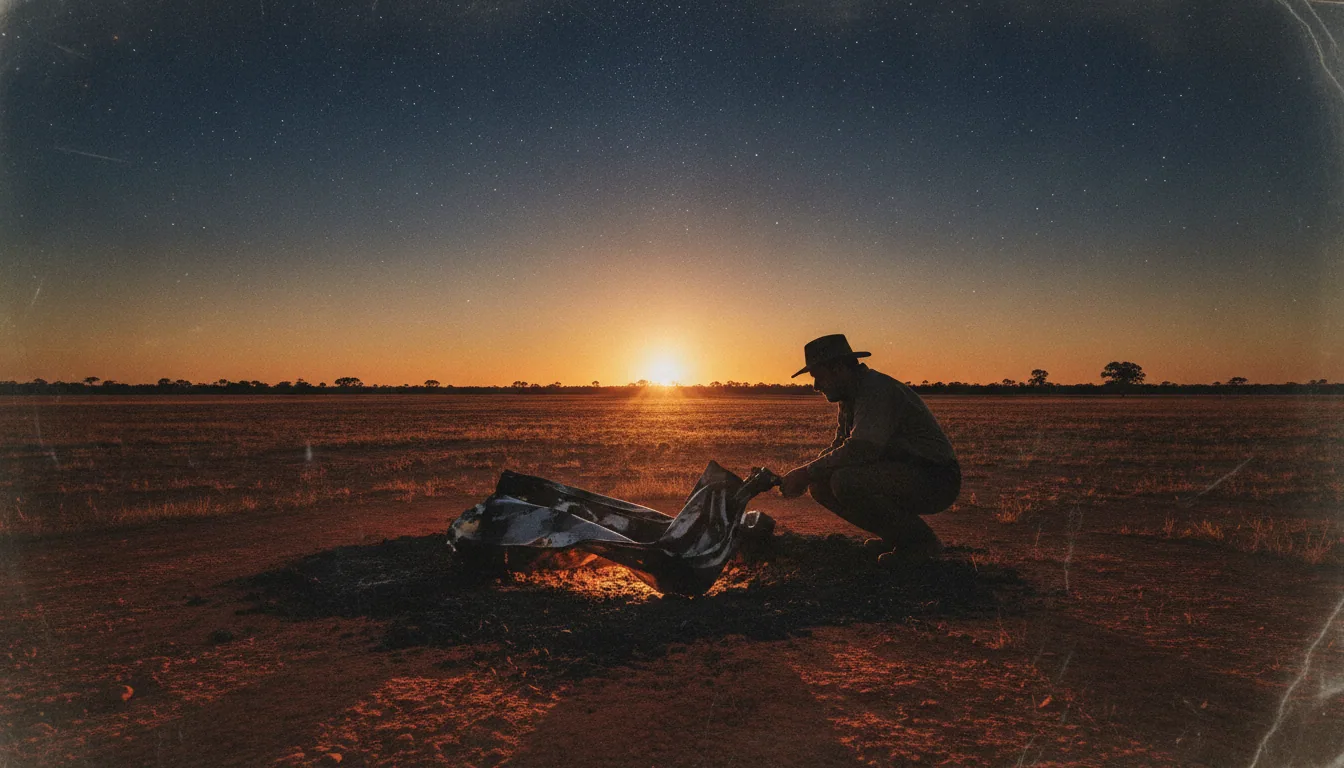
Sometime in the past few years, a farmer in Queensland looked out across a paddock and found a piece of metal that did not belong there. It was charred, twisted, and roughly the size of a car door. It had, in all likelihood, fallen from the sky at several kilometres per second, survived the furnace of re-entry, and come to rest in Australian soil without anyone filing a single form to warn that it was coming. The question of who owned it, who was responsible for it, and who would pay if it had hit something — or someone — turned out to have a surprisingly complicated answer.
Here is the strange part. That answer involves a treaty signed in 1972, a chain of diplomatic negotiations, and a growing chorus of legal scholars who now describe the whole framework as, in the words of the international law firm Taylor Wessing, a "legal black hole." Space junk liability is not hypothetical. Universe Today ran a piece in November 2025 titled "When Space Junk Comes Home" precisely because the question had stopped being abstract. Objects built by humans, launched by identifiable entities, are landing on identifiable ground.
Now hold that thought, and look up. If you open the real-time Space Debris Tracker at pocketworld.org right now, you will see hundreds of objects sketching arcs across a rotating Earth — each one a potential Queensland moment waiting for the right re-entry angle. The Australian Space Agency has had to grapple with exactly this jurisdictional vertigo: debris lands, a sovereign state has questions, and the legal machinery designed to answer them was built for a very different world.
The 1972 Rule Book: Absolute Liability, Relative Enforcement
Two treaties form the legal backbone of everything that happens when something falls from orbit. The Outer Space Treaty of 1967 laid the first rung: states are responsible for national activities in space, including those of their private operators. The Liability Convention of 1972 added the teeth, or tried to. Under it, the launching state bears absolute liability for damage its space objects cause on Earth's surface — no proof of fault required, just proof of damage and a finger pointed at the right rocket.
The principle is clean. The launching state's bill, full stop. But "absolute" turns out to describe the liability more confidently than it describes the enforcement. The Convention routes disputes through diplomatic negotiation, not binding courts. A government that refuses to pay can be pressured, but not compelled.
Here is the strange part. The framework was built for an era when only states launched rockets, so every link in the responsibility chain ran through a government. That assumption is now structurally wrong. A private company today can put hundreds of satellites in orbit, and when something comes down, the liability still lands on the launching state, not the operator. The state must then pursue the commercial actor under its own domestic law. That chain has a lot of links, and each one is a place where accountability can quietly dissolve.
Taylor Wessing, an international law firm that studied the regime in October 2025, called orbital debris liability a "legal black hole" — the phrase is provocative, but the logic is precise. The obligation exists on paper; the mechanism to actually transfer money to a damaged party does not. The rules were written for 1972. The problem they are trying to govern is 2026.
Who Owns the Chunk in Your Paddock? What Space Junk Law Actually Says
Here is the strange part. Depending on where you live, you might legally keep that scorched lump of titanium you found in your field. Some jurisdictions apply finders keepers rules to fallen space debris. You could, in theory, put it on a shelf.
But ownership of the object and liability for its damage are entirely separate questions, and this is where things get practically useful to understand. The launching entity remains legally responsible for damages their debris causes, regardless of who picks the piece up afterward. Your legal right to keep the souvenir has no bearing on who owes you for the broken fence it landed on.
That chunk also becomes something unexpected: a legal document. Fallen debris is admissible evidence in liability proceedings, which means the object itself carries forensic weight. Markings, material composition, orbital trajectory data — all of it helps establish which launch produced which fragment. The piece in your paddock is not just scrap. It is a witness.
Now hold that thought, because the object also has market value that surprises most people. Researchers want it as scientific material. Collectors pay real money for authenticated space hardware. At minimum, the raw metal has recycling value. A single re-entry fragment sits at the intersection of legal proceedings, scientific inquiry, and a surprisingly active secondary market.
The practical upshot is this: if debris lands on your property, document everything before you touch it. Photograph the impact site, note the date, contact your national space agency. The object you are holding may be the most valuable piece of evidence in a diplomatic liability claim between two governments — and also, possibly, worth something on eBay.
The piece in your paddock is not just scrap. It is a witness.
The Attribution Gap: Proving Which Chunk Is Whose
Picture a radar screen at a space surveillance facility. Thousands of dots crawl across it, each one a tracked object in orbit. The screen looks authoritative. Here is the strange part: even with all that data, connecting a recovered piece of metal on the ground to a specific launch is genuinely hard forensic work, more like archaeology than accounting.
A fragment survives re-entry, hits a roof or a paddock, and the question the law needs answered is deceptively simple: whose is it? The fragment may have been in orbit for a decade, tumbling through collisions and solar weathering until its serial numbers are gone or never existed. Attribution — tracing a physical piece back to a specific rocket body or satellite — requires matching alloys, geometry, and orbital mechanics, all under conditions where the evidence has been cooked at 1,600 degrees Celsius on the way down.
Now hold that thought, and add the scale problem. Commercial megaconstellations are putting hundreds of satellites into orbit every year. The volume of trackable debris keeps growing as launch rates accelerate, and each new object in a crowded shell raises the odds of a collision that splinters one identifiable thing into a cloud of unidentifiable things. Room: The Space Journal framed the broader legal structure, with deliberate grimness, as "a last line of defence" when debris strikes. That framing only makes sense if you understand how many lines came before it — tracking, warning, avoidance — and how often, quietly, those lines fail to hold.
When the Launching State Is a Company: Commercial Space and the Liability Chain
The 1972 Liability Convention was written for a world where only governments went to space. That world no longer exists. When a private rocket company launches a satellite today, the treaty does not reach the company directly. It reaches the state that authorized the launch, which then becomes the legal backstop for whatever that company's hardware does on the way down.
Think of it like this: a contractor builds a wall that later collapses on a neighbor's car. Under current space law, the government that handed the contractor a building permit pays the neighbor. The contractor answers to the government separately, if at all. Whether that answer comes in the form of indemnity clauses, licensing conditions, or national legislation varies by country and often remains untested.
Here is the strange part. The enforcement mechanism for the one treaty that does exist is not a court — it is diplomatic negotiation between states, slow by design and uncertain in outcome. The closest the system has come to an actual settlement was Cosmos 954: a Soviet nuclear-powered satellite that disintegrated over Canada in 1978, scattering radioactive debris across the Northwest Territories. Canada claimed compensation; the Soviet Union eventually paid a partial amount. One case in fifty years of the space age. That is the precedent.
Commercial launch rates are now outpacing the legal architecture by every measurable interval. Dozens of companies across several countries are placing hardware in orbit, each one adding links to a falling space debris liability chain the drafters of the convention never imagined.
Beyond the Falling Bolt: Interference, Cyberattacks, and the Harm That Leaves No Crater
No crater. No scorched field. No fragment to photograph as evidence. And yet the satellite is gone, or worse, it is still there, transmitting data to the wrong hands. The next frontier of space liability is harm you cannot see land.
Researchers publishing through ScienceDirect have identified a hard structural problem: the current international responsibility regime is considered inadequate for addressing cyberattacks against space assets. The 1972 framework was built around physical consequences. A signal spoofed, a command system hijacked, a megaconstellation blinded during a critical weather event — none of these leave debris that falls on Queensland. They leave no evidence trail that the Liability Convention was designed to catch.
Here is the strange part. The principles may already exist. International law concepts, including the due diligence obligation and the prohibition of harmful interference, are potentially extendable to cover non-physical harm against space assets. The architecture is there, latent in the treaties, waiting for someone to test it in practice.
No one has. The question of what a state owes another when its satellite is corrupted rather than crushed remains genuinely open — and so does the broader question of who ultimately pays when space junk, in any form, comes down. That gap is where the next chapter of the longest legal adventure humanity has ever launched into orbit is quietly being written.