{
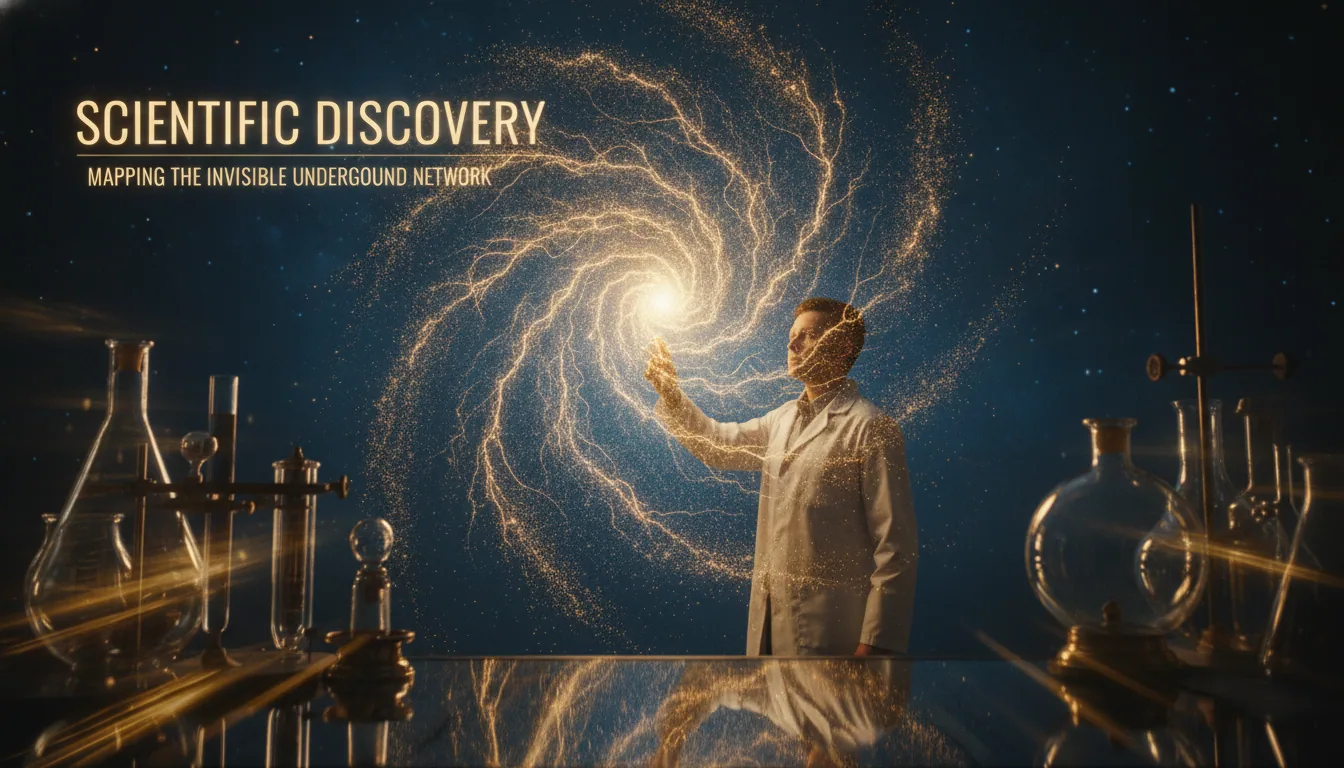
"content": "# The Hidden Galaxy Beneath Your Feet: Mapping the World’s 110-Quadrillion-Kilometer Fungal Network\n\nIf you look up on a clear night in Estonia, you are looking at the Milky Way—a staggering swirl of 100 billion stars spanning 100,000 light-years. But here is the strange part: if you look down at the soil beneath your boots, you are standing on a network of comparable vastness. Recent studies in the journals Science and Current Biology reveal that the Earth’s underground fungal threads, or mycelium, stretch for a combined 110 quadrillion kilometers. That is a number so large it stops meaning anything, so let’s try it another way: the living web beneath our feet is long enough to span one-tenth of the diameter of our entire galaxy.\n\n### The Invisible Orchard\n\nWhen we walk through a forest and see a mushroom, we usually think we’re looking at the whole organism. We aren’t. To a mycologist, that mushroom is merely a brief, reproductive afterthought. If the visible mushroom is like an apple hanging from a branch, the mycelium—the vast web of microscopic threads called hyphae—is the entire invisible orchard hidden underground. \n\nWe now know there is roughly ten times more fungal life beneath the surface than there is appearing above it. One specific group, known as arbuscular mycorrhizal fungi, represents a staggering 300 megatons of living mass. To put that on a human scale, that is four to six times the weight of every single human being currently living on Earth. We are quite literally walking on the roof of a biological empire.\n\n### A 450-Million-Year-Old Trade Deal\n\nThis network isn't just sitting there; it is the planet’s oldest and most successful logistics center. About 450 million years ago, when the first primitive plants tried to crawl out of the sea and onto the barren rock of the continents, they hit a problem: they had no real roots to find nutrients. The fungi offered a handshake. \n\nThis was the birth of the mycorrhizal relationship—an ancient trade deal that made life on land possible. Plants produce sugar through photosynthesis, which the fungi crave but cannot make themselves. In exchange, the fungi act as a precision mining operation, using their hair-thin threads to reach pockets of phosphorus and nitrogen that plant roots could never touch. Today, between 70 and 90 percent of all land plants are still plugged into this grid. Without this underground support, our green world would revert to a lifeless, rocky desert in a heartbeat.\n\n### The Planet’s Silent Carbon Filter\n\nNow, hold that thought, because this logistics network has a massive side effect that we are only just beginning to measure. Every year, roughly 13.12 gigatons of carbon dioxide equivalent flows through these fungal threads into the deep soil. \n\nTo understand the scale of that: it’s about 36 percent of the world’s annual fossil fuel emissions. It is the largest, quietest waste-management system on the planet. Most of this activity happens in the top 15 centimeters of grassland soil, which holds nearly 40 percent of the world’s total fungal biomass. For decades, this has been the \"biological dark matter\" of climate science—we knew something was balancing the books, but we didn’t have the tools to see the accountants.\n\n### Mapping the Unknown from Tartu\n\nHow do you map something you can’t see? You need 16,669 soil samples from every corner of the globe and a very sophisticated digital lens. Much of this detective work is happening right here in Tartu. Scientists at the University of Tartu, led by mycologist Leho Tedersoo, are at the global forefront of mapping this hidden biodiversity.\n\nUsing the PlutoF platform—which acts as a sort of global brain for fungal data—and working with organizations like SPUN (the Society for the Protection of Underground Networks), researchers are using artificial intelligence to fill in the blanks. The AI looks at the soil we have tested and predicts the fungal density in the square kilometers we haven’t reached yet. \n\nWhat they’ve found is a new map of the world. The densest, most active fungal \"hubs\" aren’t always where you’d expect; they are found in the Tibetan Plateau and the wetlands of South Sudan. These digital glasses have turned a series of tiny windows into a panoramic view of the Earth’s plumbing.\n\n### The Cost of a Broken Grid\n\nWe are finally learning the rules of the game just as we are disrupting the board. Traditional intensive agriculture—with its deep plowing and heavy chemical use—acts like a demolition crew for these networks. In heavily farmed soil, the density of these vital fungal webs has dropped by half compared to undisturbed land. It is like cutting half the wires in a city’s power grid and still expecting the lights to stay on.\n\nThere is hope in new technology, including work by Estonian companies like Shroomwell, which are looking for ways to use fungi to actively capture carbon. But the fundamental shift is one of perspective. We aren’t separate entities standing on a stage; we are part of a deeply integrated, 450-million-year-old system. Whether we can learn to work with this ancient network instead of through it remains the great unanswered question under our feet. That, honestly, is the next adventure.",
"meta_title": "The 110-Quadrillion-Km Fungal Network Beneath Our Feet",
"meta_description": "Earth’s underground fungal network spans 110 quadrillion km and moves 13.12 gigatons of CO2 yearly. Discover how Tartu scientists are mapping this hidden galaxy.",
"excerpt": "Beneath every footstep lies a biological network 110 quadrillion kilometers long—a living 'galaxy' that has managed the planet’s nutrient trade for 450 million years. New mapping efforts from the University of Tartu are finally revealing the scale of this invisible engine of life.",
"slug": "underground-fungal-network-science-mapping",
"tags": ["Science", "Estonia", "Environment", "Technology", "Mycology", "University of Tartu"]
}