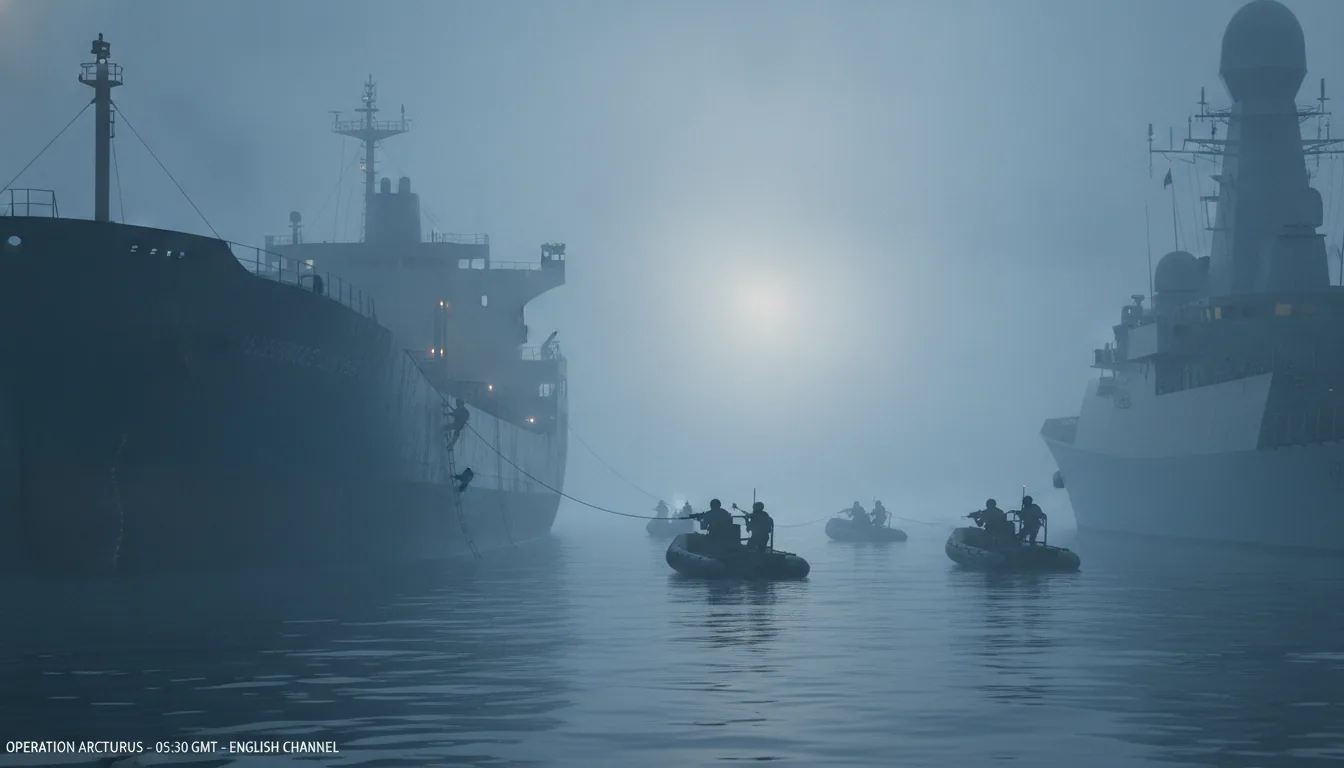
The Channel Interception on 14 June 2026 was a UK-led tactical operation where Royal Marine Commandos seized the SMYRTOS, a Russian shadow fleet tanker, to enforce international oil price caps. This high-stakes intervention in the English Channel combined military precision with law enforcement expertise to disrupt the Kremlin's economic logistics. By detaining a Cameroon-flagged vessel, British authorities signaled a new era of kinetic enforcement against opaque economic actors.
The sight of elite Royal Marine Commandos fast-roping onto the rusted, oil-slicked deck of an aging tanker captures the jarring friction between twenty-first-century security and nineteenth-century maritime evasion. This tactical friction point signals an emerging paradigm in how Western powers enforce global norms against opaque economic actors. UK forces intercepted a Russian shadow fleet vessel for the first time, marking a decisive escalation in the enforcement of international oil price caps.
The operation commenced in the early hours of a Sunday morning within the high-traffic transit corridors of the English Channel. Royal Marine Commandos, working alongside specialized National Crime Agency (NCA) officers, executed the boarding of the SMYRTOS, a tanker flying the flag of Cameroon. This Cameroon-flagged vessel represents a specific type of institutional behavior where shadow actors utilize flags of convenience to mask their true economic origin.
Tactical precision defined the engagement, with the boarding and initial control phase lasting approximately six hours before the vessel was secured. Following the intervention, the tanker was moved to an anchorage off the south coast of England for further investigation into its complex logistical trail. If the UK can successfully detain such high-risk assets, then the socio-economic blueprint for sanctioning the Kremlin’s war chest moves from a legal theory to a physical reality.
If the UK can successfully detain such high-risk assets, then the socio-economic blueprint for sanctioning the Kremlin’s war chest moves from a legal theory to a physical reality.
In the Estonian context, we recognize that maritime sovereignty is never a static condition but a constant negotiation of power against hybrid threats. The presence of these aging, under-insured vessels in sovereign waters creates a dangerous cross-border correlation between environmental risk and geopolitical instability. Rewriting the old order requires this exact combination of data-backed intelligence and raw military intervention to disrupt the shadow fleet's logistical impunity.
The Regulatory Blueprint: From Passive Monitoring to The Channel Interception
Sophisticated international sanctions often exist as mere digital ghosts until they meet the cold reality of naval steel. While the G7 price cap relied on financial leverage, the March 2026 legal authorizations transformed this abstract policy into a socio-economic blueprint for kinetic action. On 14 June, this regulatory evolution reached its peak when Prime Minister Keir Starmer personally directed the seizure of the SMYRTOS.
The use of direct executive power to halt a Cameroon-flagged vessel marks a paradigm shift in how modern states manage maritime security. Previously, institutional behavior favored passive monitoring, yet the systematic use of the shadow fleet to bypass price caps has forced a rewriting of the old order. If the UK can now bypass traditional bureaucratic delays to authorize boarding operations, then the cross-border correlation between law and defense has fundamentally tightened.
The SMYRTOS represents a broader institutional failure of global shipping registries, where aging tankers operate under flags of convenience to fund the invasion of Ukraine. These vessels function as opaque economic actors, utilizing ship-to-ship transfers to obscure their cargo's origin. This successful operation delivers a blow to the Kremlin by moving toward aggressive physical enforcement rather than just financial audits.
Tactical Integration: Mapping the Multi-Disciplinary Response
High-end technological superiority frequently clashes with the low-tech dereliction of the global shadow fleet. The 14 June operation utilized a multi-disciplinary approach to neutralize a vessel that represents a blatant attempt to bypass international oil price caps. An RAF P-8 surveillance aircraft provided the critical aerial coordination, linking real-time intelligence to the tactical units on the water.
The Royal Navy frigate HMS Sutherland and the vessel HMS Ledbury provided the essential surface support required to secure the mission perimeter during the six-hour operation. A fleet of Chinook, Merlin Mk4, and Wildcat helicopters ensured the Royal Marine Commandos reached their target with surgical precision. This level of technical coordination suggests a paradigm shift in how sovereign waters are governed against opaque economic actors.
If the state successfully merges military hardware with economic enforcement, then the traditional boundaries of maritime law begin to blur. This socio-economic blueprint demonstrates that institutional behavior is no longer limited to passive observation or bureaucratic auditing. Instead, we see the emerging paradigm rewriting the old order through data-backed future-casting and active, kinetic interdiction.
The Channel Correlation: A Comparative Shift in Maritime Doctrine
A pristine maritime border often exists as a legal fiction while coastal waters remain sites of intense humanitarian and security friction. In 2025, a total of 41,472 migrants were detected crossing the English Channel, highlighting the gap between theoretical territorial intent and the reality of physical control. This signals the emerging paradigm of assertive control over the high-traffic waters of the Dover Strait.
This transition stems from a pivotal paradigm shift on 25 November 2025, when French authorities officially altered their maritime doctrine to permit interceptions at sea. This new socio-economic blueprint enabled French forces to prevent more than 20,000 crossings during 2025, signaling a permanent departure from reactive rescue operations. Arrivals in 2026 have continued to drop as the perceived risk of intervention by coastal states increases.
The cross-border correlation between migrant interdiction and the SMYRTOS mission indicates a fundamental and necessary change in institutional behavior. These strategic lanes are no longer passive corridors. This alignment proves that when legal norms are rewritten to prioritize kinetic security, the physical behavior of global economic actors shifts in response.
Rewriting the Old Order: Strategic Implications for the Kremlin’s War Chest
Sophisticated financial engineering meets the primitive, rust-streaked reality of a decaying shadow fleet. On 14 June 2026, the boarding of the SMYRTOS by UK forces signaled a paradigm shift in how Western states enforce economic policy through direct action. This was not merely a tactical victory but a complex behavioral mapping of economic actors under extreme sanctions stress.
Historically, the English Channel was governed by a doctrine of passive monitoring, where sanctioned vessels were tracked as digital ghosts rather than intercepted. This 2026 intervention mirrors the decisive naval interdictions of the mid-twentieth century, reconfigured for a world of oil price caps and shell company networks. If the UK maintains this posture, the institutional behavior of shipping operators must adapt to a reality where sovereign waters provide no protection for sanctioned cargo.
Rewriting the old order requires a multi-disciplinary synthesis of law and technology that looks beyond the vessel to the financial architecture supporting it. In the Estonian context, this kinetic precedent serves as a vital signal that the maritime commons cannot remain a loophole for authoritarian financing. The Channel Interception marks the end of the flag-of-convenience system's impunity, forcing a permanent bifurcation of global shipping into two irreconcilable legal realities.