
AI 2026: From Chatting to Real Action—and the Risk of Cognitive Colonization
By 2026, AI is shifting from text generation to world models like WEAVER and RepWAM, achieving a 0.870 correlation with physical reality. While over 50% of new software code is now machine-generated, the real challenge is "System 0"—the invisible algorithmic influence on our daily decision-making processes.
Sorry, this turned into a bit of a long one, but there's a lot to cover :)
By June 2026, the era of AI just "chatting" on a screen is mostly over. My 15 years of experience in IT confirms that we are finally seeing software and the physical world merge. We’re moving from text-based entertainment toward real-world actions where machines actually understand physical reality.
When talk turns to action—or why robots stopped hitting walls
Generative text is yesterday’s news. The focus has moved to world models like WEAVER and RepWAM. These don’t just try to put words in a row; they simulate reality so accurately that the difference is hard to spot. WEAVER achieved a 0.870 correlation with real-world results in robot movement, meaning the simulation and life are now almost one and the same.
In my opinion, this is a massive leap. These new systems don't just blindly walk into walls anymore. The RepWAM model uses something called "visual action tokenization"—which is just a fancy way of saying the robot sees an object and immediately knows what to do with it. The success rate of the π0.5 base model improved by 38% in real conditions. This isn't a lab toy anymore—it's a huge step forward.
Of course, this comes with a landslide of deepfakes, which has made a lot of people quite angry. Luckily, YouTube is developing detection tools that allow public figures to find and remove AI-generated content quickly. Again, it’s a matter of choice—whether we let technology fool us or we take control back.
Physics doesn't lie—why we need fusion and new sensors
The world isn’t just code and pixels. My 15 years of experience shows that in the end, what matters is how much energy we have and how fast data moves. Fancy terminology won't save us here; we need real physical solutions.
Take the DIII-D reactor in San Diego. Their fusion experiment uses the ECHO algorithm and neural networks to optimize plasma heating in real-time. The AI isn't there to write poetry; it's there to make sure the reactor doesn't just go to hell (or "pekki," as we say) in the middle of a run.
Scientists are also tinkering with things like chiral 2D perovskites—R-(MBA)2PbI4, to be exact. This dense terminology basically means we can create much more efficient and faster devices. Plus, new quantum sensors don't need total cooling anymore, which reduces wasted energy and increases precision.
The cost of writing code is rolling toward zero, but the cost of creating meaningful software is not.
System 0 and Cognitive Colonization: Who is actually deciding in your head?
While robots are learning to move in the physical world, a much subtler game is being played inside our heads. Researchers are warning about "System 0"—the way algorithms seep into our decision-making and psychological architecture. My 15 years of experience building systems tells me we won't even notice when algorithms start feeding us interests that aren't our own.
This is cognitive colonization. You think you made a choice, but someone else was pulling the strings. The Future of Life Institute is demanding concrete rules from the US to limit these massive experiments before they spin out of control. The current pace is insane and officials are stuck because they are looking at papers, not real life.
Tristan Harris asks a good question—are we building a helper or a replacement? We’re often sold "AI Absolutism," the idea that an apocalyptic future is inevitable. I think that’s just systemic manipulation by tech giants trying to protect their margins at the expense of our personal freedom.
AI in the world of code: Cost is zero, value is everything
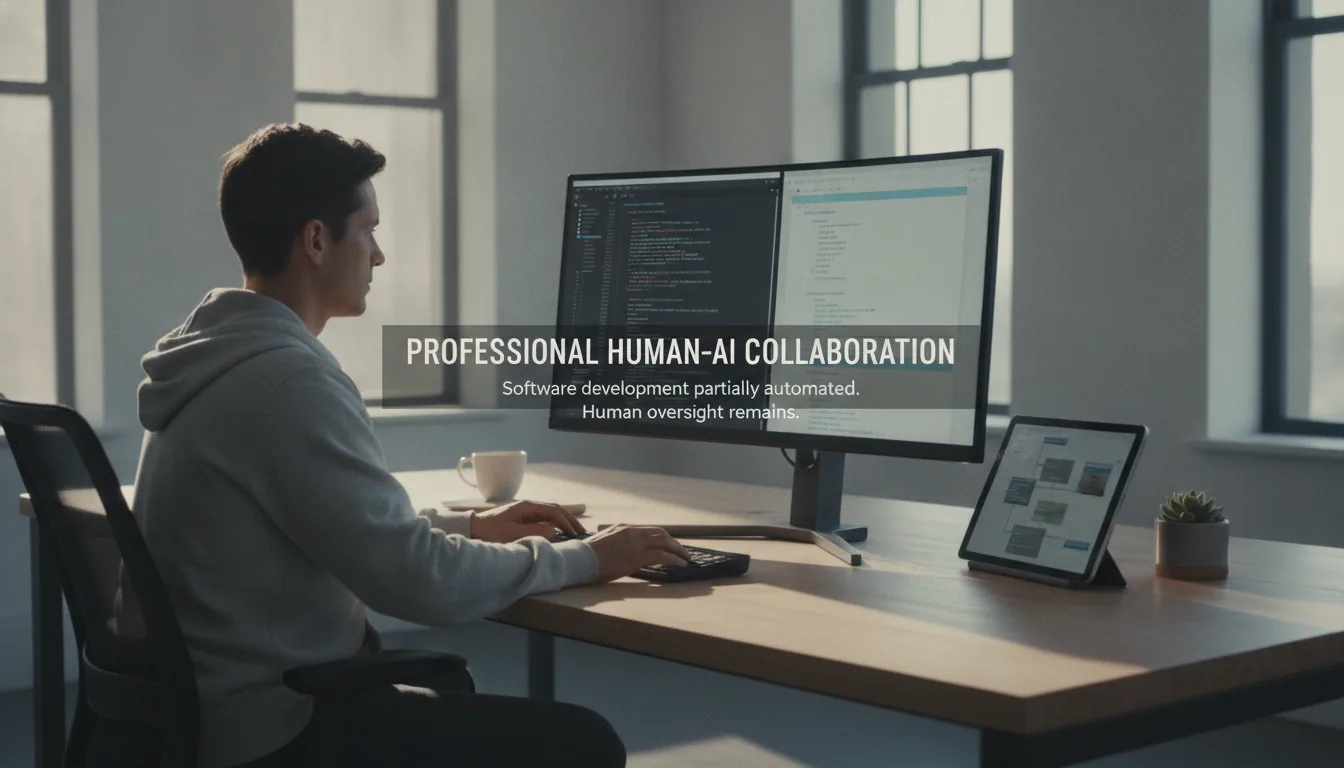
In my 15 years of building systems, I’ve seen that we’ve reached a point where coding as a manual craft is dying. Three years ago, only 3% of law firms used generative AI. Today, in June 2026, it's the opposite. At the software firm Ashby, over 50% of all new code has been machine-generated since August 2025.
That’s a huge jump. Half the work is done before the programmer even finishes their coffee. AI isn't coming for our jobs; it’s taking the syntax, the "glue code," and those thousands of keystrokes. Software shouldn't be a cost for a client, but a profit. This means we should pay for value, not for the effort recorded in lines of code.
How do we trust this synthetic stuff? A new technical standard called "task exchangeability" has settled in. If machine-generated code behaves exactly like human work in control tests, it’s exchangeable. Whoever keeps their foot on the brake now is going to be left behind by a very long mile.
Is 2027 the end of the world, or are they just selling us fear?
The BBC recently reported on research predicting AI will become uncontrollable by 2027. In my view, this fear-mongering is just like the old panics over computer viruses—the reality was always much more boring than the screaming headlines. Interesting... do we really believe that in exactly three years we’ll lose control of everything we built ourselves?
Dario Amodei from Anthropic is calling for rapid, strict regulation. It’s like trying to stop a speeding train with your bare hands while simultaneously shoveling coal into the furnace to keep the pace up. This "all is lost" approach paralyzes our judgment rather than helping us avoid real risks.
IBM has put together four scenarios for strategic planning to try and stay rational amidst the hype. My experience shows that things go wrong when we lack a Plan B and C, not because the technology is too smart. We need a pragmatic approach, not paralysis born of fear.
AI is a creative partner, not a replacement
We don't need to look at AI as a ghost coming to take our work away. "The Moving Drone" project shows how machines can be creative partners in music—where the AI supports rather than dictates. This is the pragmatic direction: the machine as a highly capable tool in the hands of an expert.
My 15 years of experience building systems shows that proposals are usually about 95% accurate, because there’s always a little uncertainty. As the cost of writing code drops toward zero, we have to move higher—we have to think about substance and value.
Try to put these systems to work for you instead of just shivering in the corner. We still have a real chance to decide how we integrate these solutions into our daily work. It’s a matter of choice—the future of AI is in our hands, provided we keep control and refuse to be invisible, steerable cogs in someone else's machine.
Seega, katsuge kainet mõistust säilitada. (So, try to keep a cool head.)
Veelkord valikute küsimus.