
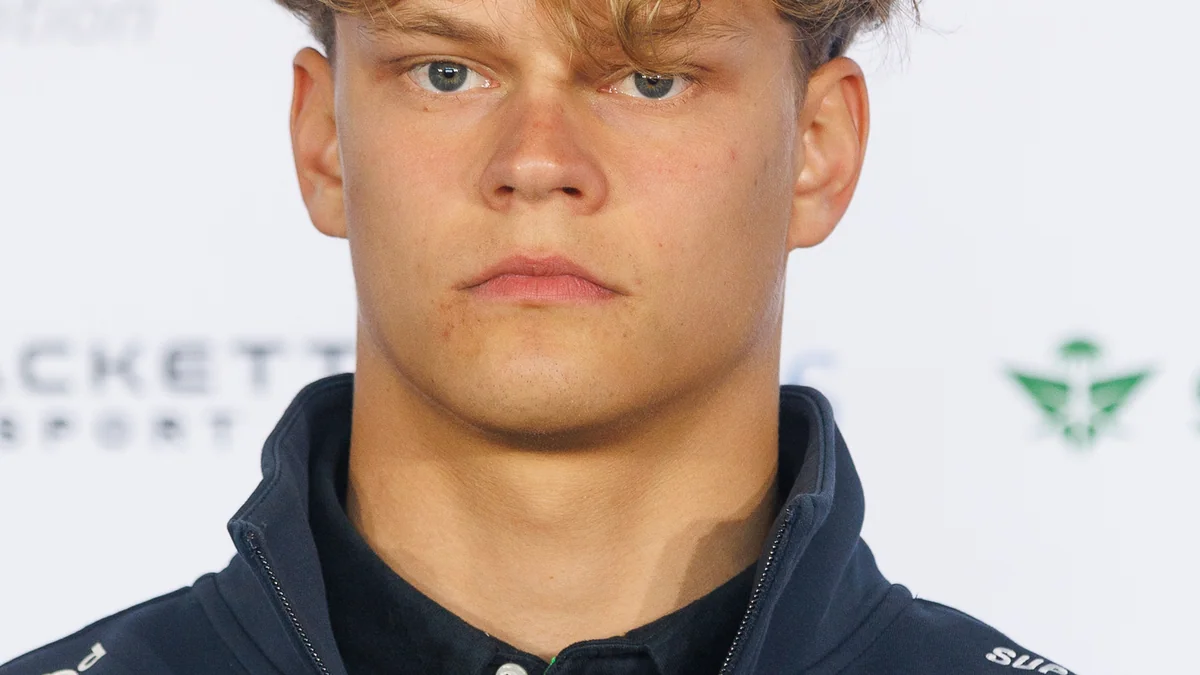
Paul Aron is entering a pivotal 2026 season as the reserve driver for BWT Alpine F1 while simultaneously conducting free practice sessions for Audi. With 126 laps of testing and 163 Formula 2 points behind him, Aron is navigating a highly technical path toward becoming Estonia’s first full-time F1 driver.
Imagine a clock that measures time in thousandths of a second. To most of us, a thousandth is an abstraction—a flicker so brief it exists beneath the threshold of human perception. But in the cockpit of a Formula 1 car, that sliver of time is a physical distance. It is the gap between a career and a footnote.
Paul Aron, a 22-year-old from Tallinn, has spent his life learning to inhabit those slivers. Recently, in Abu Dhabi, he completed 126 laps in an official F1 test, clocking a time of 1:23.847. To the casual observer, 126 laps is just a high number on a screen. Here is the strange part: it represents nearly 700 kilometers of sustained combat against G-forces—the invisible giants that try to pull a driver’s head off in every corner.
To put that in perspective, imagine driving from Tallinn to Pärnu and back three times over, without ever letting your speed drop below 200 kilometers per hour. Now hold that thought, because the physical toll is only the baseline. The real story is the mathematical proof of belonging.
The Dual Identity: Alpine’s Safety Net and Audi’s Interview
In 2026, Aron finds himself in a rare professional superposition. He remains the official reserve driver for BWT Alpine F1, a role that requires the patience of a monk and the readiness of a sprinter. He must be prepared to step into the world’s fastest game at a moment’s notice.
But the truly fascinating data points emerge in June 2026, when Aron enters the garage of the Audi Revolut F1 team (the outfit formerly known as Sauber). Under the strict gaze of a German automotive giant building its factory identity, Aron will take part in free practice sessions.
Think of these sessions not as practice, but as the world’s most high-stakes job interviews. His first appearance is at the Circuit de Barcelona-Catalunya—a track that famously punishes errors but rewards mechanical precision. To master the dynamics of two entirely different cars within a single month is a feat of mental flexibility that would leave most professional athletes reeling. It is a pragmatic investment: Alpine gets a sharper driver, and Audi gets an unbiased set of eyes on their development.
The Ladder: From the Mercedes Academy to the F2 Pressure Cooker
Every F1 career is a ladder built rung by rung, and Aron’s was forged in one of the world’s most unforgiving environments. From 2019 to 2023, he was part of the Mercedes Junior Team. This wasn’t just a sponsorship; it was a high-speed university where exams were taken at 300 kilometers per hour.
When many young talents leave such a system, they drift. Aron, however, accelerated. In 2024, he was thrown into the deep end of Formula E, becoming the youngest starter in the series’ history with Envision Racing. That technical baptism served as a prelude to his 2024 Formula 2 campaign, where he gathered 163 points and seven podium finishes.
In F2, speed is a commodity, but tire management is an art. Aron’s ability to preserve his rubber while maintaining pace is the kind of quiet, rigorous skill that F1 engineers value more than flashy overtaking maneuvers. It is the difference between a sprinter and a grandmaster.
The Human Infrastructure: Family Strategy and Tech Capital
Behind the carbon fiber and the telemetry data lies a remarkably grounded human support system. We often view these drivers as solitary figures, but Aron is the tip of a very specific spear. His brother, Ralf Aron—himself a former top-tier racer—has moved from the cockpit to the drawing board, acting as the architect of Paul’s career.
Then there is the "biological engine" maintenance. His trainer, Karl Pärjamäe, ensures the body can handle the literal weight of the car’s downforce. But perhaps the most modern element of this journey is the backing of Bolt.
In the past, racing was funded by tobacco or luxury watches. Today, the partnership between Aron and Markus Villig’s tech giant represents a bet on national talent. For a small country like Estonia, reaching F1 has always been a dream deferred—we’ve seen Marko Asmer and Jüri Vips reach the threshold, only to see the door remain closed. Bolt’s involvement functions like a turbocharger, providing the strategic fuel necessary to compete in the world’s most expensive ecosystem without relying solely on personal family wealth.
The Open Horizon
We often look for the "aha" moment in sports—the single overtake or the trophy lift. But the truth of F1 is found in the "black box" of the simulator and the quiet hours of data analysis. Aron’s third-place finish in the F2 standings was not an end point; it was a foundation.
Whether this path leads to a permanent seat in 2027 is something we still don’t know. That, honestly, is the best part. We are watching the ladder being built in real-time. For now, the darkness of the unknown isn’t a void—it’s just the space where the next hundredth of a second is waiting to be found.