Evidence for new physics at CERN emerged in May 2026 when researchers reported a 4-sigma anomaly in B-meson decays that suggests the existence of an unknown fundamental force. This statistical deviation indicates that the Standard Model may finally be reaching its mathematical limits as the definitive map of subatomic behavior.
Subatomic particles are currently behaving in ways that contradict our established charts of the universe, specifically regarding how B-mesons transform during electroweak penguin decays. Imagine a map where travelers keep stumbling over a cliff that shouldn't be there. For decades, the Standard Model has been that map, but the silence at the Large Hadron Collider was recently broken by data suggesting the map is tearing.
These decays are acting like a coin that lands on its edge just often enough to make you blink. Physicists measured this deviation at 4-sigma significance. A 4-sigma result means there is only a 1-in-16,000 chance that this is a statistical fluke.
This creates a beautiful tension in the halls of CERN. Only recently, 3,000 physicists at the ATLAS detector reported no hints of new physics at all, suggesting the old map was perfect. Yet these B-meson anomalies persist like a glitch in the particle stream that refuses to be rebooted.
If this anomaly holds, we aren't just looking at a new particle. We are looking at a hint of a fundamental force of nature that has remained hidden since the Big Bang. It is the difference between finding a new island and discovering that gravity works differently on Tuesdays.
A Map That No Longer Fits the Territory
The Standard Model is our mathematical bedrock, predicting the behavior of subatomic particles for fifty years with the precision of a master clockmaker. Now hold that thought. A map is only useful if it matches the ground, and lately, the ground has begun to shift.
Take the W-boson, a particle that carries the weak nuclear force. Recent measurements show its mass deviates from what our best equations predict. To a physicist, this is like finding a mountain ten miles away from its map coordinates, a gap suggesting we are missing an entirely new force.
Then there is the mystery of why we exist at all. Evidence of CP-symmetry violation was recently found in beauty-lambda baryons. This is essentially a subtle flaw in the mirror of the universe that explains why matter survived the Big Bang while antimatter mostly vanished.
If this anomaly holds, we are looking at a hint of a fundamental force of nature that has remained hidden since the Big Bang.
Even the smallest particles, like muons, are wobbling in ways that defy our current charts. This discovery earned the Muon g-2 pioneers the Breakthrough Prize in April 2026. They are the new explorers, documenting the specific spots where our old physics simply stops working.
Hunting for New Physics at CERN: Ghosts and Exotic Matter
While the giants like ATLAS were squinting at the distant horizon, a small experiment called FASER was busy catching ghosts. In May 2026, they reached 5.5-sigma significance, which officially moves the electron-neutrino from a theoretical guess to a proven reality.
The team detected these electron-neutrinos created right inside the accelerator for the first time. This is incredibly difficult because these particles can pass through a light-year of lead without hitting an atom. It is like finding one specific grain of sand in a vast desert by waiting for it to blink at you.
FASER is also hunting for the shadows these ghosts cast. New data has set world-leading constraints on dark photons in the 10 to 150 MeV mass range. Think of a dark photon as a messenger between our world and the "dark sector," the hidden 85 percent of the universe we cannot see.
The ATLAS collaboration also spotted a new exotic particle in March 2026 that looks like a proton but contains two charm quarks and one down quark. These aren't just entries in a physics catalog; they are the building blocks of a hidden reality. We are finally touching the edges of a world that, to someone in 1610, would have been indistinguishable from magic.
From the Baltic Edge to the Heart of the Ring
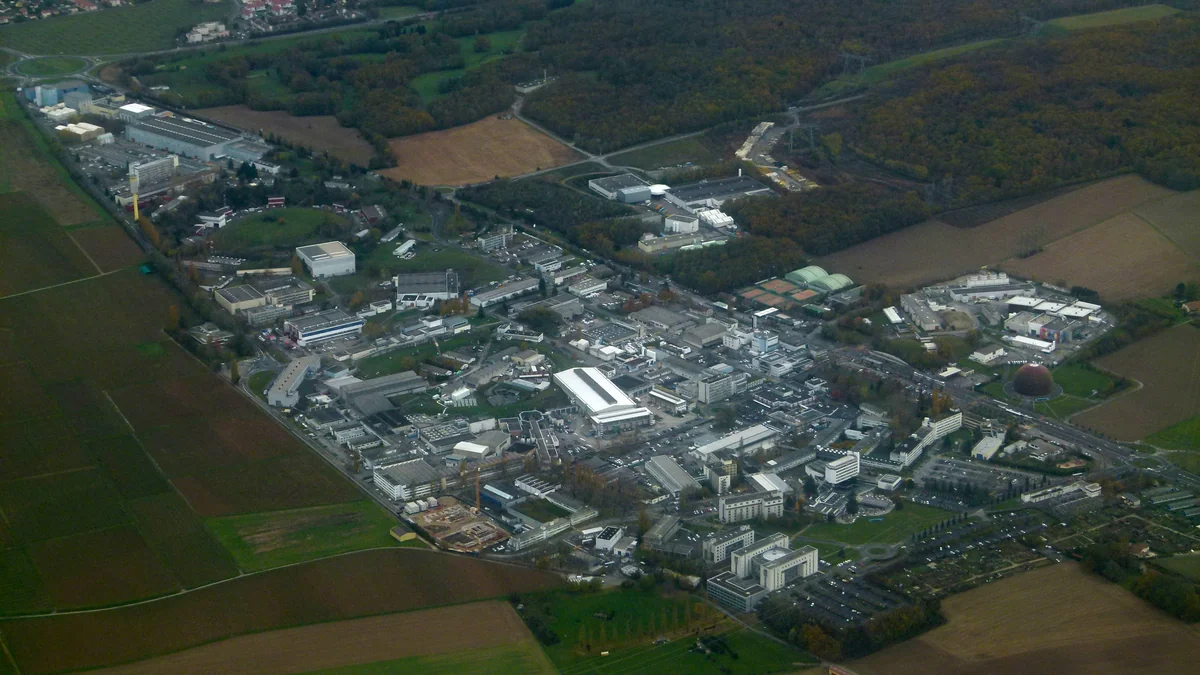
In March 2025, sixteen Estonian physics teachers stood in a tunnel beneath the French-Swiss border, surrounded by the world's most complex machine. They were there because Estonia became a full member state of CERN in 2024. This graduation changed our national role from spectators to stakeholders in the search for truth.
Researchers at the National Institute of Chemical Physics and Biophysics (KBFI) are now helping to draw the new map of the subatomic world. This is where the abstract math of the universe meets the actual steel and silicon of the machine.
Estonian companies like GScan and Testonica are already translating theoretical physics into high-tech industrial contracts. They are participating in the development of the Future Circular Collider, the proposed 91-kilometer successor to the current machine. This turns a hunt for dark matter into a concrete economic opportunity for Tallinn-based engineers.
The 92-Kilometer Question
The Large Hadron Collider is a 27-kilometer ring that has defined our understanding for a decade. Even this engineering masterpiece is starting to feel like an old map with fraying edges. To find what lies beyond, physicists are looking toward a machine that would stretch 92 kilometers in circumference.
Imagine the current LHC as a high-powered flashlight showing us the heavy furniture in a dark room. The shadows in the far corners remain pitch black because our current light cannot reach them. To see into those gaps, the FCC aims for a collision energy of 100 TeV, a scale of force that is difficult to fathom.
If the energy of the LHC is like a professional tennis serve, the FCC is more like a supersonic jet hitting a concrete wall. Director-General Fabiola Gianotti is currently steering this vision toward a feasibility report scheduled for 2026. The FCC represents our best chance to turn 4-sigma whispers into an undeniable shout from the universe.
The Five-Sigma Horizon
In the world of particle physics, truth has a specific mathematical address: 5-sigma. This is the discovery threshold where the chance of a fluke is only one in 3.5 million. Right now, the B-meson anomalies sit at 4-sigma, which is a 1-in-16,000 chance of being a phantom in the data.
To bridge this gap, CERN’s Run 3 is operating at record speeds to collect the deciding evidence. There is no clear energy scale pointing to the origin of these phenomena for the first time in decades. We are essentially sailing off the edge of the known map into a region where old rules no longer provide a compass.
We are using a 27-kilometer subterranean ring to interrogate the invisible, yet we remain curious children playing with a very large magnifying glass. If the anomalies hold, we are not just adding a room to the house of physics, but discovering a hidden basement. Whether these results reach 5-sigma or vanish like morning mist, the pursuit of new physics at CERN remains the most significant scientific voyage of our time.