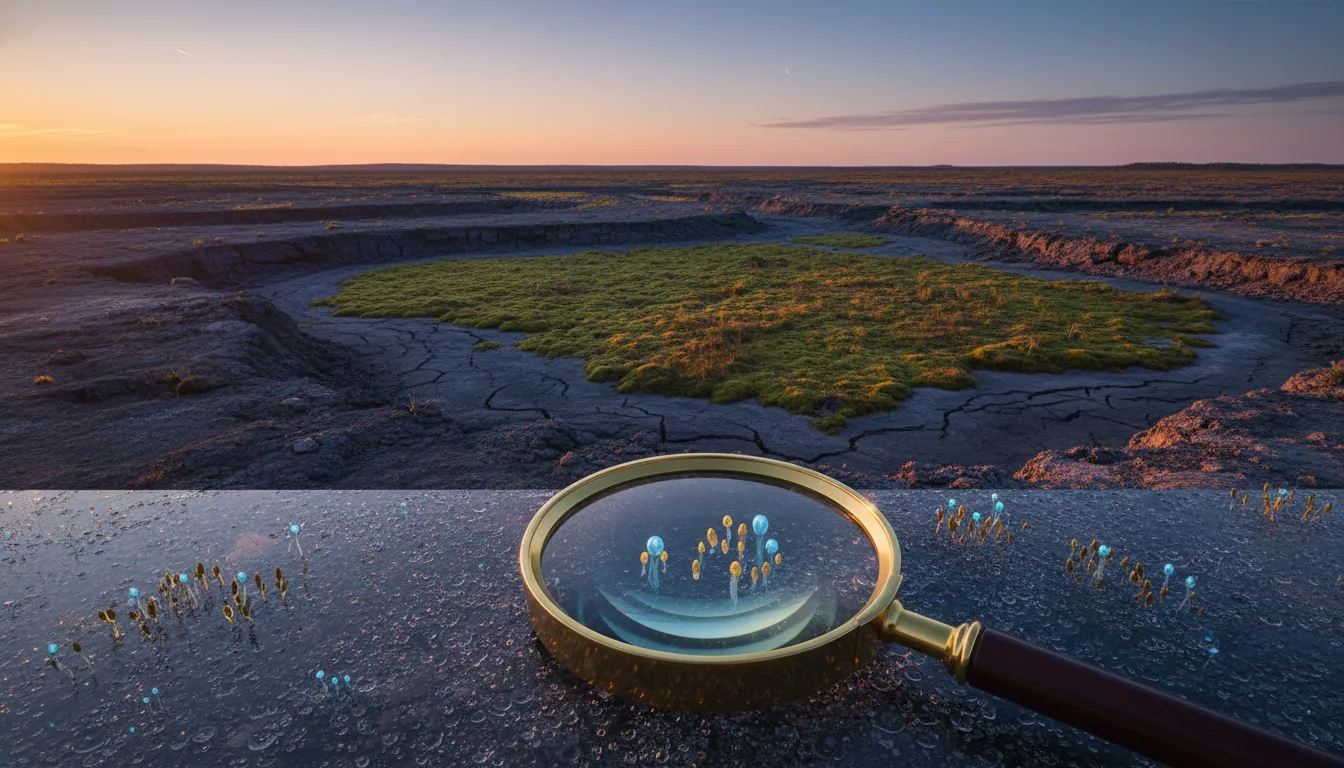
Fungal warfare utilizes specialized organisms to restore peatlands, transforming carbon-emitting deserts into efficient carbon sinks. By deploying targeted fungi as biological control agents, scientists can revitalize biodiversity and secure ecosystem services. This method offers a precision alternative to chemical interventions in damaged landscapes.
Fungal warfare provides a targeted biological solution to restore damaged peatlands by using specific fungi to eliminate invasive species without harming the native environment. If you stand in the middle of an abandoned peat mining field in rural Estonia, the first thing you notice is the eerie silence. It looks like a brown desert, stripped of its skin, waiting for a life that never arrives.
While this scarred earth looks frozen in time, it is actually one of the most active chemistry labs on the planet. Instead of inhaling carbon and exhaling life, this ground is slowly, invisibly, exhaling heat into our atmosphere. Expert Kuno Kasak has noted that the biodiversity in these fields is currently essentially non-existent.
A healthy peatland is the world's most efficient vacuum cleaner for carbon, trapping it for millennia under a wet blanket of moss. When that cycle breaks, the landscape turns against the climate. Restoring these fields into wetlands transforms them back into carbon sinks and provides critical animal habitats.
Fungal Warfare: Hiring Nature’s Own Assassins
In the textbooks, we call this biological control, which is actually a form of ancient, calculated warfare. Researchers at UC Agriculture and Natural Resources define it as using "good bugs" or other organisms to manage invasive pests. We are looking for a biological sniper that ignores native forests but hunts the intruder with absolute focus.
This is where the fungi come in. We usually think of mushrooms as the forest's clean-up crew, turning fallen logs into soil. In this fight, certain fungi are being rebranded as targeted biological weapons. A specialized fungus can be deployed to infect only a specific invasive moss, leaving the rest of the ecosystem untouched.
To someone standing here in 1610, this would have been indistinguishable from magic. Today, it is a matter of precision biology. It is about finding the exact parasite that evolved over millions of years to eat only the thing we want gone.
We are trying to restart the pulse of a landscape that has forgotten how to beat.
This strategy turns the invader’s strength into its own greatest weakness. The more the invasive moss spreads, the more food there is for our fungal assassin to consume. It is a self-correcting system that eventually breathes life back into the land.
The Estonian Paradox: Leading the EU in Wildness
To someone flying over Europe, the continent looks like a patchwork quilt of cities and farms. As you cross the Baltic border into Estonia, the green patches grow larger and more jagged. While much of the world is losing its grip on wild spaces, Estonia is actually gaining ground.
Scientists at the Keskkonnaagentuur use a ladder of understanding called ecological status to measure how well a habitat functions. They check if it can still breathe, filter water, and grow as it should. A March 2024 report confirmed that the ecological status of Estonia’s Natura 2000 habitats is currently more favorable than the European Union average.
Healthy, coherent ecosystems are the shock absorbers of our world. They mitigate the effects of global warming in ways a concrete wall never could. To keep our leading position, we must move beyond watching the woods grow and understand the mechanics of recovery.
The Speed of Spores versus the Speed of Paper
Imagine a researcher standing in a hallway in Washington, D.C., clutching data about a fungus that could save a forest. Outside, the invasive species they are fighting does not wait for a signature. We call this the friction between biology and bureaucracy.
The U.S. Department of the Interior is currently in a race against the clock to stop the spread of invasive species. Their reports show an urgent search for biological weapons because traditional tools are failing. In many cases, bureaucratic delays have become the greatest ally of the invasive plants we are trying to stop.
In Estonia, our Natura 2000 sites are thriving, but the global struggle is much more bogged down. For many agencies, the fear of a biological solution going wrong is greater than the certainty of an ecosystem dying. When an invasive species is rewriting an entire landscape, waiting is a luxury we no longer have.
The Invisible Payroll: Why We Depend on a Healthy World
Our planet has built-in systems for plumbing, ventilation, and waste management. Scientists call these "ecosystem services," or looduse hüved. The Kliimaministeerium views these benefits as the bedrock of our survival.
Data from Statistikaamet shows that nature is actually our most sophisticated and vital piece of technology. Healthy, coherent ecosystems are our primary defense against global warming. According to the Keskkonnaportaal, a healthy ecosystem's status is directly tied to its ability to provide these essential functions.
The economic value of these natural services is estimated in the trillions. We are learning to use fungi as allies in a battle for planetary stability. As we refine the tools of fungal warfare, we shift from being conquerors of the land to being its maintenance crew.