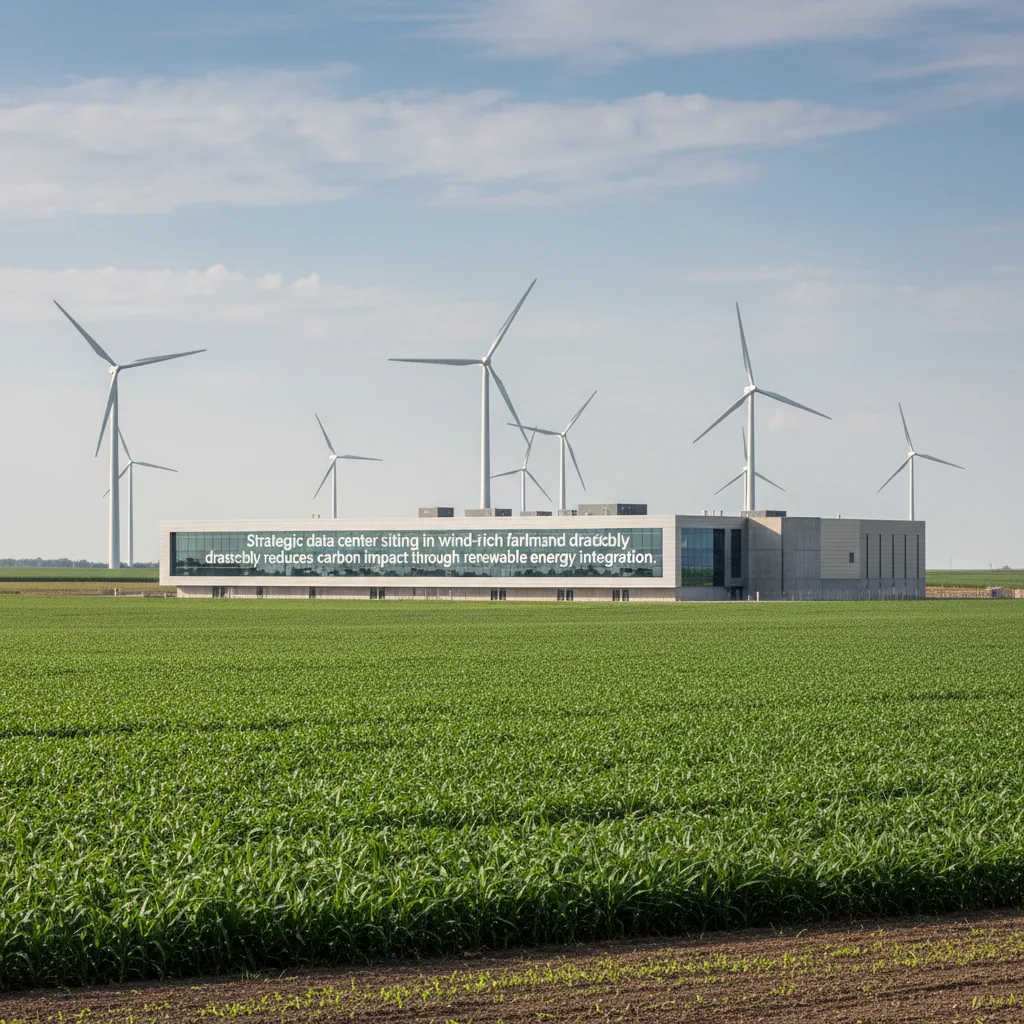
The environmental price of data centers reached an estimated $25 billion in 2025, driven by massive energy demands and water usage for cooling. Relocating facilities to cooler, wind-rich regions can cut emissions by 73% and water consumption by 86%, mitigating the physical impact of the digital cloud.
Calculating the environmental price of data centers requires looking past the "cloud" metaphor and into the physical reality of grid pressure and water scarcity. Locating a data center in a "windbelt" state like Nebraska or Texas can slash its carbon emissions by 73%. This is the result of smart siting—a strategy that prioritizes the chemistry of the grid over the convenience of the city.
The math of relocation is even more striking for water. Moving these facilities to regions with abundant wind and cooler climates reduces operational water use by 86%. In 2025, U.S. data centers caused $25 billion in environmental and health damage, which is roughly $75 for every person in the country.
For decades, we built infrastructure where the customers were, prioritizing low latency over the measurable impact on local resources. Prioritizing millisecond responses over resource management is a luxury we can no longer afford. The honest scorecard shows that current siting priorities are failing the environment.
Siting is a lever that avoids the need for private natural gas plants and protects local utility rates. Sustainable growth is already mapped out by engineers who prioritize geography over optics. This pragmatic shift turns a looming catastrophe into a series of solvable technical challenges.
The Grid Under Pressure: Managing the Environmental Price of Data Centers
The physical reality of the "cloud" is becoming impossible to ignore. As of May 2026, data centers in the U.S. and UK consume 6% of total national electricity. This volume is roughly equivalent to the UK's remaining nuclear power fleet, marking it as a primary driver of national energy demand.
Ireland serves as the clear-eyed warning for where this trend leads. In 2024, data centers consumed 22% of Ireland's total electricity, with projections suggesting a climb to 33% by 2026. This means one out of every three electrons generated in the country will soon power a server rack rather than a hospital or school.
This surge creates direct financial pressure for every other ratepayer on the network. In early 2025, utilities requested over $29 billion in rate increases to fund grid upgrades specifically for large power consumers. This shifts the hidden costs of AI infrastructure directly onto the public.
The honest scorecard shows a friction between geopolitical policy and physical constraints. The European Union targets a threefold increase in data center capacity within seven years to match global competition. Finding the copper, transformers, and generation capacity to sustain this growth is the real challenge.
When a utility asks for billions to upgrade its lines, the bill lands in the mailbox of an ordinary household. A $29 billion national hike means higher monthly costs for families who may never interact with complex AI models. The digital economy is now a heavy, physical utility that competes for the same resources we use to keep our lights on.
The 1-Trillion-Liter Ledger: Auditing AI’s Thirst
North American data centers consumed approximately 1 trillion liters of water in 2025. For one ordinary household, that volume would cover water needs for over 2.7 million years. While we treat the "cloud" as weightless, cooling it requires a physical, local volume of water.
Every 10 to 50 AI prompts you send consumes an estimated 500 ml of water for cooling and operations. Using an AI assistant to draft ten emails is effectively pouring out a small bottle of water through a server rack. It feels like a minor digital gesture, but the data says it is a lever.
Making a process 10% more efficient does not help the planet if you perform that process 100% more often.
The thirst starts long before a model reaches your screen. Training a single model like GPT-3 requires 700,000 liters of fresh water, which is what an average person would drink in 640 years. This is the baseline cost for the intelligence we are currently scaling.
Corporate reporting provides the honest scorecard for these impacts. Microsoft reported that 42% of its total water consumption in 2023 occurred in areas already classified as water-stressed. These are regions where the geography of compute is colliding directly with the geography of drought.
Meta’s water usage increased 51% between 2020 and 2024, reaching 5,637 megaliters annually. That volume would fill over 2,200 Olympic-sized swimming pools every year. While companies talk about "water positive" goals, the chemistry of a cooling tower remains an industrial reality.
Efficiency gains struggle to catch up to the sheer volume of demand. Right now, the numbers show we are trading local water security for global processing speed. That is the catch we must honestly account for as we build the next generation of tools.
Accounting for the Surge: Why Efficiency Alone Fails
Walk into a modern hyperscale facility and you will hear the constant, low-frequency thrum of fans. This mechanical breath carries a hidden price tag of $25 billion in economic and health-related damages. This cost is a direct result of the pollution and energy demands required to keep processors running.
For years, the industry used Power Usage Effectiveness (PUE) to signal environmental responsibility. While individual servers do more work with less power, the sheer volume of hardware has broken the link between efficiency and total impact. Efficient code simply cannot outpace industrial expansion.
Google offers the most honest scorecard on this trend. Google's greenhouse gas emissions climbed 48% between 2019 and 2024 due to AI infrastructure expansion. This surge happened while the company was leading the world in renewable energy contracts.
AI infrastructure could add 44 million metric tons of CO2 annually by 2030. That is the equivalent of adding 10 million cars to our roads every year. This is not a minor gesture; it is a lever moving in the wrong direction.
Utilities requested $29 billion in rate increases in early 2025 to fund infrastructure for these heavy users. For an ordinary family, this means paying higher monthly bills to subsidize the energy needs of silicon chips. Making a process more efficient is irrelevant if you perform that process significantly more often.
From Citizen Maps to Shadow Grids: The New Industrial Friction
The cloud now has the heavy footprint of a traditional industrial mill. Environmental advocate Erin Brockovich launched brockovichdatacenter.com to track the impact of the 4,200 data centers active in the United States. This mapping initiative allows citizens to document water scarcity and rising utility costs linked to local facilities.
The data documents deep friction, with over 2,716 community reports submitted so far. Texas leads the volume with 612 reports, signaling where the public grid has reached its breaking point. This is a necessary audit of the resource competition between our digital lives and our physical survival.
To bypass regulation, some developers are now building "Shadow Grids." Shadow Grids are private, behind-the-meter natural gas power plants that lock in fossil fuel emissions outside of public carbon-reduction targets. It feels like a pragmatic fix for energy security, but the chemistry says otherwise.
Space-based data centers are being evaluated as the ultimate "off-site" solution to mitigate terrestrial costs. The massive energy and carbon cost of launching hardware into orbit means we must solve the resource math on the ground first.
The honest scorecard requires a shift from "green" branding to mandatory transparency. Prioritizing siting in states with existing renewable surpluses to cut emissions by 73% is a lever, not a gesture. The real work is ensuring the environmental price of data centers is reflected in every project's bottom line.