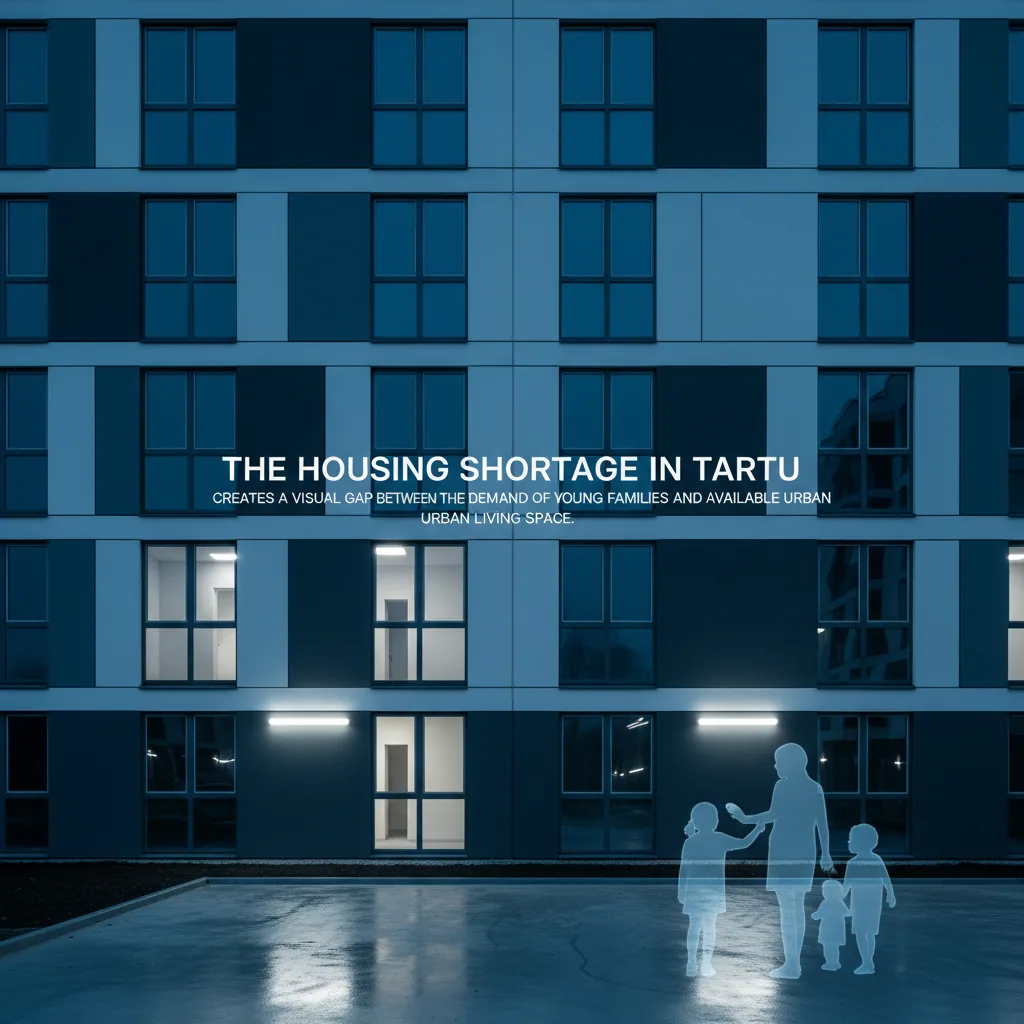
To maintain its status as a competitive intellectual hub, Tartu must address a critical structural deficit: the city requires 5,000 new affordable housing units by 2030 to accommodate young professionals and families. This local demand is inseparable from a global paradigm shift, where a 21.4 percent decline in the US temporary labor market signals a broader institutional cooling that will redefine regional real estate dynamics.
In the Catalonian city of Terrassa, rows of modern apartment blocks stand with vacant windows while young families on the street find themselves priced out of the market entirely. This paradox—high supply potential meeting zero accessibility—is a symptom of a larger institutional shift where US pre-recession indicators and global capital flows intersect with local housing pressures.
The hidden cooling of the US labor market
In economic analysis, what remains beneath the headlines is often more telling than the headline itself. As of April 2026, the primary US unemployment rate (U-3) sits at a seemingly stable 4.3 percent. However, the reality is captured in the 3.9 percentage point gap between the U-3 and U-6 rates, signaling a rapid increase in discouraged and underemployed workers.
Data from the Federal Reserve Economic Data (FRED) provides a stark socio-economic blueprint of the temporary help services sector. From a peak in March 2022, the number of temporary jobs has plummeted to 2.48 million by April 2026. This represents a loss of 676,300 jobs—a 21.4 percent contraction in the temporary labor sector in less than four years.
Historically, every US recession since 1990 has been preceded by a sharp decline in temporary labor demand. While the 2008 financial crisis saw a 33.9 percent drop, the current 21.4 percent decline has already reached two-thirds of that magnitude. If we view the temporary help sector as a leading indicator, then institutional behavior suggests that companies are already cutting costs in anticipation of a significant downturn.
Global correlations: Lessons from Terrassa and Algoma
While global macro-indicators cool, local real estate markets have reached a critical inflection point. Terrassa, Spain, serves as a cautionary cross-border correlation: a market where record-high prices coexist with a significant volume of empty dwellings. This inefficiency suggests that traditional market corrections are being hindered by institutional rigidities.
Conversely, in Algoma, Canada, social pressures have forced the creation of new legal safeguards. The opening of a housing rights clinic at the Community Connection Centre illustrates how a real estate crisis inevitably becomes a multidisciplinary legal challenge. It demonstrates that when economic norms fail, the state must rewrite the old order to protect the socially vulnerable.
As global capital seeks safety, the pressure on regional centers like Tartu intensifies. To avoid the Terrassa scenario, where a lack of accessible supply throttles social mobility, Tartu’s development must be viewed as a strategic necessity.
"Tartu needs 5,000 new apartments by 2030 to prevent a scenario where a lack of supply begins to limit the city’s social mobility."
— Elisabeth Saar
Saudi Arabia and the sportswashing paradigm
On the global stage, we see a different kind of institutional behavior: authoritarian regimes managing reputational risk through massive investments in entertainment. Saudi Arabia, currently 148th on the Democracy Index, is pivoting toward e-sports. The Esports World Cup (EWC) 2026 is a calculated strategy to utilize state capital to alter international perception.
Critics define this as "sportswashing," noting that Saudi Arabia’s democracy score remains a mere 2.08 out of 10. This outward-facing investment stands in sharp contrast to internal policies, such as the imprisonment of citizens for social media activity. Despite billions spent, the shadow of the 2018 Khashoggi assassination continues to color the emerging paradigm of Saudi soft power.
However, digital-native communities are pushing back. The moderation team of the r/ValorantCompetitive subreddit implemented strict restrictions on EWC 2026 discussions, signaling that economic might cannot always rewrite ethical values. This friction highlights a shift where the digital citizenry holds institutions accountable in ways traditional diplomacy cannot.
The Estonian landscape 2023–2026: Adaptation over stagnation
The Estonian economy has spent the last three years navigating a complex transformation. Following the high inflation and interest rate hikes of 2023, we have entered a phase of cautious expectation. In the Estonian context, the period between 2023 and 2026 has been a test of agility.
| Sector | Impact During Downturn | Primary Growth Factor |
|---|---|---|
| Efficiency Technology | Positive | Corporate drive to cut operational costs via automation. |
| Logistics & Distribution | Neutral | Critical need for supply chain optimization. |
| Legal & Advisory | Positive | Growing demand for contract renegotiation and institutional protection. |
| Social Infrastructure | Critical | State and local investment in housing and healthcare. |
| Luxury & Export | Adjusted | Shifting demand as global consumer purchasing power recalibrates. |
Identifying the beneficiaries of the shift
Recessions serve as a filter, removing inefficient units from the ecosystem. The winners in this climate are entities that provide solutions for scarcity. Technology firms focusing on process optimization are seeing an influx of orders as inefficiency becomes an unbearable cost for modern companies.
In Estonia, this presents an opportunity for social innovation. As economic uncertainty grows, the demand for qualified assistance in housing and social law will rise proportionally. This is where the private and public sectors can collaborate to build new models for citizen support under economic pressure.
Ultimately, the investors who succeed will be those who recognize trends before they are codified in mainstream statistics. If the 21.4 percent drop in US temporary labor is the signal, the flow of capital toward knowledge-based regions is the logical response.
Tartu’s vision and future implications
Securing 5,000 new apartments for Tartu is not merely a construction target; it is a strategic investment in the city’s future as an intellectual hub. If we fail to provide high-quality, accessible housing, the new generation of mobile, high-value talent will simply choose a different destination.
The real estate market must transition toward greater transparency to prevent the accumulation of vacant speculative assets. This requires a synthesis of law and economics—legal frameworks that encourage utilization over speculation. As a social scientist, I see this as the definitive crossroad: will the state proactively shape the rules for long-term stability?
The cooling US labor market, Saudi sportswashing, and the Terrassa housing crisis are all interconnected threads in a global blueprint. Our task is to decipher this correlation and ask: Is Estonia prepared to lead in this new order, or will we remain reactive? The Tartu housing shortage is not an inevitability; it is a solvable challenge for a state brave enough to invest in its future housing stock.