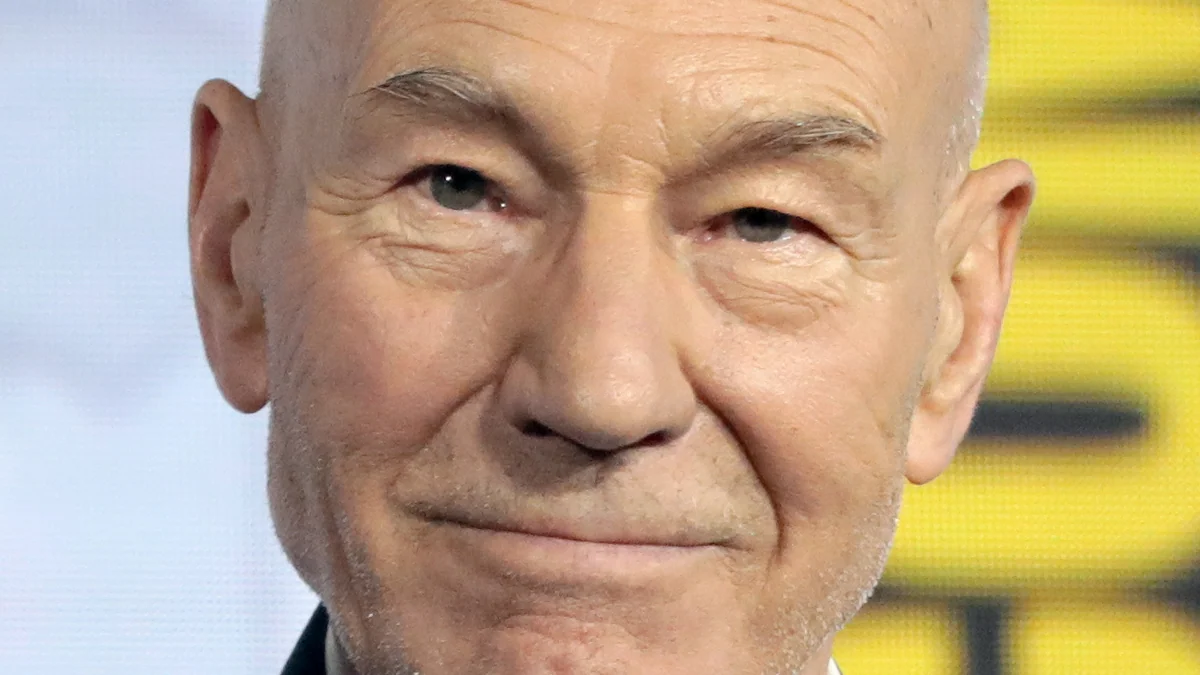
Patrick Stewart's legacy spans sixty years — it ended, in person, on October 28, 2026, in Los Angeles. He was 86. The cause was Alzheimer's disease and Lewy body dementia, a battle his family kept almost entirely private, which feels right somehow — a man who gave so much of himself in public deserved to keep this part.
His widow, the American singer Sunny Ozell, was with him. They had been married since 2013, an unlikely and clearly devoted match: the Yorkshire boy who climbed from working-class Mirfield to a knighthood, and the woman who was still beside him at the end of an extraordinary run.
Here is the thing about Patrick Stewart: he was never just an actor you admired from a polite distance. He was the kind of performer who made you feel that seriousness was allowed, that genre was not a ceiling, that a man trained on Shakespeare could stand on a starship bridge and make it feel like Elsinore. Sixty years of work. A voice like warm mahogany. An almost stubborn refusal to coast.
This is not an obituary, because a list of roles and dates would miss the point entirely. It is a portrait. Of a boy from a cold Yorkshire town who became one of the most recognizable faces on Earth, who used that visibility with intention, and who apparently had no plans to stop right up until he couldn't anymore. That last part matters more than it might seem. We will get to it.
The Boy from Mirfield Who Meant Every Single Word
Mirfield is a small mill town in West Yorkshire, the kind of place that produces practical people with no illusions. Patrick Stewart was born into a working-class household there, and nobody looking at that postcode in the late 1930s would have predicted a knight of the realm. What Mirfield did give him, though, was a seriousness of purpose — a quality you can fake in comfortable circumstances but tend to actually own only when comfort was never guaranteed.
He joined the Royal Shakespeare Company in 1966 at twenty-six, and he stayed sixteen years. Sixteen years is not a stint. It is a formation, a discipline, a daily reckoning with language at its most demanding. That RSC apprenticeship is the reason his later work always had weight underneath it - the reason even the most outlandish line of science fiction dialogue landed like it meant something, because he had spent the better part of two decades learning how to mean every word.
His Broadway debut came in Peter Brook's production of A Midsummer Night's Dream — not a cautious first step but a defining moment, directed by one of the twentieth century's most rigorous theatrical minds. The production is still cited as a landmark. Stewart was inside it, building a reputation one precise performance at a time.
The record speaks clearly. Two Laurence Olivier Awards: one for Antony and Cleopatra in 1979, another thirty years later for Hamlet in 2009. The second award is the more remarkable fact - most actors at seventy are asked to play supporting fathers, not Danish princes. Then, in 2010, Queen Elizabeth II knighted him for services to drama.
The trajectory from Mirfield to that investiture is not a fairytale. It is the result of accumulated craft, stubbornly applied across five decades.
The Captain Who Made Science Fiction Worth Taking Seriously
Before Patrick Stewart, science fiction television was something you watched guiltily, like a second slice of cake. After him, it was something you argued about at dinner. That is not a small shift, and it happened almost entirely because one classically trained Shakespearean from Yorkshire refused to treat technobabble as anything less than Chekhov.
When he was cast as Captain Jean-Luc Picard in 1987, the Hollywood trade papers described him as "an unknown British Shakespearean actor." The description was accurate and slightly insulting, which is probably how Stewart preferred it. He had spent sixteen years at the Royal Shakespeare Company by then, and he brought every one of those years to the bridge of the USS Enterprise-D. Where James T. Kirk had been all swagger and gut instinct, Picard was measured, diplomatic, and genuinely curious about the universe he was sailing through. The contrast was deliberate. It was also, it turned out, exactly what the audience wanted.
The numbers tell you something. At its peak, Star Trek: The Next Generation drew 12 million viewers a week. Thirty million people watched the 1994 series finale. Stewart played Picard across all 176 episodes, and the consistency of that performance is what makes those numbers mean something. He did not coast. He treated every scene as if it had real stakes, because to him, it did.
Here's the thing nobody tells you: the reason that show holds up is not the special effects. It is one actor making you believe, through sheer discipline and attention, that the speech matters. That the person giving it means it. RSC training, applied to a starship. It worked.
Ten Films, One Grammy, and a Final Bow Coming in December
Count the X-Men films sometime, if you want to feel the weight of a commitment. Ten movies across twenty-four years, the same face in the same wheelchair, the same quiet authority in the voice — Professor Charles Xavier, telepathic patriarch of the mutants, played by a man who had spent sixteen years at the Royal Shakespeare Company learning exactly how to hold a room without raising his volume. That is not a franchise appearance. That is a relationship.
The range surprised people, which itself is telling. In 1996, Stewart won a Grammy Award for Best Spoken Word Album for Children. A Grammy. The man who delivered Picard's speeches to thirty million viewers sat down and read stories to children, and did it well enough to win. He was never doing the one thing you thought he was doing.
In 2023, at eighty-three, he published his autobiography, Making It So. Frank, unhurried, and worth the afternoon it takes to read it — he wrote about Yorkshire, about the violence in his childhood home, about the Paramount lot and what it felt like to become globally famous at forty-seven. He didn't smooth the difficult parts. He just described them, which is a much harder thing to do.
And then, December 2026. Avengers: Doomsday opens in cinemas, and Patrick Stewart appears on screen as Charles Xavier one final time. He filmed it before the diagnosis became public knowledge, before the last quiet months at home in Los Angeles. A posthumous curtain call, projected large in the dark. He will not be there to watch it, but the work will be, which is its own kind of answer to something.
The Work He Did When the Cameras Were Off
Most public figures find a charity the way they find a publicist: someone recommends one, the optics are good, the association is clean. Stewart was not most public figures. His advocacy ran straight back to the source, to a small house in Mirfield where a boy watched his father - a WWII veteran with demons nobody had named yet - use his fists on his mother. That isn't brand management. That is a man settling a very old account.
He became a patron of Refuge, the UK charity supporting survivors of domestic violence, and he spoke about it without softening the story. He said what it looked like. He said what it felt like to watch. Compare that to the standard celebrity approach — a gala appearance, a quote polished to a gleam — and the difference is the difference between signing a card and showing up.
He supported Combat Stress, the veterans' mental health charity, because he understood exactly what undiagnosed PTSD had cost his father and everyone near him. He was a patron of Humanists UK and a consistent, vocal supporter of LGBTQ+ rights, positions he held without the hedging that often passes for courage in public life. He did not wait for the culture to catch up before he opened his mouth.
He was reportedly a complicated man in private. A distant relationship with his two children in earlier years is part of the record, and it would be dishonest to paper over it. Lives are not CVs. The advocacy and the complications existed together, in the same person, which is how it usually goes when something is real rather than performed. The work was not penance. It was the logical consequence of surviving something and deciding what to do with that knowledge.
What Patrick Stewart's Legacy Leaves in the Room
In July 2026, three months before he died, Patrick Stewart told an interviewer he had no plans to ever officially retire. "I can't imagine ever officially retiring. I'll always and forever be an actor." He was 86, and he meant it.
That is not a celebrity deflection. That is data. Ten X-Men films across 24 years. One hundred and seventy-six episodes of Picard. Two Olivier Awards separated by three decades. A final film performance still scheduled for cinema release in December. The numbers read like a man who never once checked the exit signs.
His stubbornness about stopping is the most generous thing about him.
What Stewart leaves in the room is not just a career — it is a refusal. A refusal to treat curiosity as something you outgrow, to let the world hand you an honorable ending and politely accept it. His stubbornness about stopping is the most generous thing about him.
"What we leave behind is not as important as how we lived," Picard said once, in Stewart's own voice wearing a uniform. He lived it forward, not backward. He kept learning lines and meaning them.
Patrick Stewart's legacy is, in the end, a challenge to the rest of us. Here is the one thing to do today: pick something you quietly shelved because the timing was never right. Write it down. Do not wait for the credits.