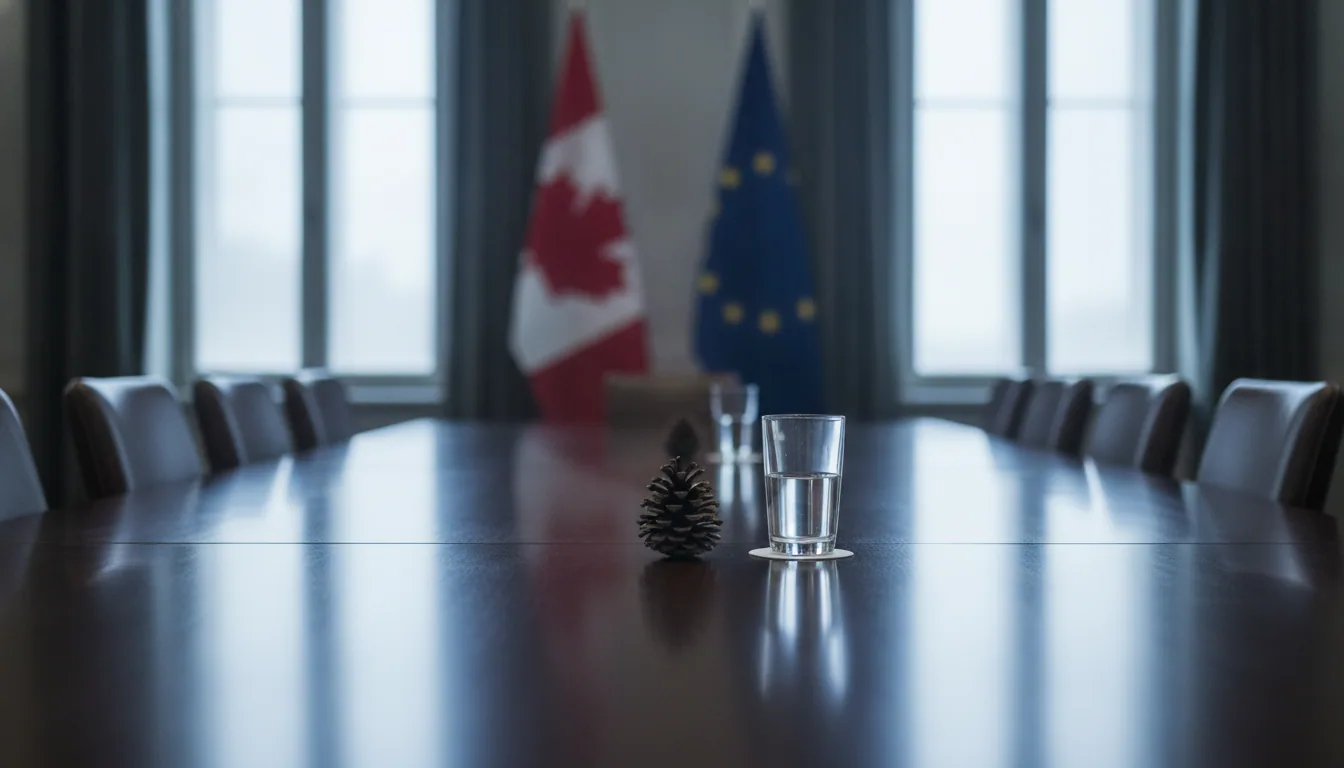
On 27 October 2026, Finland and Norway initiated a ninety-minute Nordic call to Putin — the first direct Nordic-Russian diplomatic contact in over fifteen months. The exchange covered Ukrainian energy infrastructure, Black Sea security, and High North stability, and fractured Nordic unity in the process.
The Line Goes Dead, and Then It Rings Again
There is a particular kind of silence in diplomacy that is not the absence of speech but the presence of a decision - the decision that the phone stays on the hook because picking it up costs more than leaving it down. European chancelleries maintained that silence toward the Kremlin for the better part of fifteen months, from July 2025 onward, and they maintained it with the studied deliberateness of people who had watched previous calls go nowhere and did not want their faces in the photograph that followed.
On 27 October 2026, the phone rang in Moscow. It was Helsinki and Oslo on the line.
Finland and Norway initiated the call jointly, and the geography here is not incidental - it is the argument. Both countries share a land border with Russia, a fact that concentrates the mind in ways that Copenhagen or Stockholm, for all their genuine stakes in this war, cannot quite replicate.
The two governments were explicit about what they were not doing: they spoke for their own countries, not for Europe, not for the alliance, not for the continent's collective diplomatic posture. That framing was deliberate enough to be its own message - addressed not to Moscow but to the allies sitting in the waiting room, watching.
Whether that distinction holds is a different question. A fracture, however carefully labeled, is still a fracture.
What Ninety Minutes Covers That Twenty Cannot
Twenty minutes is a courtesy call. Ninety minutes is a negotiation in its infancy. The extension from the scheduled slot to the actual duration is, in diplomatic arithmetic, the only number in the readout that cannot be managed after the fact.
President Stubb described the exchange as "frank and substantive." The phrase is a technical term of art, not a compliment. Frank signals that at least one party said something the other party did not want to hear.
Substantive signals that the conversation moved beyond ritual - that positions were stated with enough specificity to create a record, however informal. Together they mark the call as something other than a photo opportunity conducted by telephone.
The stated agenda covered three distinct files: de-escalation of Russian attacks on Ukrainian energy infrastructure, security arrangements in the Black Sea, and stability in the High North. Each is technically separable from the question of Ukraine's sovereignty. Each is also, from Moscow's vantage point, a lever.
The energy infrastructure file concerns the winter heating season; the Black Sea concerns shipping lanes under pressure from sanctions and the shadow fleet; the High North concerns the one geographic border where Finland and Norway can claim standing without speaking for the rest of the continent.
Then there is TASS. The Russian state wire reported that the call also covered international maritime law and freedom of navigation. That is not a Ukrainian agenda item - it is a Russian one, and it points to a different set of interests being brought through the same open door.
Read the two readouts side by side and you have, already, two conversations layered inside one phone call. Somewhere in that gap between ninety minutes and the official summary, the actual exchange lives.
The Oslo Meeting Behind the Nordic Call to Putin — and the Question of Who Knew
Seven days before the call, the groundwork was laid in Oslo. On 20 October, Nordic leaders sat with Volodymyr Zelenskyy and US special envoy Steve Witkoff - the configuration matters, because Witkoff's presence is what separates a Nordic solidarity gesture from something with Washington's handwriting on it.
The Oslo meeting was the calibration session. Helsinki and Oslo were the delivery mechanism.
Donald Tusk was briefed before the call and after. That geography of advance notice is load-bearing information. Poland shares a border with Ukraine and controls a significant share of western military transit; consulting Warsaw is not courtesy, it is structural.
The question is not whether Tusk was told - he was - but why the same courtesy did not extend to Stockholm and Copenhagen. Ulf Kristersson was not informed in advance. Mette Frederiksen was not informed in advance.
Read the list of who knew, and you have read the decision about who could have said no.
On the same day as the call, a local humanitarian truce in Oleshky was mediated by US First Lady Melania Trump - a detail the wire services treated as separate business. It was not separate. Two diplomatic signals transmitted on the same day, one quiet and local, one loud and Nordic, both carrying the same return address.
The Abu Dhabi talks provisionally set for 4 November needed Russian ground preparation. The Oleshky truce tested whether Moscow would perform tractability at the tactical level. The call to Putin tested whether Moscow would perform it at the strategic one.
Somewhere a schedule was quietly coordinated.
A fracture, however carefully labeled, is still a fracture.
The Neighbors Who Were Not Asked
Mette Frederiksen used two words: 'acting on their own.' Then she added a third: 'dangerous.' That is the sharpest public rebuke a Nordic prime minister has aimed at a Nordic partner in recent memory, and it came not from a hostile capital but from Copenhagen, a NATO ally sitting inside the same security architecture as Helsinki and Oslo.
Ulf Kristersson was not informed in advance. The Swedish prime minister said so plainly, and paired the admission with low public expectations for what direct contact with Putin can produce.
His restraint was diplomatic in register, not in substance. Two Nordic leaders reached out to Moscow; two others learned about it from the news.
Margus Tsahkna put the structural problem more precisely than anyone. The Estonian foreign minister's warning was not that the call would fail, though he likely expects it will. His warning was that Putin would use the fact of the call itself as evidence — evidence that the Western front is developing seams, that pressure is negotiable, that patience works.
From Tallinn, that reading of Moscow's habits is not theoretical. It is the accumulated lesson of a neighborhood that has watched Russia collect diplomatic concessions the way a ledger collects entries, quietly and without sentiment.
The tension here is not a personality conflict between Helsinki optimism and Copenhagen caution. It is a structural disagreement about what silence communicates.
Finland and Norway concluded that eighteen months of isolation had produced no movement and that another voice needed to be heard. Denmark, Sweden, and Estonia concluded that breaking isolation without coordination communicates something far worse than silence: it communicates that the coalition has a price.
What Putin Said, and What the Word 'Interests' Carries
Putin's stated condition for peace is that Russian interests must be fully considered. The phrase has appeared in Kremlin communiqués since at least February 2022, and its content has never been made precise - because imprecision is the point.
"Interests" in this register is a container word. It holds whatever the speaker requires at the moment of unpacking.
Compare it with a harder formulation. The 1975 Helsinki Final Act traded territorial borders for human rights provisions; both sides knew exactly what they were signing. The 1994 Budapest Memorandum traded Ukrainian nuclear weapons for security assurances; that text said "assurances," not "guarantees," and the distinction cost a country.
Putin's "interests" sits in the same grammatical room as "assurances" - soft enough to mean everything, binding enough to mean nothing.
On NATO and the EU, the Kremlin's structural argument has not changed by a syllable since the first months of the invasion. The war's duration is attributed to Western escalation, not Russian choice.
This is not a negotiating position. It is load-bearing ideology - remove it and the war requires a different explanation entirely.
Donald Tusk offered the most useful gloss: Russia's agenda and interests are, in his reading, quite precisely defined, and one should not harbor illusions. The 70-minute overage tells its own story. A man genuinely seeking an exit does not need seventy additional minutes to explain why the door is locked.
Abu Dhabi, 4 November: The One Date Worth Watching
The stated purpose of the 27 October call was narrow: to prepare the ground for technical-level trilateral talks between Ukraine, Russia, and the United States, provisionally set for 4 November in Abu Dhabi. Donald Tusk confirmed the date publicly. "Technical-level" is a precise term in diplomatic usage - it means the people in the room are not authorized to settle anything, only to map what a settlement might require.
That distinction matters more than the summit photograph will suggest. Tusk also placed on the record that Russian personnel losses had recently reached 2,500 in a single night - a number he cited not as a humanitarian observation but as a pressure variable, the kind of arithmetic that is supposed to concentrate a delegation's mind. Whether it does depends entirely on who Russia sends to Abu Dhabi.
Ignore the venue. Watch the mandate. If Russia's delegation arrives with authority to negotiate energy infrastructure pauses - specific, verifiable, timed - something structural has shifted.
If it arrives with authority only to receive the other side's positions and report back, the November talks following the Nordic call to Putin are a staging post, not a turning point, and the European coalition buys another six weeks of managed uncertainty.
A postponement of 4 November would, paradoxically, tell more than a cancellation: it would mean both sides still want the table, but not yet on the other's terms.