One Announcement, One Recusal, and a Corporate Structure That Defies Convention
On October 20, 2026, the proposed Tesla-SpaceX merger entered formal review when Elon Musk — controlling 85 percent of SpaceX's voting power — recused himself from negotiations and confirmed the formation of independent special committees at both companies to study a combination analysts value at up to $3.5 trillion.
The structural irony runs deeper than Musk's recusal. Tesla, the company ostensibly being absorbed, already holds a minority stake of less than 1 percent in SpaceX, its prospective acquirer. This is not a clean separation between two independent entities evaluating a novel partnership; it is an unwinding of an already entangled institutional relationship, now placed under formal legal scrutiny.
What made formal review possible at all was SpaceX's IPO in June 2026, which delivered a $2 trillion public valuation and, crucially, the financial transparency that public markets demand. Before that milestone, a merger was structurally incoherent: you cannot form an independent special committee to evaluate a private company's offer when no auditable market price exists. The IPO changed the governance calculus entirely.
Musk described the recusal with characteristic understatement, calling the situation an "odd kabuki dance," acknowledging that his simultaneous leadership of both entities creates a conflict that even the most flexible interpretation of fiduciary duty cannot absorb. The committees now carry the institutional weight he cannot. Whether that weight is sufficient is the question the next several weeks will answer.
Counting the Trillions: The Financial Architecture Behind a $3.5 Trillion Consolidation
A valuation range of $3.5 trillion to $3.74 trillion does not emerge from speculation alone. It reflects two companies that have, quietly and methodically, been building shared financial infrastructure for years. The numbers, examined closely, reveal a transaction that is less a sudden merger than the formal consolidation of an already-integrated economic organism.
SpaceX's Q3 2026 results provide the clearest indicator of its maturity as an acquisition vehicle. The company posted a quarterly profit of $4.4 billion, its first in company history, driven substantially by $7.56 billion in AI-related revenue from data-center rentals to firms including Anthropic and Google. A private aerospace company generating tech-sector margins on leased compute capacity is not a familiar institutional type. It is something genuinely new.
The pre-existing entanglement runs deeper still. Tesla recorded $143.3 million in revenues from sales to SpaceX in 2025 alone, a figure small relative to Tesla's total revenues but significant as evidence of operational codependence. These are not two independent companies considering a merger. They are two nodes in a supply chain that have yet to formalize the relationship their balance sheets already describe.
RBC Capital Markets estimates that SpaceX would need to pay a 20 to 30 percent premium on Tesla shares to secure sufficient shareholder consent, with a potential acquisition price around $480 per share. Barclays analyst Dan Levy anticipates an all-stock structure with SpaceX as the primary acquirer. The arithmetic is consequential: a premium of that magnitude applied to Tesla's current capitalization demands that SpaceX's own post-IPO valuation of $2 trillion carries genuine market confidence. Based on Q3 data, the case is credible.
The question this financial architecture forces is structural: if the integration is already this deep, what precise risk does the merger introduce, and for whom?
The Governance Paradox: Voting Asymmetry and the 50 Percent Threshold
Here is the core mechanics problem: Musk holds 85 percent of SpaceX's voting power but only 20 percent of Tesla's. That asymmetry is not merely an inconvenience — it is the structural fault line that makes or breaks this deal. A CEO who dominates one side of the transaction while holding a minority position on the other is precisely the configuration that independent committee oversight was designed to manage.
What makes the approval threshold particularly demanding is its construction. The merger requires 50 percent of all outstanding Tesla shares, not simply a majority of votes actually cast. This distinction is consequential. In any large-cap public company, a significant portion of shares at any given vote are held by passive funds, retail investors, and institutional actors who do not mobilize without a compelling financial case.
Barclays analyst Dan Levy predicts an all-stock transaction, with SpaceX functioning as the primary acquirer. If that structure holds, Tesla shareholders face a different calculus — exchanging liquid public equity for shares in a newly combined entity, priced against SpaceX's post-IPO $2 trillion valuation. The practical question for any institutional holder is straightforward: is the offered exchange ratio sufficiently above intrinsic Tesla value to justify the vote?
The independent special committees now carry the full weight of fiduciary duty under these conditions of ownership disparity. Their mandate is not advisory — it is gatekeeping. If they cannot demonstrate to Tesla's broader shareholder base that the deal terms adequately protect minority interests, the 50 percent threshold becomes an effective veto.
The governance architecture here is, by design, resistant to one man's conviction that the merger is, as Musk himself put it, "a good idea." What remains to be seen is whether the financial terms can convert structural skepticism into a majority position.
From Terafab to Starlink: The Technological Logic of Vertical Integration
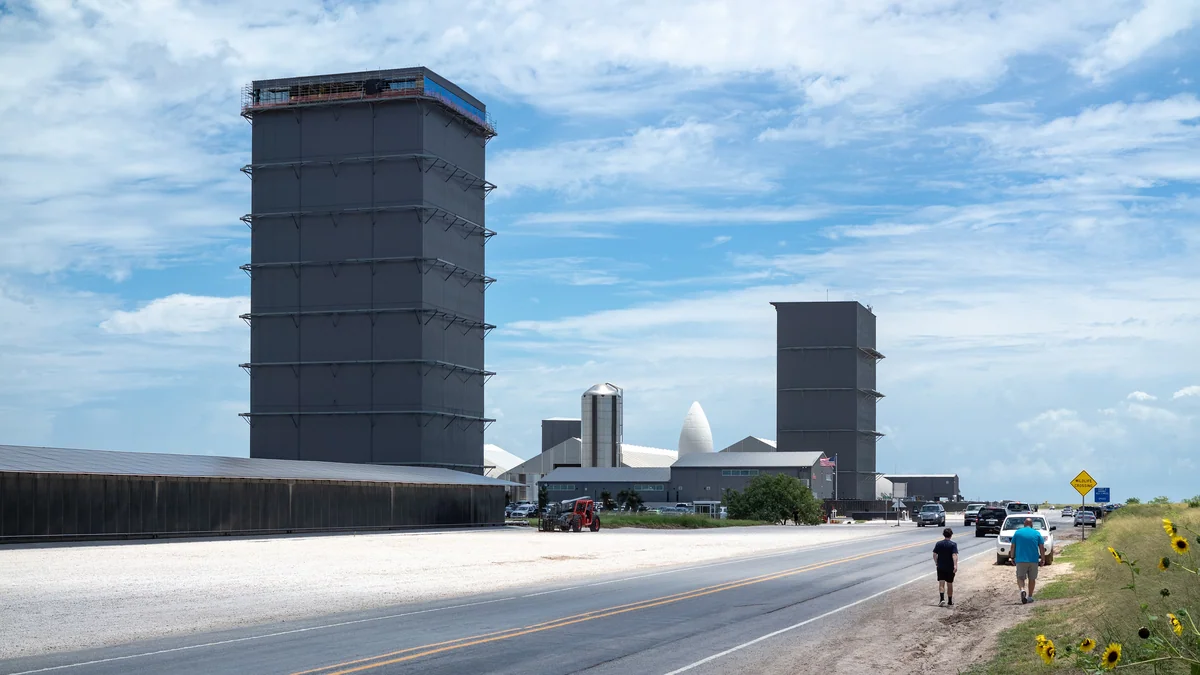
Drive an hour outside Austin and you will find it: a low-profile industrial facility where Tesla and SpaceX engineers work side by side, designing the next generation of AI microchips. Terafab is not a pilot program or a concept paper. It is a live demonstration that the corporate combination, in functional terms, is already underway.
The technological ambition behind the deal becomes clear once you map the assets against each other. Tesla brings robotics and autonomous driving systems, a fleet intelligence capable of processing billions of miles of real-world environmental data. Starlink brings low-orbit telecommunications coverage spanning most of the inhabited Earth. If you integrate those two systems, you get something that no competitor — not a European consortium, not a Chinese state manufacturer — currently possesses: a closed-loop infrastructure connecting terrestrial machines to orbital communications in real time.
Antitrust law was built to discipline markets. It was not designed to govern a superintelligence conglomerate spanning three strategic verticals simultaneously.
SpaceX's acquisition of xAI in February 2026 functions as the connective tissue. xAI is the AI spine through which Terafab's chips, Starlink's data throughput, and Tesla's Optimus robotics would communicate. The result is a conglomerate effect spanning energy generation, ground transport, and global communications. The question this poses is not merely commercial. When a single private entity controls that much physical and digital infrastructure, the socio-economic blueprint for critical systems changes — and regulators on both sides of the Atlantic will need to decide whether their existing frameworks are built to answer it.
Three Jurisdictions, One Conglomerate: The Antitrust Gauntlet Ahead
Legal analysts have mapped the exposure with unusual precision: the proposed deal triggers simultaneous antitrust scrutiny across horizontal, vertical, and conglomerate market dimensions. No single framework covers all three at once. That is not a procedural inconvenience — it is a structural problem for which regulators in Washington, Brussels, and Beijing hold different, and potentially conflicting, tools.
The historical analogy worth examining is AT&T's 1982 breakup, which took a decade of litigation to resolve a far simpler vertical integration question. The Tesla-SpaceX combination is categorically more complex. A single private entity would control autonomous ground transport, orbital communications infrastructure, and AI compute capacity — a combination that existing antitrust doctrine was never designed to evaluate as one coherent competitive threat.
China's State Administration for Market Regulation represents the most structurally unpredictable veto point in this process. Tesla operates significant manufacturing capacity inside China, which gives Beijing both legal standing and geopolitical leverage to delay or condition approval in ways that serve interests well beyond consumer welfare. Unlike the Federal Trade Commission, SAMR operates without the procedural transparency that allows deal architects to game timelines.
The national security dimension compounds the regulatory calculus further. Starlink already functions as critical communications infrastructure in active conflict zones. If that network merges with the company building autonomous vehicle platforms and AI chips at Terafab, the question shifts from market concentration to sovereign risk. Who audits a conglomerate whose failure modes touch both ground mobility and global connectivity?
Antitrust law was built to discipline markets. It was not designed to govern a superintelligence conglomerate spanning three strategic verticals simultaneously.
The Strategic Question Europe Cannot Afford to Defer
Barclays analyst Dan Levy has positioned December 6, 2026 — the Tesla AGM deadline — as the structural forcing function for a resolution. Before that date, an announcement on the final merger architecture could materialize. Yet three critical unknowns remain: the exchange ratio for any all-stock transaction, the full exposure of SpaceX's government contracts with NASA and the Department of Defense, and whether the special committees will recommend full merger or a constrained joint venture.
Europe has no coordinated answer to any of these questions. A $3.5 trillion conglomerate spanning satellite communications, autonomous transport, and AI infrastructure would rival the GDP of several EU member states combined. No single regulatory body — not the European Commission, not the European Space Agency — has mapped a unified response to a private entity of this jurisdictional reach.
The asymmetry is structural, not incidental. If European states cannot agree on a framework before December 6, they will negotiate with this combined entity from a position of dependency, not sovereignty. The Tesla-SpaceX merger is not a corporate event European policymakers can afford to watch from the sidelines — the question is whether they will shape the terms of engagement with this new infrastructure layer, or simply inherit them.