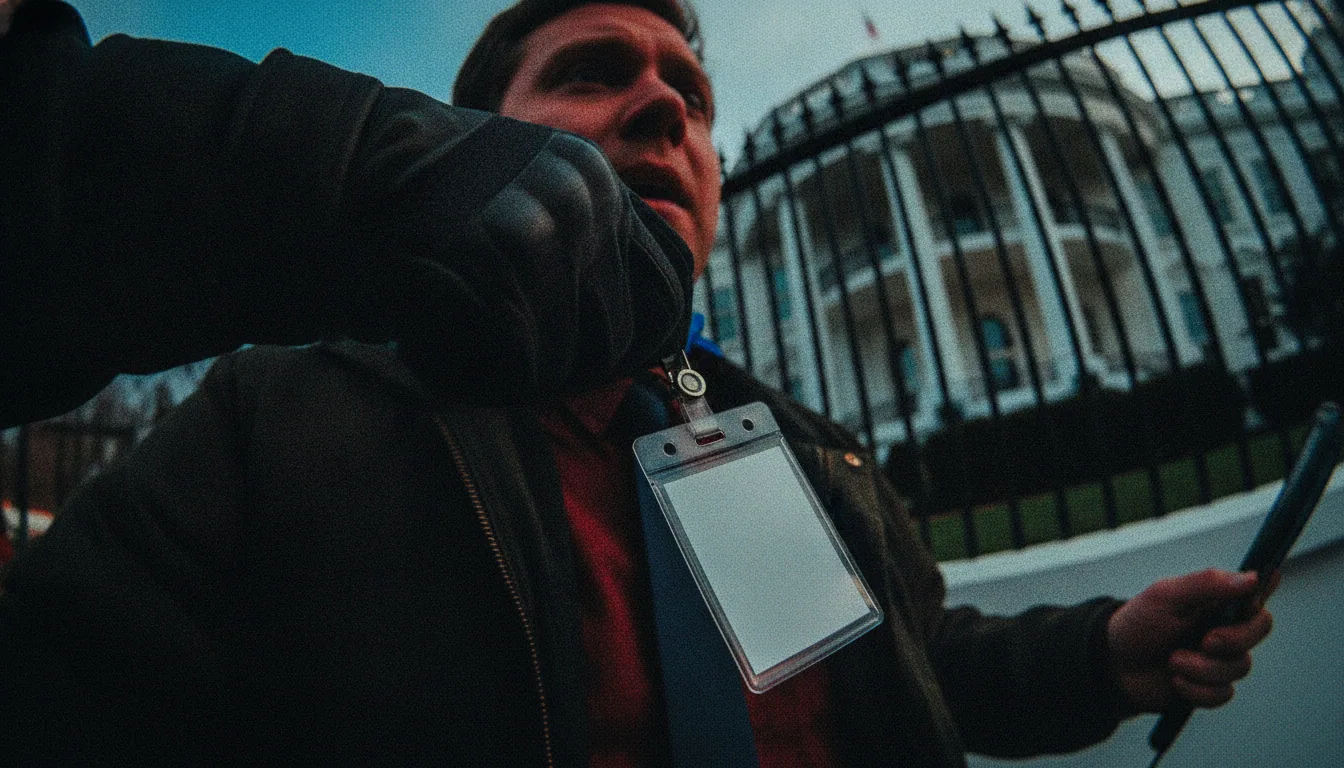
One Word at a Podium, and Then the Searches Begin
On October 13, 2026, the Katie Zacharia bar exam controversy began with a single word. President Trump stood before cameras and introduced Katie Zacharia as an attorney — one word, formal setting, a new White House Press Secretary taking her place at the highest communications podium in the country.
That word sent Judd Legum to the licensing databases.
Legum, writing for Popular Information, searched attorney licensing records across all 50 U.S. states and Washington, D.C. He found nothing. No active license. No record of admission to any state bar under Zacharia's name. Fifty-one jurisdictions. Zero results.
The State Bar of California confirmed it separately. They have no record of Zacharia's admission under either her married name or her maiden name. California matters here because Zacharia graduated from Pepperdine Caruso School of Law in 2011. If she had passed a bar exam anywhere in the United States, California would be the most logical starting point. There is no record there either.
This is the gap at the center of the story. A presidential introduction carries weight. It is not a casual remark at a dinner party. When a president calls someone an attorney in a formal appointment announcement, the reasonable assumption is that someone, somewhere, checked.
A Juris Doctor is a law degree. It is not a law license. The distinction is not obscure or technical — it is the entire difference between studying law and being permitted to practice it. Millions of people hold JDs and are not attorneys. The title matters because the credential it implies is specific, verifiable, and regulated by state bars precisely so the public can trust it.
One word at a podium. Then the searches. Then the silence where a license number should be.
What Her Credentials Actually Say
Zacharia graduated from Pepperdine Caruso School of Law in 2011 with a Juris Doctor. A JD is a law degree. It is not a license. The two are related the way a culinary school diploma is related to running a restaurant kitchen — necessary preparation, not proof of permission.
That same year, she sat for the California bar exam. She failed it. According to the Wall Street Journal, she was preparing for her wedding and an international relocation at the time — context that humanizes the failure but does not change its legal significance. Failing the bar is common; roughly half of first-time California exam takers do not pass. The difference is that most of them do not later describe themselves as attorneys.
After the exam, she moved to Beijing and worked as an associate in the international transaction law department at Zhong Lun Law Firm from 2011 to 2013. She has described this period as practicing "international transaction law, with all the appropriate credentials." That claim deserves scrutiny. China legally prohibits foreign nationals from obtaining a Chinese lawyer license — citizenship is required. Foreign staff at Chinese firms typically hold the status of legal consultant, not licensed lawyer. The distinction is not bureaucratic fine print; it determines what work you are permitted to do and under what authority.
So the credential record, read carefully, shows a law degree earned, a bar exam failed, two years of work at a foreign firm in a country where she could not have been licensed. Popular Information searched attorney licensing records across all 50 U.S. states and Washington, D.C. and found no evidence of Zacharia holding a license anywhere. The State Bar of California confirmed the same — no record of admission under her married or maiden name.
A JD and a bar license are not interchangeable. That distinction is precisely what the next several days of reporting forced into public view.
The Title She Used — and Whether It Was Legal
Between 2024 and 2025, Katie Zacharia listed herself as "general counsel" for Fix California, a nonprofit. General counsel is a legal role. It requires bar admission.
Erwin Chemerinsky, dean of UC Berkeley School of Law, was direct about this: "You can't be a general counsel to a company in the United States unless you're admitted to the bar to practice law." That is not a technicality. It is the definition of the job.
Zacharia has said she received reassurance. Her explanation, reported by Hindustan Times, is that the president of Pepperdine University told her that holding a JD made calling herself a "lawyer" acceptable. That is an informal conversation with a university administrator. It is not a licensing authority. It does not change what the State Bar of California requires.
This is the gap that matters in practical terms. A reassuring word from a senior person in your professional network feels like permission. Professional licensing law does not work on reassurance. It works on registration, examination, and public record.
The White House has not engaged with the specific question of the Fix California title. White House Communications Director Steven Cheung called Zacharia "uniquely qualified" and "whip smart." Those are character endorsements. They do not address whether she was legally permitted to hold the title she held.
For anyone who has ever needed a licensed professional — a lawyer to review a housing contract, an accountant to file a dispute, a doctor to sign a form — the distinction is familiar. Credentials exist so that the people relying on them do not have to take someone's word for it. That is what the piece of paper is for.
When 'China' Became the Answer — and Then It Wasn't
A reporter asked a direct question. On October 13, 2026, during a press availability, someone wanted to know where Zacharia had passed the bar. Her answer came quickly: "When I moved to China."
It was a specific claim. China has bar exams. Chinese law firms hire foreign lawyers. Zacharia had worked at Zhong Lun Law Firm in Beijing from 2011 to 2013, so the geography at least made sense on the surface. But there was a problem built into the answer that anyone with access to Chinese legal licensing rules could find within minutes.
Foreign nationals cannot obtain a Chinese lawyer license. Chinese law requires citizenship. A foreign associate at a Beijing firm works as a legal consultant, not a licensed lawyer. The New York Times reported this clearly: the "China" answer was, as a factual matter, legally impossible.
Then came the second explanation. Zacharia told reporters she had misheard the question because of noise from Marine One. The helicopter was nearby. She thought she was being asked something else entirely, she said, and "China" was the answer to a different question.
You can follow the sequence and notice what it contains. First, a confident and specific answer. Then, after the legal impossibility of that answer became public, a retraction built on ambient noise.
The first explanation had the wrong facts. The second explanation had no facts at all, only a reason not to hold the first one against her.
Both answers landed on the same day the searches of all 50 U.S. state licensing records came back empty.
A Formal Complaint and What Comes Next for Katie Zacharia
On October 15, 2026, the Campaign for Accountability filed a formal complaint with the State Bar of California. The complaint centers on Zacharia's time as "general counsel" at Fix California, the nonprofit she joined in 2024. The allegation is straightforward: she held a legal title, in a legal role, without a license to practice law in California or anywhere else.
State bars take unauthorized practice of law complaints seriously, at least on paper. When a private citizen does it, prosecution is common. When a public figure does it, the process tends to move more slowly, with more scrutiny of intent, context, and whether actual legal advice was given to clients. The bar's investigation will likely turn on exactly what Zacharia did day-to-day at Fix California, not just what her business card said.
What nobody has answered yet: whether she ever sat for a bar exam in any state besides California. Whether the White House vetting process asked for bar records. Whether anyone reviewed her licensing status before the president called her an attorney on national television. These are not small gaps. A credential check for a senior White House appointment should take an afternoon.
Compare that to other credentialed appointments. Cabinet secretaries list their bar numbers. Legal advisors provide active membership records. The system has a normal gear, and it runs fine when someone uses it.
The State Bar of California will now do what the White House apparently did not: check the record, ask the questions, and issue a formal finding. The Katie Zacharia bar exam controversy — and the unlicensed practice question it raised — may not be resolved for months. But the complaint exists, and the door that should have been checked before the podium introduction is now being checked from the outside.