A Number That Has No Business Being This Large
Twenty-three zettajoules. Hold the number for a moment, because it is not going to mean anything on its own. A zettajoule is ten to the power of twenty-one joules, which is the kind of figure that exists only in physics textbooks and the more unsettling corners of climate science. So let's try it another way: in the year ending September 2026, the world's oceans absorbed roughly 40 times the total energy consumed by every human being on Earth, in every factory, every car, every lightbulb, every phone, combined, across an entire year. That is not a rounding error. That is a planet running a fever.
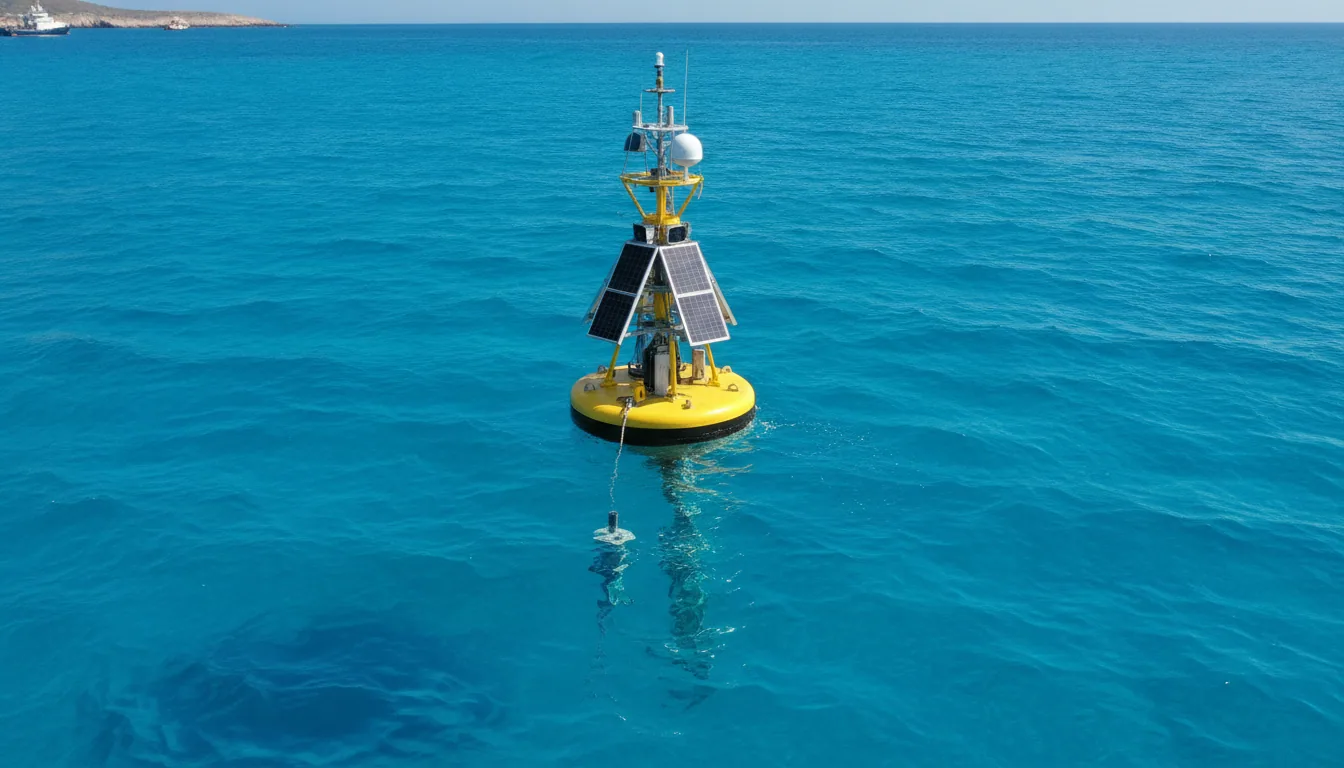
The number comes from the Copernicus Marine Service and Mercator Ocean International, who released their findings on September 30, 2026. This is not a model projection or a computer simulation. It is a measurement, drawn from a global array of satellites, Argo floats, and ocean buoys that together constitute the most comprehensive monitoring system the ocean has ever had.
The 40-times comparison is useful, but it has a seam worth naming: human energy use is a flow, burning and releasing, while ocean heat is an accumulation, stored and compounding. The analogy illuminates the scale; it does not quite capture the patience of the ocean's arithmetic. And the surface of that arithmetic is now visible to anyone watching. On August 22, 2026, the global average sea-surface temperature reached 21.11 degrees Celsius, a record high in the history of reliable ocean measurement. It is one number inside a larger number inside a trend that, when you finally see the shape of it, does not look like noise.
Why the Sea Has Always Been the Planet's Quiet Heat Sink
Water is stubborn about temperature. To raise one kilogram of it by a single degree Celsius, you need to deliver roughly four times the energy required for the same job on a kilogram of rock. Physicists call this high specific heat capacity; the everyday picture is a pot that takes forever to boil. That stubbornness, scaled to the volume of a global ocean, produces what scientists call thermal inertia: the sea absorbs enormous quantities of heat while barely registering a change on the thermometer. For decades, this property has quietly saved us from ourselves.
Oceans currently absorb around ninety percent of the excess heat that human greenhouse gas emissions trap in the climate system. Without that buffer, atmospheric temperatures would have climbed far faster and far higher than they have. Scientists began piecing this picture together seriously in the 1980s, when oceanographers studying long-term heat budgets realized the atmosphere alone could not account for where all the energy was going. The sea, it turned out, was swallowing the fever.
Then came 2026. The long baseline of human-driven warming had already been loading heat into the ocean for generations. Layered on top of that baseline arrived the 2026 Super El Niño, a periodic shift in Pacific wind patterns and warm surface water that acts as an amplifier, not a cause. The distinction matters. El Niño is a natural oscillation; what it amplified in 2026 was anything but natural. The result was record sea-surface temperatures reached during months when the ocean historically cools, suggesting the buffer itself is straining under the weight of what we have asked it to carry.
The 2026 Oceanic Heat Absorption Record: When 82 Percent of the Sea Is Running a Fever
By the end of June 2026, 82 percent of the world's ocean surface was experiencing a marine heatwave. Not 8 percent. Not even 28 percent. More than four in every five square kilometres of sea, simultaneously running hot. The first anomaly in this story was a number; here is the second one.
A marine heatwave is not a wave in the physical sense. It is a period when sea temperatures stay significantly above their historical range for five days or longer, sometimes weeks. The Mediterranean offers the clearest case study: the sea has warmed by 0.32 °C per decade, and in 2026 that cumulative heat pushed deep-water heatwaves that persisted for over a month. That last detail matters. Deep water takes far longer to warm than the surface, so when it goes, you know the heat has lodged itself somewhere the ocean cannot easily shake.
Pierre Bahurel, director general of Mercator Ocean International, put it simply: "The ocean is transforming before our eyes." This is worth pausing on, because Bahurel is not a headline writer. He leads the team that runs the monitoring infrastructure. When an engineer talks this way, the number behind it is real.
What the heat does to life underwater is not subtle. Between January 2023 and September 2025, 84 percent of global coral reefs experienced bleaching-level heat stress. Coral bleaching is the animal equivalent of a fever so high the body ejects its own immune system. The coral expels the symbiotic algae that give it colour and energy, turns white, and begins to starve. At Level 5 alert, as raised for the Florida Keys in September 2026, the question shifts from whether a reef bleaches to whether anything survives.
The practical consequence reaches further than the reef itself. Reefs shelter roughly a quarter of all marine species, buffer coastlines from storm surge, and feed hundreds of millions of people. A fevered ocean is not a remote ecological problem.
A planet absorbing 40 times humanity's annual energy use does not look like noise.
The Chemistry Is Quietly Changing Too
Heat is not the only thing the ocean absorbs. Every year, the sea pulls down roughly a third of the carbon dioxide humanity releases into the air. It is a service so vast it is easy to take for granted. The process works like this: CO2 dissolves into seawater the way it dissolves into a soft drink, a slow and silent fizz that forms carbonic acid and nudges the chemistry of the whole ocean downward in pH.
That nudge, over four decades, has added up to a 17 percent increase in ocean acidity. Seventeen percent sounds moderate until you understand that pH is a logarithmic scale, so a shift that reads small on paper represents a genuinely large chemical reorganization. Shells soften. Coral skeletons thin. The animals that built the shallow-water reefs for hundreds of millions of years now struggle to build anything at all.
In 2025, acidification crossed what researchers call a planetary boundary — think of it as a guardrail, a quantified threshold beyond which the Earth system behaves in ways that threaten the conditions life evolved to expect. Planetary boundaries are not cliffs; crossing one does not mean immediate collapse. But it does mean we are operating outside the envelope of the last ten thousand years of human civilization.
Whether the ocean chemistry can recover, and on what timescale, remains genuinely open. We do not yet know. That uncertainty is not a comfort. It is a question still looking for its answer.
The Consequences That Come Ashore
The sea rises 4.2 millimetres every year. That sounds like nothing. Over a decade it becomes four centimetres; over a century, on a beach already softened by storms and subsidence, it becomes the argument for whether to rebuild or retreat. Marine ecologist Ángel Borja at the Basque institute AZTI has watched the Mediterranean coast for long enough to say plainly what the data show: "Some people insist on rebuilding in places that will undoubtedly disappear." The grief in that sentence is not poetry. It is a surveyor's report.
The ocean's heat does not stay in the water. Warmer seas accelerate the chemistry of air pollution, triggering what atmospheric scientists call the ozone-climate penalty — the mechanism by which heat and sunlight cook ground-level ozone out of ordinary vehicle exhaust and industrial fumes. In 2026, that penalty was collected from more than one-third of humanity, roughly 2.5 billion people breathing air that failed basic safety thresholds. Compare that to 1990s projections of a warming world, which worried mostly about floods and droughts. Nobody modelled a planetary fever that redrew the air quality map of every continent at once.
Ecology, meanwhile, is sending its own signals, and they carry economic weight. Mackerel are moving steadily north as European waters warm; octopus have begun appearing in UK coastal waters where they were rare before. Those are not curiosities for a nature documentary. They are leading indicators for fishing fleets, processing plants, and coastal towns whose livelihoods were built around species that are quietly relocating their range by hundreds of kilometres.
Then there is the image that resists being framed as data. Four emperor penguin colonies in Antarctica recorded total breeding failure following record-low sea ice. Not reduced productivity. Not a difficult season. Zero chicks. The scale of what the ocean is carrying announces itself, sometimes, not in zettajoules, but in empty ice.
What the Record Does — and Doesn't — Tell Us
The 2026 ocean heat absorption record arrives at COP31 like evidence at a trial. It doesn't argue; it simply sits there. Delegates in November 2026 will need to decide what a planet absorbing 40 times humanity's annual energy use actually demands of policy, which is a different question from what the physics demands of the ocean.
Here is the honest ledger of unknowns. Scientists cannot yet pinpoint when the ocean's thermal inertia — its deep, buffering patience — will be overwhelmed, triggering sharper atmospheric spikes than the sea has so far absorbed. The recovery potential of coral reefs currently at Level 5 bleaching alerts remains genuinely open. And the timeline for the 2026 Super El Niño to transition toward a neutral phase is still unresolved.
That isn't a failure. Every era has believed it understood the world, and every era has been partly, gloriously wrong; that is the engine, not the breakdown. The 23-zettajoule figure is a rung on a ladder, not the ceiling. The better question — the one science hasn't answered yet — is how many rungs remain.