Erbil, September 30: The Arithmetic of an Exit from Iraq
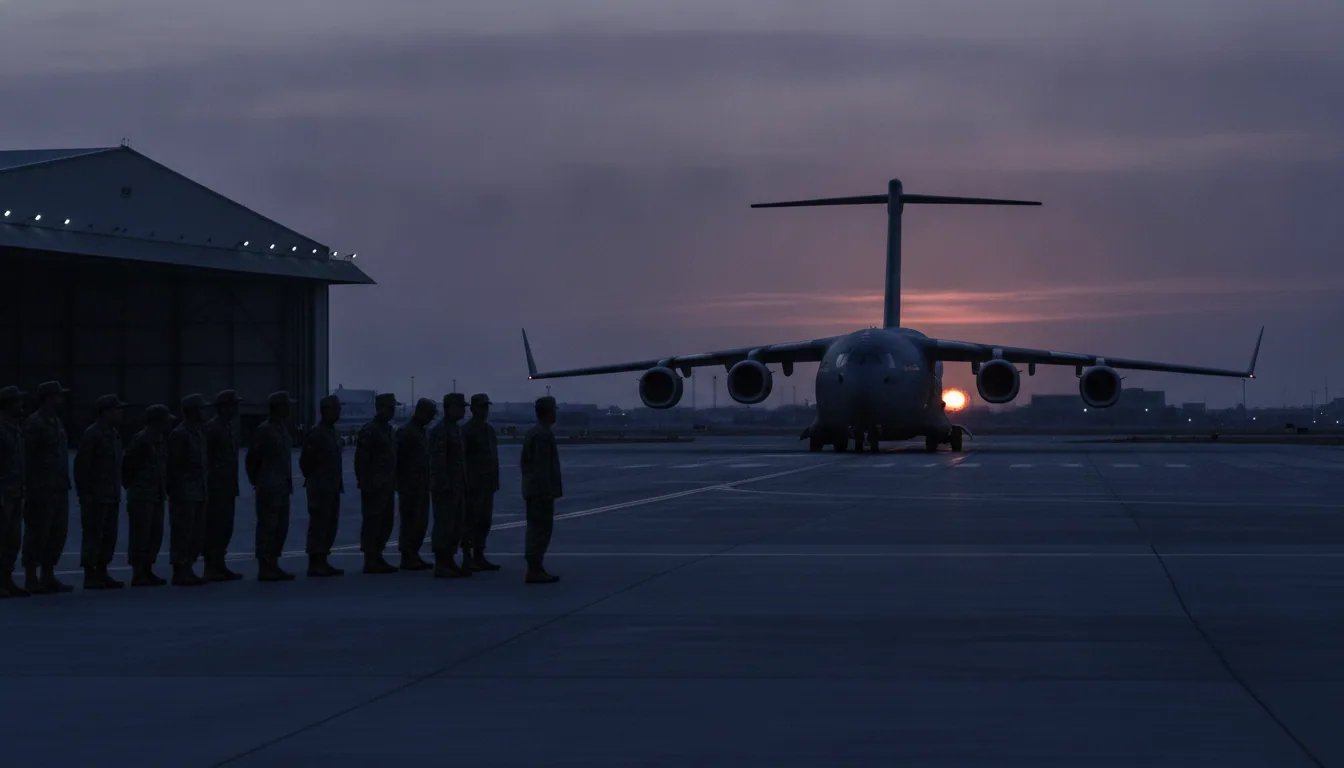
The last American flight out of Saigon carried 58 people and a great deal of unfinished business. The comparison to Iraq is lazy, and here is exactly where it breaks: no helicopter rooftops, no collapsing perimeter, no visible rout. What happened at Erbil Air Base on September 30, 2026 was orderly, scheduled, and photographed with the composed dignity of a ceremony.
That is a different kind of story, though not necessarily a simpler one.
The numbers are what they are. Twenty-three years after the 2003 invasion opened the account, the US withdrawal from Iraq was formally complete. The final 2,500 troops, serving in advisory roles, departed through Erbil in the Kurdistan region — the last operating hub of a presence that had outlasted four American presidencies.
Operation Inherent Resolve, the anti-ISIS mission that began in 2014, ran for twelve years before its colours were cased.
Four thousand four hundred and eighteen US personnel were killed in the 2003-2011 occupation phase. Another 123 died during the Inherent Resolve years, fighting a war that grew from the ruins of the first one. Somewhere a spreadsheet was quietly updated.
Baghdad declared October 1st Sovereignty Day. The date is arithmetically correct: the troops are gone, the base is empty, the bilateral security partnership — whatever that means in practice — begins now. The question the arithmetic cannot answer is what fills the space that 23 years of presence, however contested and however costly, had previously occupied.
That question is not rhetorical. It has a structural answer, and several interested parties have already drafted it.
The Accord That Two Presidents Signed
The legal architecture behind September 30 was assembled in stages, across two administrations, and its authorship matters. The joint US-Iraq statement of September 2024 was a Biden initiative: a formal timetable for ending Operation Inherent Resolve, negotiated with Baghdad as the price of a functioning bilateral relationship.
Trump inherited the document and, in July 2026, stood beside Prime Minister Ali al-Zaidi at the White House to announce the final withdrawal timeline. Both men claimed the outcome as their own. Both were correct, which is the kind of bipartisan clarity Washington rarely manages.
The accord's mechanism was a two-stage architecture. The coalition's combat mandate in Iraq ended first; the logistics corridor supporting residual Syria operations ran until 2026. What replaced it, in the official language, was a bilateral security partnership and intelligence-sharing arrangement, 2,500 advisory troops converted, on paper, into something called a "partnership architecture."
Qasim al-Araji, Iraq's National Security Advisor, was careful to say the end of the mission did not mean the end of the relationship. The Pentagon's framing was identical: not a termination, a transformation.
The distinction is load-bearing only if the new arrangements carry weight under pressure. A bilateral security agreement is a document; 2,500 troops stationed in country are a fact on the ground. The difference between those two things is precisely what the coming months will test.
Watch the intelligence-sharing provisions: if the classified annexes remained operative after the last flight left Erbil, the transformation argument has something behind it. If they quietly lapse, the communiqué will have done what communiqués are built to do.
Sovereignty Day, and the Flag That Took Twenty-Three Years
Iraq declared October 1 a national holiday. The name chosen was Sovereignty Day — a public claim of full territorial control, timed to follow the last American departure by exactly one day. The timing is deliberate; so is the name.
What the holiday asserts is worth examining plainly. The Iraqi government is telling its citizens, and its neighbours, that the question settled itself on September 30, 2026. Twenty-three years after the 2003 invasion opened the file, the file is closed.
The gap between the declared date and operational reality is the more useful number. Qasim al-Araji, the national security advisor, said plainly that the end of the coalition mission does not mean the end of the partnership. That statement, issued in the same week as the Sovereignty Day announcement, quietly contradicts the holiday's premise.
You do not celebrate a clean break and negotiate its continuation in the same breath.
The practical question for any reader is this: what changed on October 1, and what did not. What changed is the flag over Erbil Air Base. What did not change is the bilateral security agreement, the intelligence-sharing arrangement, and the 2,500 advisory personnel who were present until the final week.
The holiday names a condition Iraq intends to reach. Whether the bilateral partnership is the scaffolding toward that condition, or a polite way of deferring it indefinitely, is the question the communiqué was built not to answer.
The Borderland the Base Protected
Erbil Air Base was not simply a transit point. It was the fixed point around which Kurdish security calculations rotated for twelve years, a physical guarantee written in concrete and fuel lines that no diplomatic communiqué could fully replicate. When the last American flight departed on September 30, it took that guarantee with it.
The asymmetry of the closure is the fact the official celebration in Baghdad quietly buries. For the Iraqi government in the capital, the departure is a sovereignty dividend, long promised and finally paid. For the Kurdistan Regional Government, it is something closer to exposure.
The Peshmerga now hold a perimeter without a confirmed anchor, in a neighborhood that includes Baghdad's federal ambitions, Turkish cross-border operations, Iranian Revolutionary Guard proxies, and whatever ISIS cells survived the twelve-year campaign that Erbil itself helped direct.
No replacement security guarantor has been named. The bilateral partnership announced at the White House in July 2026 speaks of intelligence sharing and continued cooperation — language that belongs to the decorative register, not the load-bearing one. A Peshmerga commander does not call in close air support from an intelligence-sharing framework.
The soft fact the wire buries is simple arithmetic: Kurdish security exposure increases in direct inverse proportion to the official celebration unfolding two hundred miles to the south. Baghdad gains a flag to raise on Sovereignty Day. Erbil inherits the silence where the aircraft used to be.
Erbil inherits the silence where the aircraft used to be.
The Beneficiary the Communiqué Does Not Name
The Islamic Resistance in Iraq did not wait for the dust to settle at Erbil. Its statement arrived within hours: a strategic victory, a vindication. The group's candour was, in its way, more informative than the Pentagon's press release.
Security analysts had named this outcome before the last C-17 lifted off. The formal US step back created a vacuum in the northern operational corridor, and the history of such vacuums in Iraqi political space is consistent: every departure since 2011 has corresponded with an expansion of Iran-aligned influence in Baghdad's cabinet calculations, its intelligence services, its streets. The mechanism is not mysterious.
When the external guarantor leaves, the parties who remained and who will remain negotiate the new distribution of weight. The Islamic Resistance in Iraq has been present continuously; the 82nd Airborne has not.
Compare the position now to 2011, when the Obama administration withdrew the last combat brigades. The following two years saw Iranian-backed factions consolidate leverage over Iraqi security ministries that the surge had briefly interrupted. The 2026 exit is structurally similar, and smaller in troop numbers — 2,500 advisory personnel against tens of thousands in 2011 — which means the leverage shift may be proportionally faster.
Analysts hoping the bilateral security partnership fills the gap are betting on a document against an organisation with guns and a constituency.
Concurrent stalling in US-Iran negotiations over the Strait of Hormuz added one more variable. Oil markets read the combination — withdrawal plus deadlock — as a premium risk, and priced accordingly.
The Strait negotiation and the Iraq exit are formally separate files. The timing, at minimum, is convenient for one side.
Jordan, a Spreadsheet, and the One Marker Worth Watching
Some 2,500 personnel held the advisory mission together at its end. The units now repositioned to Jordan represent the arithmetic of over-the-horizon doctrine: presence replaced by reach, the base replaced by the sortie radius. The Pentagon has sold this logic before.
It sold it in 2011, and by 2014 the Islamic State held Mosul.
The bilateral security partnership that replaces physical presence rests on undisclosed terms. How many contractors remain, what intelligence infrastructure survives, which equipment was transferred to Iraqi Security Forces at Erbil rather than flown out: none of this has been published. A communiqué that cannot name its own load-bearing walls is worth reading carefully.
The one marker that matters is legal, not military. The Baghdad Security Accord was an executive arrangement, negotiated between governments and signed without parliamentary ratification in Baghdad. The Iraqi parliament has not voted on the bilateral framework that replaced it.
That distinction is decorative until the next militia offensive, at which point it becomes structural: an unratified agreement gives any future government, or any Iran-aligned bloc with sufficient seats, the procedural instrument to void the partnership without a shot fired.
Watch for a parliamentary vote on the bilateral framework. If it comes, and passes, the partnership has a foundation. If the executive arrangement simply persists, unratified and quietly renewed, then what was declared on September 30 as a completed US withdrawal from Iraq is, by the evidence, something else.