A Discovery That Has No Skeleton
The genetic heritage of lost ancestors surfaced in the human genome this past July — and it left no bones. Researchers at UC Berkeley announced the identification of two previously unknown archaic groups woven into modern human DNA, groups that lived and mattered and vanished without leaving a single fossil we can point to. We know they existed only because their code is still inside us, a statistical shadow cast by ancestors who otherwise escaped the geological record entirely.
This is what scientists call a ghost ancestor. Not a metaphor, an actual technical category: a population whose existence is inferred purely from the shapes left in living genomes, the way you can deduce a missing puzzle piece from the silhouette it leaves in the surrounding pieces. The ghost was real. The bones just never arrived.
That these ghosts could be found at all is largely the achievement of one field and one milestone. When Svante Pääbo received the Nobel Prize in 2022 for sequencing the Neanderthal genome, it marked the moment paleogenomics — the science of reading genetic material from extinct species — became legible to the wider world. The tools he and his colleagues built at the Max Planck Institute for Evolutionary Anthropology made it possible to treat ancient DNA like a document rather than a relic.
What those documents are rewriting is the whole story. The old picture, a tidy march of one species replacing another, is gone. In its place stands what researchers now call the braided stream model: human lineages did not flow in a single channel but split, ran parallel, looped back, and merged. Repeatedly.
The genome is not a clean inheritance from a single source. Here is the strange part. It never was.
The Percentages That Should Not Exist
Pick up any non-African human being on this planet and sequence their genome. Somewhere between 1.5% and 2.1% of what you find will be Neanderthal. That fraction sounds modest. It is not.
The human genome contains roughly 3.2 billion base pairs. Two percent of that is 64 million nucleotides — a library of ancient code, line by line, embedded in living tissue. Every cell in your body copies it faithfully when it divides. That is not a trace. That is a chapter.
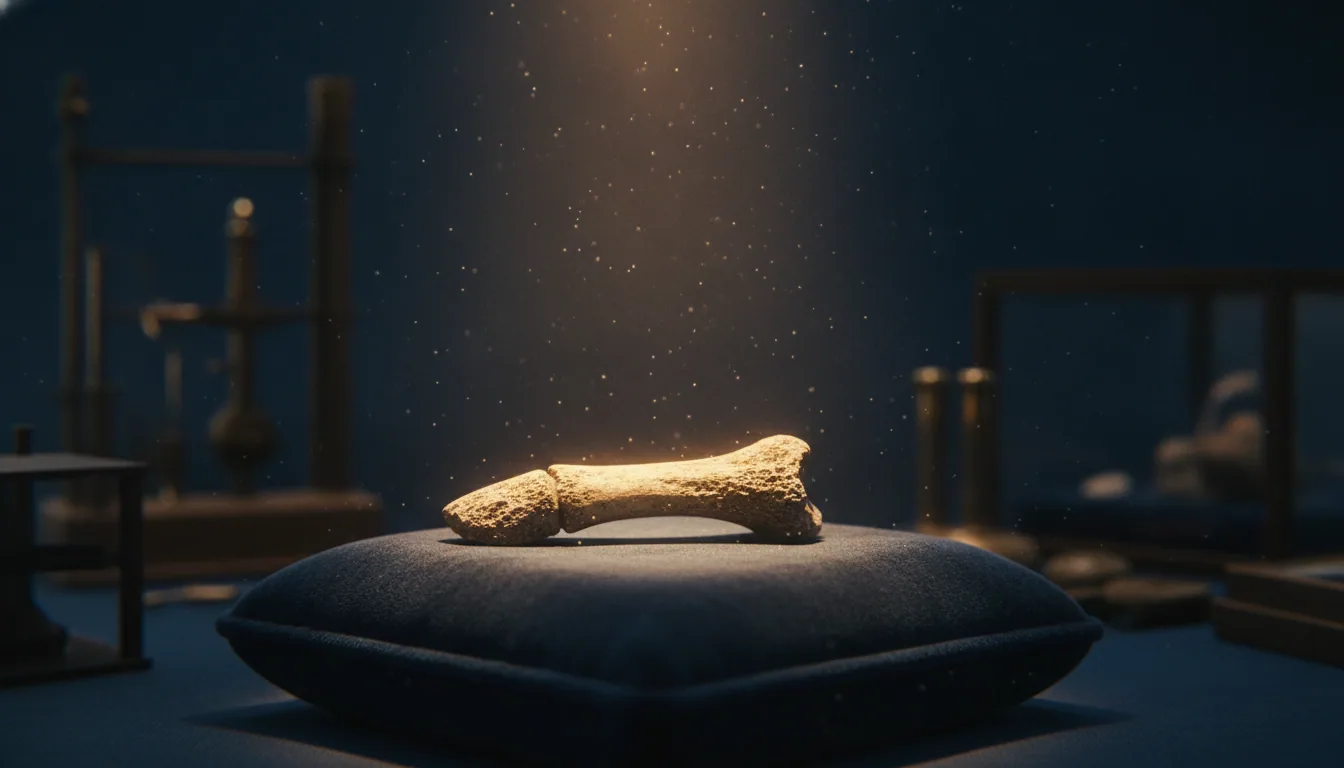
Move to populations in Oceania and Southeast Asia, and the numbers climb further. People of Papuan and Aboriginal Australian descent carry between 3% and 5% Denisovan DNA — a separate archaic lineage, known from a fragment of a finger bone found in a Siberian cave. At 4%, we are talking about 128 million base pairs of a people who left almost no fossil record. They exist, overwhelmingly, inside us.
The mechanism that put them there is called introgression. The word sounds clinical, and geneticists use it deliberately: it strips away any implication of accident or contamination. Introgression means a documented, heritable transfer of functional genetic material between populations through interbreeding.
These are not copying errors. Not noise in the sequencing read. Working genes, inherited across species boundaries, that have been selected and retained because they did something useful.
The genome is not a museum. It is a tool chest, and some of the most reliable tools in it are 50,000 years old and arrived from a species we can no longer name.
Species Without Faces: The Deeper Ghosts
Neanderthals and Denisovans at least have names. Some of our ancestors have neither name nor face nor a single surviving bone. They exist only as a signal in the noise of the genome, a statistical whisper that says: something was here, and it was not quite us.
Around 1% of the modern African genome traces to one such ghost, a lineage that interbred with our ancestors more than 50,000 years ago. No skull, no jaw fragment, no campfire ash. Just code.
And because Africans were long treated as a baseline in human evolution studies rather than a population with their own complex archaic history, this ghost went unnoticed for years. That is its own kind of lesson.
The deeper the researchers look, the stranger it gets. Paleoproteomics — the reading of ancient proteins rather than DNA (proteins survive far longer in warm climates where DNA decays) — has now confirmed that Homo erectus interbred with Denisovans roughly 400,000 years ago. So the Denisovans themselves were already a braided cord, not a single thread.
And Denisovans themselves may now have a face. Dragon Man, Homo longi, a massive-browed skull found in China and formally described in 2021, has emerged as a serious candidate for the physical form the Denisovan lineage wore. We sequenced Denisovans from a finger bone the size of a pebble. We may have been staring at their face in museum drawers for decades.
The absence of fossils, then, is not the absence of evidence. It just means the evidence is running in your bloodstream instead.
Ancient Code, Living Consequences: An Archaic DNA Legacy Still Active Today
Picture a Tibetan herder moving her yaks across a plateau at 4,500 meters, where the air holds roughly 40% less oxygen than at sea level. Most lowland humans at that altitude grow sluggish, their blood thickening dangerously as the body panics and overproduces red cells. She does not.
The reason sits in a single gene called EPAS1, a molecular dial that controls how the body senses and responds to oxygen. She inherited that dial's precise calibration not from her parents' culture or her childhood of hard climbing, but from the Denisovans — a ghost species that vanished from the fossil record while quietly leaving this one exquisitely functional gift in her genome.
EPAS1 is the most vivid example, but it is not the only one. Irene Gallego Romero, working at the University of Tartu, has traced how Denisovan sequences tune immune-system genes, sharpening a modern population's ability to recognize and fight pathogens it had never previously met. Think of it as borrowed field notes: the Denisovans spent tens of thousands of years in environments that modern humans were just beginning to enter, and their hard-won molecular experience traveled forward in the DNA.
Archaic sequences also shape skin pigmentation, hair texture, and blood-clotting pathways in populations alive today.
The inheritance is not a clean gift, though, and this is the part that asks something of us. The same archaic variants that once conferred advantage are now linked to elevated risk of type 2 diabetes and, in some populations, worse COVID-19 outcomes. That is not a design flaw or an evolutionary mistake.
It is a trade-off: a gene favored in one environment, under one set of pressures, finds itself in a different world entirely. The ancient code runs faithfully. The world has simply changed around it.
Why Estonia Ended Up at the Center of This Story
Most countries in this story are famous for their fossils. Estonia is famous for something quieter: its living people carry an unusually dense inheritance from Stone Age hunter-gatherers, more than most other European populations. The continent was reshaped by farming migrations that diluted that older signal almost everywhere else.
Estonians, sitting at a geographic crossroads where those waves arrived late and mixed unevenly, preserved a genetic anchor that researchers can use the way a surveyor uses a benchmark. That made Tartu an obvious place to build.
The University of Tartu Genomics Institute, led by evolutionary genomicist Mait Metspalu, has grown into one of Europe's genuine hubs for this kind of work. The tool that makes it legible is Principal Component Analysis, a statistical method that collapses thousands of genetic variants into a map where distance means difference. Plot ancient hunter-gatherers, early farmers, Bronze Age steppe migrants, and modern Estonians on one chart and you can watch the braiding happen across millennia, population by population, in two dimensions.
Researcher Christiana Lyn Scheib recently secured a 1.5 million euro European Research Council grant to push the question further, specifically into how ancient DNA shaped the immune system across generations. The money is significant, but the location is the point.
When you want to understand what the deep past left in living bodies, you go where the deep past left the most. Right now, that is partly here, in a small country with an outsized genomic memory.
The Right to Not Know — and Everything We Still Don't
In early 2026, an unauthorized third party accessed the genetic test results of Horizon and Vistara customers, names and lab IDs included. The cost of curiosity, it turns out, is not only philosophical. It is now also a question of who else gets to read your ancestral code.
The irony runs deep. We are only beginning to count our extinct relatives. The exact number of archaic species woven into the modern human mosaic remains an open figure; beyond Neanderthals, Denisovans, and the newly identified Berkeley ghost groups, the tally keeps growing.
And those Berkeley ghosts offer no face, no homeland, no name — only a statistical signal in modern DNA, a whisper with no mouth.
That is where science stands in 2026: precise enough to find a species inside you, not yet able to tell you what it looked like. You carry the genetic heritage of lost ancestors — chapters of a story that no one has finished translating. The question is not only what we will learn next. It is whether we are ready for the answer.