Five Years in a Dish, and the Tissue Still Knows What Time It Is
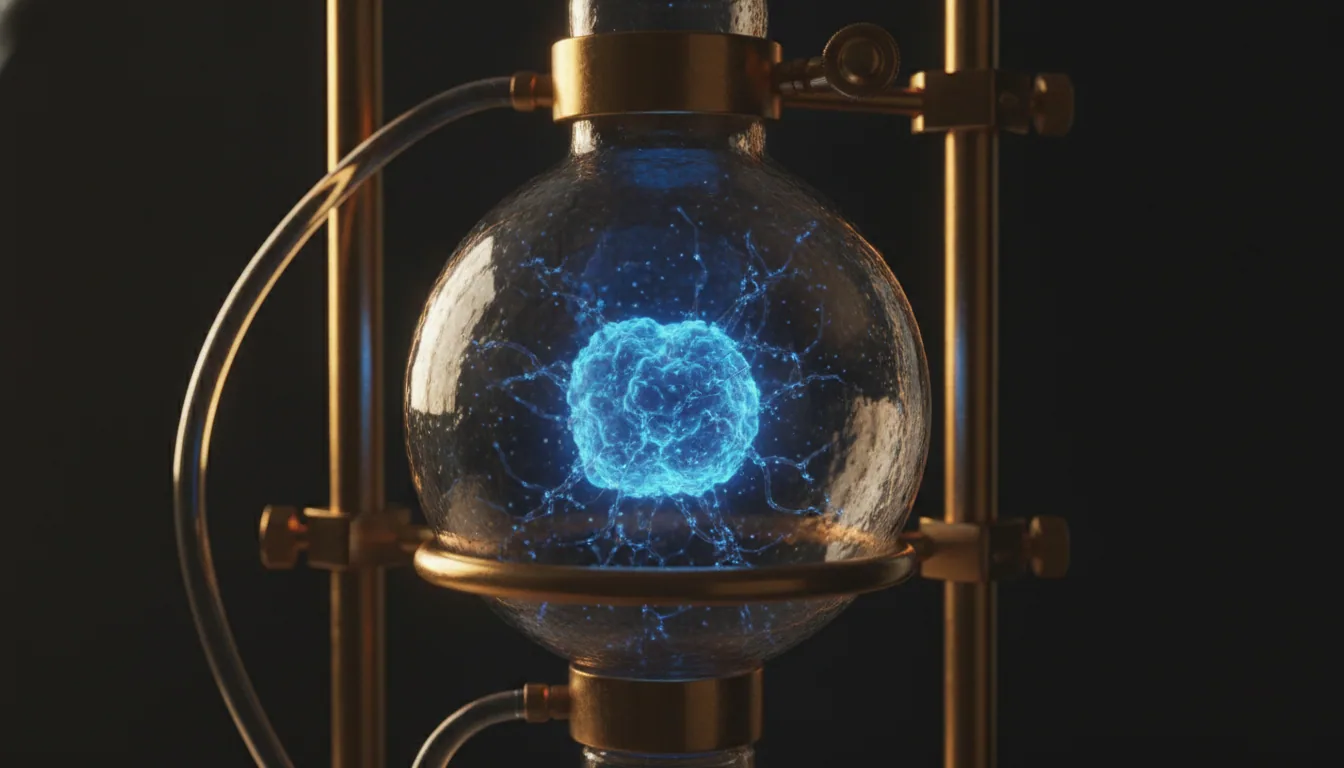
Take a peppercorn. Hold it between your fingers. Now imagine that peppercorn contains over one million human brain cells — a working demonstration of biological timekeeping — grown from a stranger's blood, sitting in a laboratory dish, ticking quietly through time. Not metaphorically ticking. Actually tracking the passage of years, replaying the molecular script of human brain development in strict chronological order, with no body around to tell them what day it is.
That is what Paola Arlotta's team at Harvard University reported in Nature in August 2026. They had kept human brain organoids alive for more than five years — 1,825 days, roughly three times the previous record of 694 days set in 2021.
The number alone is striking. What the organoids did with that time is stranger still.
To grow one, researchers take blood from a donor, reprogram those blood cells backward into pluripotent stem cells, essentially resetting them to a state of pure developmental potential, and then guide them forward along the path toward cerebral cortex tissue. The resulting clusters are small enough to sit on a fingernail. Each one holds more than a million cells organized with enough fidelity to recapitulate the layered architecture of the human cortex.
Here is the strange part. Nobody scheduled these cells. No hormone signal from a developing body reached them, no neural feedback from a beating heart, no environmental cue most biologists would consider essential.
And yet the organoids proceeded through developmental milestones in the correct order, at roughly the correct pace, as if they carried an internal calendar and intended to keep it. The question worth asking, before we ask anything else, is how.
The Molecular Calendar: Chemical Tags That Record Every Day of Development
Every cell in a developing human brain carries something like a logbook. Not written in ink, but in chemistry: tiny molecular tags, called methyl groups, that attach to specific points along the DNA strand and flip genes on or off according to a strict chronological schedule. This process, DNA methylation, acts as a reliable epigenetic clock, mirroring the molecular steps of human gestation and early life so faithfully that a researcher who reads the pattern can tell, within a narrow window, how far along development has traveled.
When Paola Arlotta's team at Harvard compared the methylation signatures of their five-year organoids against known human developmental benchmarks, the match was striking. "The methylation clock told us that these organoids were basically doing things that the endogenous brain would do," Arlotta said. The tiny peppercorn of cells was not drifting or stalling; it was following the same molecular calendar as a brain growing inside a skull.
Then came the result that made even the researchers pause. When older organoid cells were combined with younger ones, the older cells did not simply sit alongside their junior neighbors. They skipped ahead, jumping to developmental stages they had not yet reached, as if the presence of less-mature tissue reminded them how far they still had to go.
Arlotta called it a "time warp." The implication is precise: these cells hold a memory of elapsed time, and that memory is chemically encoded, not lost when the tissue is moved or manipulated.
The logic runs deeper than any single lab. Estonian researcher Kärt Mätlik has mapped a molecular clock operating across brain development more broadly, finding that specific genes must activate at specific moments. Arrive too early or too late, and the consequences can include autism or intellectual disabilities.
The clock is not decorative. It is load-bearing architecture, and getting the timing wrong collapses the structure.
Clocks All the Way Down: Biological Timekeeping From Neurons to Cyanobacteria
The brain organoid is a spectacular timekeeper, but it is not the only one. Biological timekeeping is not one clock — it is a nested system of oscillators, from the organelle to the organism, each one ticking at its own scale and lending its signal to the whole.
Consider what researchers at UC Merced managed to do with cyanobacteria proteins: they built synthetic cells from scratch and watched those cells sustain a clean, reliable 24-hour rhythm for four days. No nucleus. No nervous system.
Just proteins cycling through a molecular loop, counting out circadian time as faithfully as any living thing. The implication lands quietly but hard: the logic of biological clocks is so fundamental that it survives being stripped down to its bare chemical skeleton.
Now step back into a living, breathing body. Three minutes of all-out sprinting produces immediate, dramatic changes in the molecular composition of blood — a full-body timestamp written in real time by the effort of moving fast. The body does not merely respond to exercise; it records it, chemically, in a way that outlasts the gasping.
And then there is heat. Older adults experience significant heat stress at a temperature rise of just 1.5 degrees Celsius. Younger adults only cross a comparable threshold at four degrees warmer.
That gap is not a failure of fitness. It is biological age rewriting the body's relationship to physical time — altering how fast the environment feels, how urgently the system has to respond.
One clock. Thousands of clocks. They run in parallel, and they are all keeping score.
Reading Your Own Clock: Dogs, AI Portraits, and a Sweat Sensor on Your Wrist
Start with the dog. For decades, popular wisdom converted canine years to human years by multiplying by seven — a tidy rule that turned out to be almost entirely wrong.
What actually happens is logarithmic: a dog's first year of life burns through the equivalent of several human decades in methylation changes alone. Researchers replaced the comfortable fiction with a formula built from DNA methylation data, and the numbers came out far stranger and more accurate than the old rule ever managed.
That same logic — read the chemistry, not the calendar — is now available to humans, at a price. Tallinn's Geenitestide labor offers a commercial epigenetic test that analyzes 1,532 specific CpG regions across your genome and returns a biological age estimate. The test costs between 259 and 289 euros — it is, in effect, asking your cells how old they feel rather than asking your passport.
Elsewhere, the clock is being read without a single blood draw. The FaceAge algorithm looks at a portrait photograph and estimates biological age from the face alone — not appearance in the colloquial sense, but subtle structural patterns the model has learned to associate with cellular wear. Oncologists have begun using it to gauge whether a patient is resilient enough for aggressive treatment.
The camera, it turns out, may see what the birth certificate cannot.
And the next instrument may sit on your wrist. The AGE RESIST project, which involves ETH Zürich among its partners, is developing wearable sensors that monitor biological age markers directly from sweat. No needle, no lab, no waiting. The ambition is continuous monitoring — a running log of how your biology is actually aging, updated not once a decade, but in something close to real time.
Winding the Clock Forward: What You Can Do With Time You Can Control
The "time warp" finding — older organoid cells pulling younger neighbors forward into accelerated development — is not just a curiosity. It is a blueprint. If mature tissue can drag immature tissue forward through time, then growing adult-stage replacement brain tissue on demand becomes a question of engineering, not fantasy.
The comparison that matters here is not to science fiction but to organ transplantation: we already replace hearts and kidneys, and the organoid clock suggests the brain may one day join that list, with the right developmental age built in from the start.
Meanwhile, the accounting world has already internalized something biologists spent decades proving. IAS 41, the international standard governing biological assets, formally defines them as entities that transform through growth, reproduction, and aging. Institutions are not merely observing time in living systems. They are pricing it.
The consumer end of this spectrum is more modest, and honesty demands we say so. Combined supplementation with omega-3 and vitamin D, paired with regular exercise, may slow biological aging by 2.9 to 3.8 months across three years. Three months against three years is a small return. But it is a measurable one.
Before you can slow a clock, you have to be able to read it.
The moment biological age becomes a personal number, ordinary choices acquire a new kind of feedback loop.
What the Clock Cannot Tell Us Yet
Five years is the record. What happens at year six, nobody knows, and that is not a casual gap in the data. The absolute upper limit of organoid lifespan remains unmeasured, and the question carries weight: a tissue that can be kept alive indefinitely would be a fundamentally different kind of tool than one with a ceiling.
There is a deeper uncertainty beneath the lifespan question. Brain organoids replicate the molecular choreography of early development with striking fidelity, but whether they can ever generate the higher-order neural oscillations associated with late adolescent brain complexity — or anything remotely resembling conscious processing — is genuinely open.
The clock ticks. Whether it is ticking toward anything like experience, we cannot say.
And then there is the human on the other end of a commercial result. The psychological impact of receiving a biological age estimate that runs significantly ahead of your chronological age is, as of today, undocumented. No trial has followed those people. No protocol exists for what to tell them.
Every good clock raises questions the previous clock was too blunt to ask. Biological timekeeping in the lab does not close the book on time — it opens the next chapter. That is not a flaw in the instrument. That is exactly what instruments are for.