The Ebola-conflict nexus in the DRC represents a catastrophic collision where active warfare prevents the containment of infectious diseases. In 2026, the Bundibugyo ebolavirus strain emerged in the conflict-ridden eastern provinces, causing 3,605 cases and 1,587 deaths because military instability blocked vaccine distribution and contact tracing efforts.
The Ebola-conflict nexus in the DRC exists because armed violence destroys healthcare infrastructure, making it impossible to stop a pathogen that thrives in the cracks of civil unrest. If you look at a map of the eastern Democratic Republic of the Congo, the statistics for May 2026 look like a terrifying typographical error. On May 17, the World Health Organization declared a global emergency for the rare Bundibugyo virus.
By August 1, the ledger recorded 3,605 confirmed cases and 1,587 deaths, a Case Fatality Ratio of 44 percent. Nearly every second person who walked into a clinic failed to walk back out. Today, we call this a "catastrophic collision" of conflict, disaster, and infectious disease.
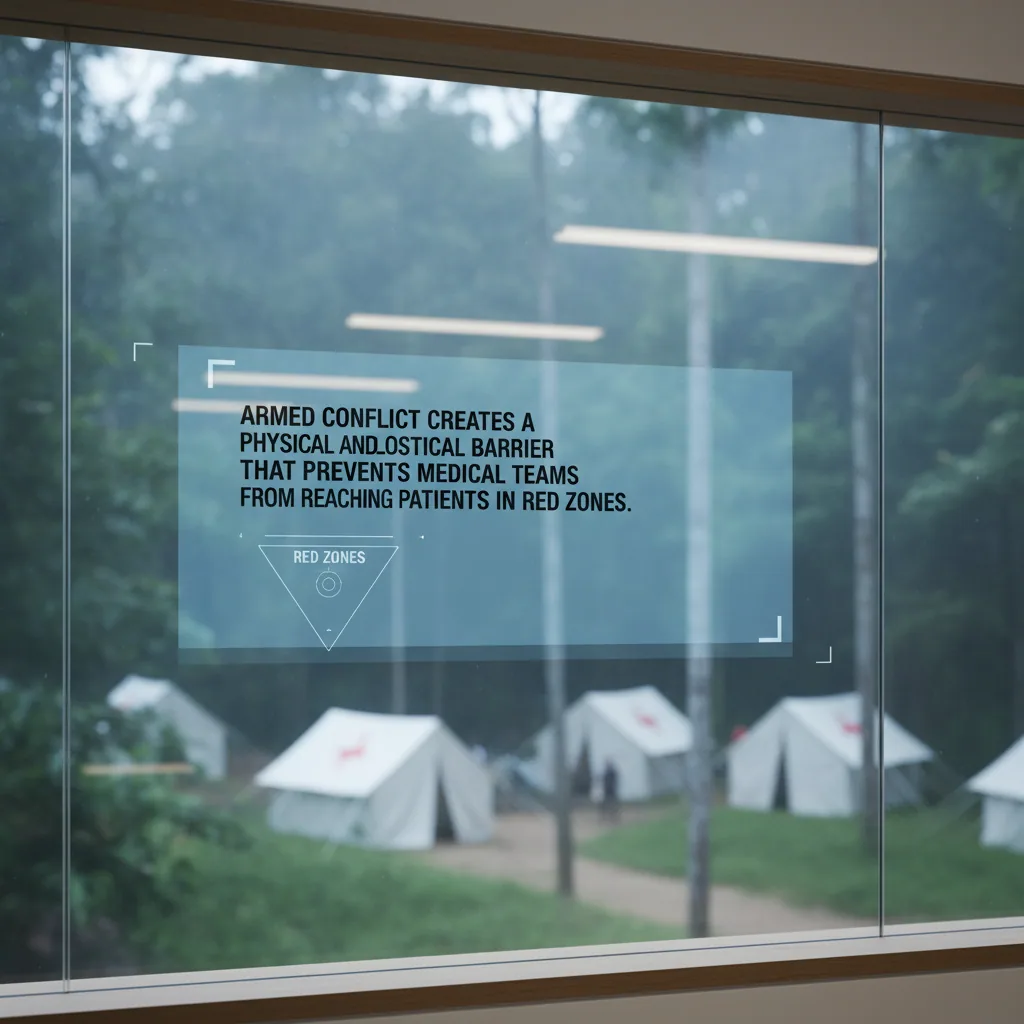
We are currently navigating the 17th Ebola outbreak in the country's history, yet our modern maps are failing us. The geometry of this crisis is shifting because the virus thrives in the cracks between borders. We are watching a pathogen move through "red zones" where the local law is written in lead.
A Ladder of Biology: The Bundibugyo Anomaly
To understand why the 2026 outbreak is so defiant, we have to look at the virus under a microscope. Think of the Ebola family as a group of closely related languages. We perfected a dictionary for the common Zaire strain, but Bundibugyo is a different, more elusive dialect.
Research shows that Zaire ebolavirus vaccines produce significantly lower levels of cross-reactive antibodies against Bundibugyo. Currently, there is no approved vaccine or specific treatment for this rarer, stubborn strain that has now spread across five provinces.
This biological mismatch is compounded by a total collapse of surveillance in the conflict-ridden red zones. There was a massive delay in detecting the virus, a silence that usually indicates a broken health system. The virus was moving through remote villages long before the world noticed in May.
Somewhere in the deep forest, a biological bridge was crossed, and we simply missed the moment it happened. We haven't yet identified the specific animal source or the original spillover event for this 2026 surge. That is where the mystery lives.
The Ebola-Conflict Nexus in DRC: Tracing Contacts Amid War
In a laboratory, science follows a script where you find a case, list their contacts, and monitor them for twenty-one days. In the "Grand Nord" of the DRC, that script has been shredded. Ituri province is currently the epicenter, holding a staggering 94 percent of all confirmed infections.
Imagine trying to map a family tree while crossing a minefield. Over 120 different armed groups operate in this region, turning every dirt road into a high-stakes gamble. This is where the invisible biology of the virus meets the cold reality of human conflict.
To stop an epidemic, you need to see it. In Ituri, teams are monitoring less than 40 percent of identified contacts. In the world of infectious disease, 40 percent is not a passing grade; it is an open door.
Tedros Adhanom Ghebreyesus, the Director-General of the WHO, warned that it is nearly impossible to trace contacts while bombs are falling. For someone sitting in a quiet office, this is the practical, messy core of the crisis.
The healer becomes a target, and the clinic becomes a symbol of the very state the rebels are fighting.
We have the technical knowledge to stop Ebola, but the tools of science require a social stability that does not exist here. For a health worker, a "red zone" is a house containing a sick person they are forbidden from reaching. We still don't know how many cases are hiding in those shadows, which is the most dangerous part.
The Security-Health Paradox
In March 2026, the quiet of the Lubwasi clinic was shattered by the sound of gunfire. Suspected militants from the Allied Democratic Forces (ADF) burned the building to the ground, killing six civilians inside. It was a moment where the thin wall between a hospital and a war zone finally collapsed.
When doctors are targeted, the logical response is to protect them with force. The UN peacekeeping mission, MONUSCO, provides armored escorts so medical teams can reach the most dangerous provinces.
This brings us to the militarization of health. To a parent in a village that has seen decades of violence, a doctor jumping out of an armored vehicle looks like a combatant. The blue helmet, intended to signal peace, often acts as a lightning rod for community mistrust.
When the stethoscope and the assault rifle arrive together, the medical mission loses its perceived neutrality. We still don't know how to break this tension. The tools meant to protect lives are exactly what can make their work impossible.
The Friction of Trust and the "Ebola Business"
To someone standing in a village in Ituri, the arrival of health workers in moon-white suits looks like an invasion. We often think of medicine as an objective good, but history suggests otherwise. Mistrust is a logical response to a world that seems to value a virus more than the people it kills.
Red Cross burial teams have faced violent attacks for trying to implement safe burial practices. To a grieving family, being forbidden from washing their loved one feels like a final, cruel theft of humanity.
Then there is the perception that international aid is just a profit-making scheme for distant elites. This skepticism grows when a million people are displaced while expensive aid convoys zip past them.
Whispers of traditional healers possessing plant-based cures fill the void left by the silence of the laboratory. Because there is no approved vaccine for the Bundibugyo strain, a forest herb can sound just as plausible as a distant, invisible science.
The Frontline Under Fire
When a virus enters a hospital, the building is supposed to be the fortress, but in the DRC, that fortress is crumbling. As of August 2026, frontline staff have suffered 151 confirmed infections and 44 deaths.
While these doctors risk everything, many are doing it for free. Healthcare workers across the region recently went on strike because of overdue salary payments. It is a staggering psychological math to risk an infection while the state fails to provide a paycheck.
One estimate suggests trade and travel disruptions could cost African economies $3,600,000,000. It is the equivalent of losing the entire annual economic output of several small nations to a microscopic strand of RNA.
Uganda declared its related outbreak over on July 28, 2026, after just 20 cases because stability allowed them to shrink the virus. In the DRC, the circle remains broken. Cases even reached Germany and France in mid-2026, proving this is a global leak in a system that cannot find its footing.
The Unanswered Horizon: Can Science Outrun War?
The bill for stopping a virus across 49 health zones is 518 million dollars. It is the cost of building a medical shield while the ground is shaking.
We still don't know if the experimental vaccines used for the common Zaire strain provide any meaningful real-world protection against this Bundibugyo outbreak. A thick silence hangs over the "red zones" where medical access is blocked by the M23 Militia. These groups have created a data vacuum where we cannot see how many people are suffering behind the battle lines.
We are witnessing a race between a rare virus and the machinery of peace. Can science outrun the bullets when the road is closed? We still don't know, and that is the horizon the Ebola-conflict nexus in the DRC forces us to walk toward.