
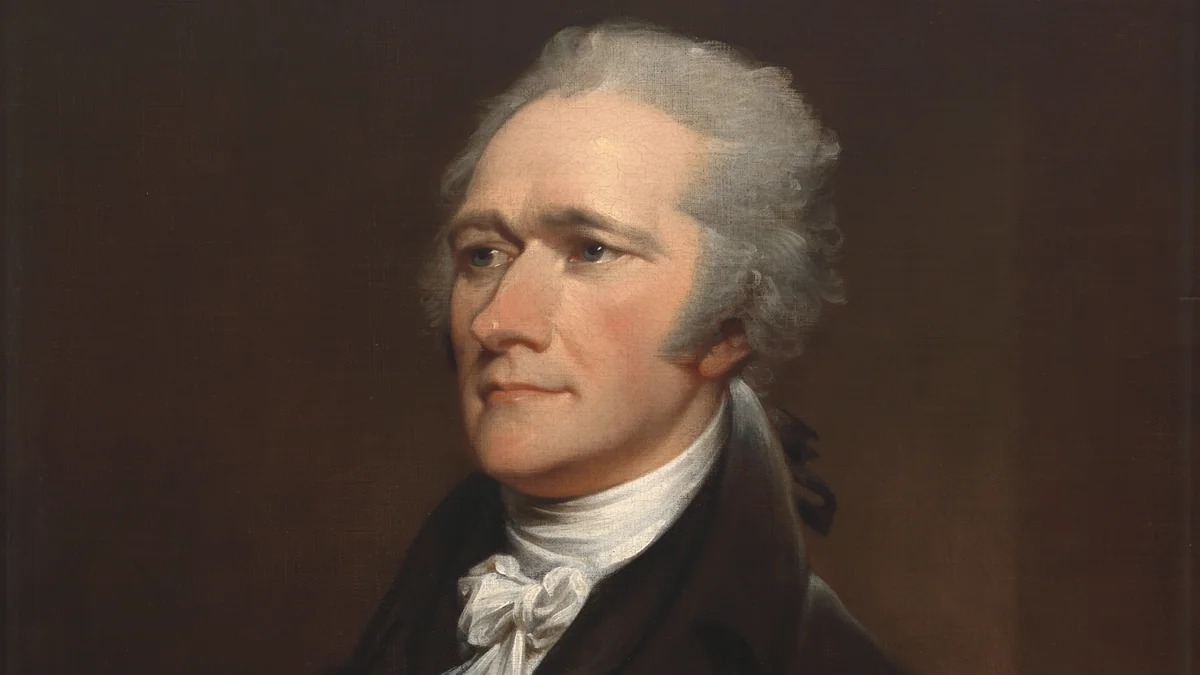
The birth of the American financial empire began with Alexander Hamilton's decision to consolidate $77 million in Revolutionary War debt into a unified federal obligation. By transforming liabilities into assets through the Funding Act of 1790, the young republic established the "full faith and credit" principle that still anchors the global economy today.
Hamilton's strategy was to honor debt so precisely that the young republic's credit became a source of geopolitical power rather than a liability. When he assumed the post of the first U.S. Secretary of the Treasury in 1789, European creditors viewed the nation's $77 million burden as evidence of terminal unreliability. How a bankrupt republic became the financial architecture of the modern world is a story of turning debt into infrastructure.
The Funding Act of 1790 codified this logic, forcing wealthy bondholders into a direct financial stake in federal survival. Creditors became constituents, and debt became the glue that held the states together. The blueprint Hamilton drafted transformed skeptical lenders into invested partners by mapping economic behavior to the survival of the state.
The Hamiltonian Blueprint: Engineering the Birth of the American Financial Empire
Hamilton first built the argument for why the nation deserved stability before he built the machinery to manage it. At the Annapolis Convention in 1786, he pressed for a stronger federal compact long before a treasury existed. His authorship of the Federalist Papers reveals an architect laying ideological foundations before pouring financial concrete.
The Funding Act of 1790 transformed a patchwork of post-Revolutionary War liabilities into a single, legible federal obligation. This signaled to European creditors that the republic would honor its contracts regardless of the internal cost. Hamilton understood that a state's creditworthiness is the actual foundation of its wealth.
By guaranteeing repayment at face value, he forced the moneyed class to become the government's most motivated defenders. The political cost was a structural fault line, as Southern states resented absorbing Northern liabilities. This cross-border correlation between fiscal architecture and regional grievance would reverberate through American history for decades.
The act of owing became, itself, a form of power.
The Institutional Architecture: Bank, Tax, and the Jefferson Opposition
In December 1790, Hamilton proposed a national bank to act as the government's fiscal agent and issue paper currency. This was the operating system for a socio-economic blueprint that relied on institutional trust. Import tariffs and a whiskey tax aligned revenue generation with commercial expansion to capitalize the First Bank of the United States.
Thomas Jefferson mounted a constitutional objection, arguing that Congress had no explicit power to charter such an institution. This collision between state sovereignty and centralized financial power remains a defining paradigm shift in American law. The bank question was a battle over who controls the architecture of money.
Jefferson lost that battle, and the rules of the game were set for the next two centuries. In the Estonian context, where small states operate within externally set monetary frameworks, the lesson is structural. Those who design the institution define the rules for everyone downstream.
Full Faith and Credit as Geopolitical Lever
During the winter of 1862, the Union Treasury was nearly bare, yet the government borrowed its way through the catastrophe. The "full faith and credit" principle Hamilton encoded into the nation's DNA held firm even as the republic fractured. Sovereign debt, when structured correctly, functions as essential geopolitical infrastructure.
The U.S. dollar's reserve currency status grew directly from this institutional behavior of honoring obligations at any cost. This borrowing capacity financed westward expansion and underwrote Allied victory in two World Wars. Low interest rates were the compounded return on creditor trust built bond by bond since 1790.
Small open economies like Estonia have no such inheritance and cannot manufacture credibility at this scale. The rules of global fiscal discipline were written for nations that lacked the American option to monetize trust. The U.S. dollar's "exorbitant privilege" is the direct result of Hamilton's original engineering.
The $39 Trillion Reckoning: Hamilton's Instrument, Inverted
As of the 2026 Sestercentennial, U.S. national debt is cited between $35 trillion and $39 trillion depending on the methodology. A discrepancy of four trillion dollars, larger than most national GDPs, suggests a shift away from institutional transparency. Hamilton's warning was precise: debt must not become excessive, yet interest payments now exceed defense spending.
The original Hamiltonian instrument was capital deployed forward for production and expansion. Today's debt increasingly services past consumption, indicating a corrosion of the original socio-economic blueprint. The current architecture transfers resources from public investment to debt maintenance, reversing Hamilton's logic.
In the Estonian context, where no reserve currency cushions fiscal overreach, this distinction defines the boundary of sovereign survival. The state now works to service bondholders rather than bondholders working to protect the state. The inversion of Hamilton's model represents a structural shift that threatens the empire's foundation.
Exorbitant Privilege Under Siege: The View from the Periphery
Reserve currency status provides the structural permission to run deficits that would trigger crises in any other economy. This trust is facing its first systemic test as debt reaches unprecedented levels. De-dollarization efforts across Asia and Latin America represent a behavioral signal that confidence in U.S. fiscal discipline is weakening.
Cryptocurrency markets function as a canary, positioning against credit erosion when sovereign actors hesitate. For small open economies, the asymmetry is sharp; no Estonian fiscal framework would survive the current U.S. debt-to-defense ratio. The strategic question for the next decade is how the global financial architecture will reorganize.
If the world's largest debtor diverges permanently from Hamilton's productive-use logic, a new socio-economic blueprint will emerge. For small states, the priority is to understand whether the next system will be built on trust or transparency. Navigating this transition requires a deep understanding of the history behind the birth of the American financial empire.