
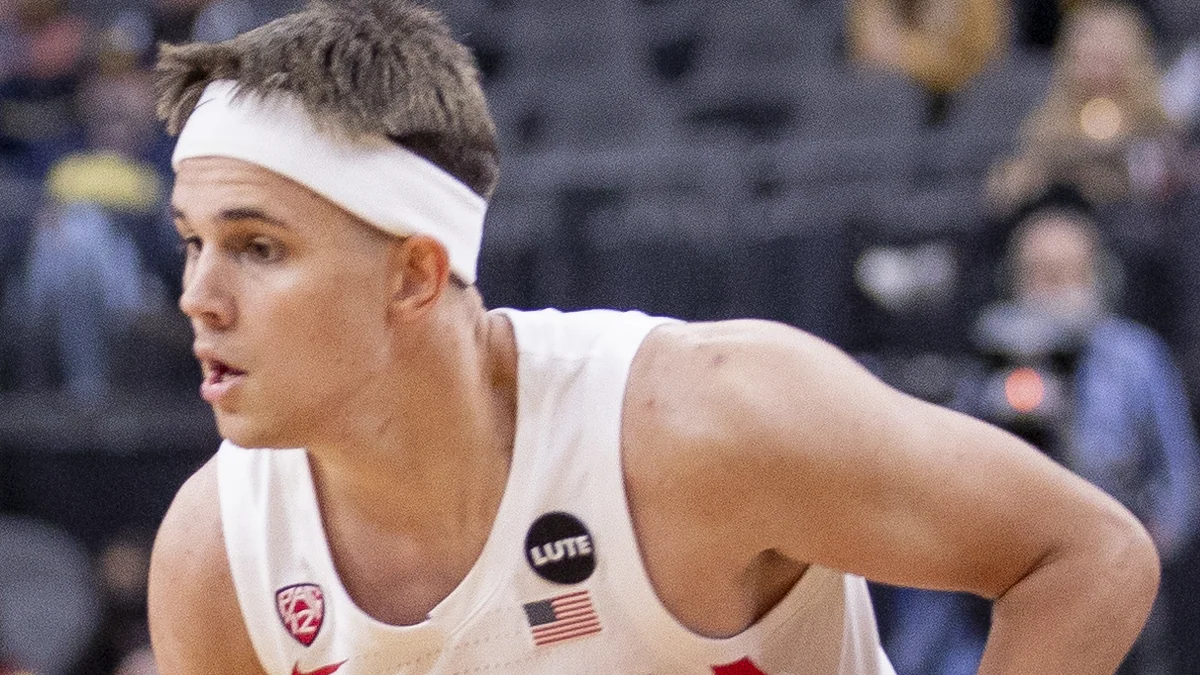
On July 4, 2026, FBI agents detained Kerr Kriisa on charges tied to an alleged multi-million dollar point-shaving scheme at West Virginia University during the 2023–2024 season. He is the first Estonian basketball player to face U.S. federal criminal proceedings. Journalist Jack Pilgrim broke the story first; Reuters made it international within hours.
An elite university athlete, four institutions, six years of American collegiate basketball — and a federal arrest warrant. The gap between those two realities is not merely biographical; it is structural. FBI agents detained Kriisa not at the request of some regional police department, but through the most powerful investigative agency in the United States. What plays out in a federal courtroom next will resonate far beyond one player's career.
Four Universities, Six Years, One Federal Arrest
To understand the arc of this case, you have to trace Kriisa's six-year journey through the NCAA ecosystem: Arizona, West Virginia, Kentucky, Cincinnati. That trajectory is not an anomaly — it is a paradigmatic illustration of how the transfer portal has restructured player mobility in American collegiate sport, turning institutional loyalty into an optional feature.
The alleged criminal conduct is localised to the West Virginia period, specifically the 2023–2024 season. The core accusation is point-shaving — manipulating game outcomes not to produce losses, but to ensure wins fall below the betting spread, generating systematic profit for those placing the wagers. The scheme's estimated scale runs into millions of dollars, though formal federal indictments had not been published as of July 5, 2026.
Kriisa now awaits extradition to the state of West Virginia. A first court appearance is scheduled for the second week of July.
Point-Shaving in the Language of Federal Law
The mechanics of point-shaving are, in a perverse way, elegant in their simplicity — and that elegance is precisely what makes them structurally dangerous. A player does not need to throw a game. He needs only to ensure that a victory arrives with a narrower margin than the betting market anticipated. The manipulation is invisible to casual observers and statistically ambiguous even to analysts.
The formal federal charges have not yet been published — a deliberate prosecutorial tactic. Arrest first; release documentation when the legal strategy is set. Federal fraud jurisdiction typically activates when a scheme crosses state lines or uses federally regulated financial channels.
The higher a player's institutional mobility and the more unstable his institutional footing, the more vulnerable he becomes to organised sports corruption.
Organised sports fraud does not respect state boundaries. The larger the betting scheme, the greater the likelihood of federal jurisdiction. What happened on an NCAA court in one season now carries consequences in a federal courtroom — a jurisdictional shift that amplifies the stakes beyond anything a state-level proceeding would imply.
The NCAA Transfer Portal as a Systemic Vulnerability
Four university transfers in six years is not, by current NCAA standards, unusual. The transfer portal was designed as a protection mechanism — giving players the freedom to seek environments better suited to their development. What the architects of that system may not have adequately modelled is the structural exposure that follows from continuous institutional churn.
A player who changes universities every year does not, in any meaningful sense, belong to a long-term community. Institutional bonds remain shallow. Trust networks do not mature. And that social vacuum creates an opening for external actors operating with very different interests.
Kriisa's time at Kentucky illustrates this pattern concretely: injury, institutional uncertainty, minimal integration into a squad. Cincinnati followed a similar trajectory — declining performance metrics combined with institutional instability. Together, these form what a sociologist would recognise as a risk-exposure model: isolation compounded by economic pressure, leaving an individual uniquely susceptible to organised influence.
Tartu Ülikool and the Anatomy of Club Risk
Tartu Ülikool Maks & Moorits had signed Kriisa as what the Estonian basketball community considered the biggest international homecoming in recent memory. The ink on that contract had barely dried before federal procedures activated. The arrest followed so quickly after signing that both events occupy almost the same news cycle.
Kriisa had also been scheduled to participate in a University of Kentucky alumni game in July — plans immediately voided by the arrest.
The club now faces a contractual question that Estonian basketball has not previously had to answer. Almost certainly, the contract contained no clause specifically addressing federal criminal proceedings of this nature. That is not negligence — it reflects where Estonian clubs currently stand on the learning curve of international player acquisition.
Estonian clubs enter the global labour market operating under rules they are still in the process of understanding. A player's career may appear clean from the statistical record, but federal-level background processes operate at a different speed and depth entirely. Contractual risk no longer ends with injury clauses — it now extends deep into a player's legal and institutional history.
The Investigation's Open Questions and the Logic of the Rule of Law
Federal criminal proceedings move on their own timeline, indifferent to the rhythm of public expectation. As of July 5, the prosecution had not released formal indictments. The precise scope of the charges remains unknown — consistent with the handling of comparable large-scale corruption cases.
The names of other individuals allegedly involved in the scheme have not been disclosed. Point-shaving structurally requires a network: organisers, betting intermediaries, and cross-border financial flows. In federal proceedings, cooperation agreements are routinely offered to peripheral actors in exchange for evidence against the scheme's core operators.
The tension between presumption of innocence and public narrative is acute here. No verdict has been rendered, yet the sports media has already constructed its own parallel proceeding. The line between accusation and established fact is not always where the first reader assumes it to be.
Estonian Basketball's Reputation and the Global Corruption Pattern
Reuters distributed the arrest news internationally. The signal strength is disproportionate to the involvement of one player — it touches the international positioning of Estonian basketball as a whole. Organised fraud targets individuals rendered vulnerable by economic pressure or social isolation. That is not a moral failing unique to one person; it is a systemic pattern that governance structures are supposed to detect and prevent.
The Estonian Basketball Federation and its clubs now face a choice. Passive observation is a strategic error. Global sport demands that due diligence expand well beyond the signing ceremony — proactive risk assessment that maps a player's full institutional and legal history, not merely their performance metrics.
Whether the NCAA and Estonian sports governance are prepared to rewrite their standards is an open question. It will remain open until the Kerr Kriisa case reaches its federal resolution — and the answer, whatever it proves to be, will carry institutional implications well beyond one player's career.