Bottlenose dolphins in the Adriatic have adopted a new dolphins' survival strategy by becoming "obligate scavengers" behind fishing trawlers. As Mediterranean fish stocks decline to half of sustainable levels, these predators now follow 76 percent of otter trawlers to find food in a depleted marine ecosystem.
This dolphins' survival strategy is a direct response to industrial fishing pressure that has turned once-rich hunting grounds into a barren desert. If you stood on the sun-drenched docks of Italy's Marche region thirty years ago, a dolphin following a fishing boat was a rare sight. Today, if you spot an otter trawler heading out into the Adriatic, you are looking at a dinner bell.
In the 1990s, research showed that only about 10 percent of these vessels had a dolphin "shadow." Today, that number has climbed toward a near-total reliance. This is no longer a chance encounter, but a calculated survival strategy.
The dolphins are remarkably picky about which boats they choose to follow, almost completely ignoring beam trawlers. They favor midwater and otter trawlers, and in the Marche region, that preference hits a fever pitch with 76 percent of otter trawlers being shadowed. Beam trawlers are tidy, but otter trawlers create a messy, accessible feast of disturbed fish and discards.
What we are witnessing is a shift from the "opportunistic visitor" to the "obligate scavenger." The Mediterranean is currently fished at double its sustainable level, turning once-rich hunting grounds into a blue desert. The trawler has stopped being an interloper and has become the only reliable supermarket left in the Adriatic.
The Empty Blue Desert: A Dolphins' Survival Strategy Born of Necessity
The UN Food and Agriculture Organization (FAO) notes that Mediterranean fishing pressure is double the sustainable limit. This is not just a statistical overreach; it is a mathematical death spiral. It is like a bank account where you withdraw two euros for every one you deposit until the balance hits zero.
Now hold that thought. This deficit created a vacancy for the common dolphin, a species that once ruled the Adriatic for millennia. Today they are ghosts, having virtually vanished and leaving a silence that tells a story of total ecological displacement.
The cause is a process experts call benthic disturbance, the technical name for a simple tragedy. Trawlers scrape the seafloor, leveling the reefs and seagrasses where fish spawn and hide. It is the marine equivalent of clear-cutting an entire rainforest just to catch a few exotic parrots.
Once the "trees" are gone, the entire biological neighborhood disappears, leaving the bottlenose as the last apex predator in a collapsed web. They didn't follow the ships because they were lazy; they followed because the rest of the sea had become a barren, blue desert.
The trawler has stopped being an interloper and has become the only reliable supermarket left in the Adriatic.
Inheritance of the Scavenger
Researchers spent 148 days on the water, meticulously mapping the lives of these animals. They cataloged over 1,000 individual bottlenose dolphins by the unique notches on their fins. The data revealed that between 86 percent and 90 percent of that entire population has been photographed following trawlers at least once.
Now hold that thought. This isn't a primal instinct hard-wired into their DNA like the drive to breathe or migrate. It is a learned culture, passed from mother to calf, where dolphins teach their young a specific "trade."
In the Adriatic, that trade is now scavenging. Calves swim in the wake of their mothers, learning the exact geometry of a moving net. They learn which engine hums mean a meal and which mean danger.
Scientists call this cultural transmission, but it is really just a family inheritance. These calves are being "schooled" in a new way of life where the hum of a diesel engine is as familiar as a heartbeat. The ladder of understanding leads from ancient hunters to social scavengers as a practical answer to a depleted ocean.
The Calculated Risk of the Net
Dolphins are master problem-solvers, but every tool comes with a price tag. In Shark Bay, dolphins use sea sponges to protect their noses while foraging, yet this creates a sensory cost. Researcher Ellen Jacobs notes that the sponge muffles their vital echolocation, like trying to see through a heavy, fogged-up window.
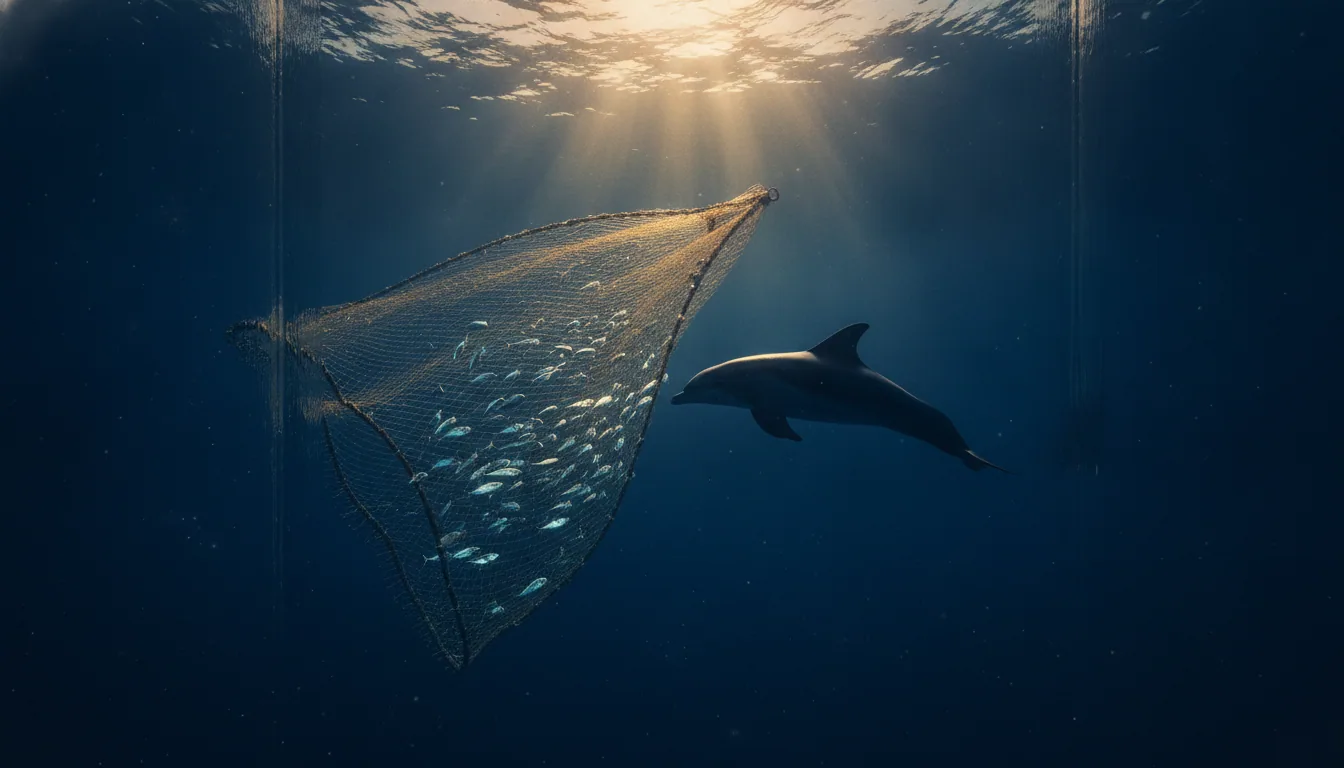
Now hold that thought. If a sponge is a muffled window, a moving fishing trawler is a roaring, underwater construction site. Adriatic dolphins frequently enter moving nets to snatch prey from the mesh despite the constant threat of entanglement.
The invisible damage is just as severe, as the chronic engine noise causes acoustic masking. This mechanical roar fills the water, making it nearly impossible for them to hear the signature whistles of their companions. We are seeing a species forced to trade its safety and its silence for a single meal.
Researcher Kyra Bankhead found that in Sarasota Bay, extreme stress led dolphins to restructure their entire social networks. They began bonding specifically over risky foraging behaviors, like raiding fishing gear together. For these animals, taking the risk is now simply better than going hungry.
The 160-Kilometer Retreat
In 2025, a population of Atlantic dolphins did something radical by abandoning their home range to migrate 160 kilometers south. This was not a seasonal stroll but a forced retreat. This migration serves as a clear warning signal of a total food chain collapse.
Imagine every grocery store in your province closed today. To feed your family, you would have to walk 100 miles to the next territory with no map and no guarantee of a meal. "Stay and scavenge" isn't the only desperate choice on the table for the hungry.
While some dolphins become the marine equivalent of urban foxes by following trawlers, others simply run. Neither path is a sign of abundance. These are the binary choices of an apex predator trying to outrun a vanishing world.
Listening to the Ghost in the Machine
Google researchers recently developed "DolphinGemma," an AI model specifically designed to decode dolphin communication. It sifts through thousands of hours of acoustic data that would take a human lifetime to parse. The AI focuses on "signature whistles," revealing a society that is literally talking its way through a crisis.
There is a deeper, more human reason to pay attention to the biology of these resilient mammals. Their blood systems are currently being researched for vital insights into human cardiovascular health and aging. Because they share our basic mammalian blueprint, their response to a changing ocean is a mirror for our own survival.
We are finally getting the tools to see how these creatures adapt when the world shifts beneath them. Yet, the central mystery remains untouched regarding what happens to these behaviors if the trawlers eventually stop. That mystery is the final chapter in the evolution of the dolphins' survival strategy.