
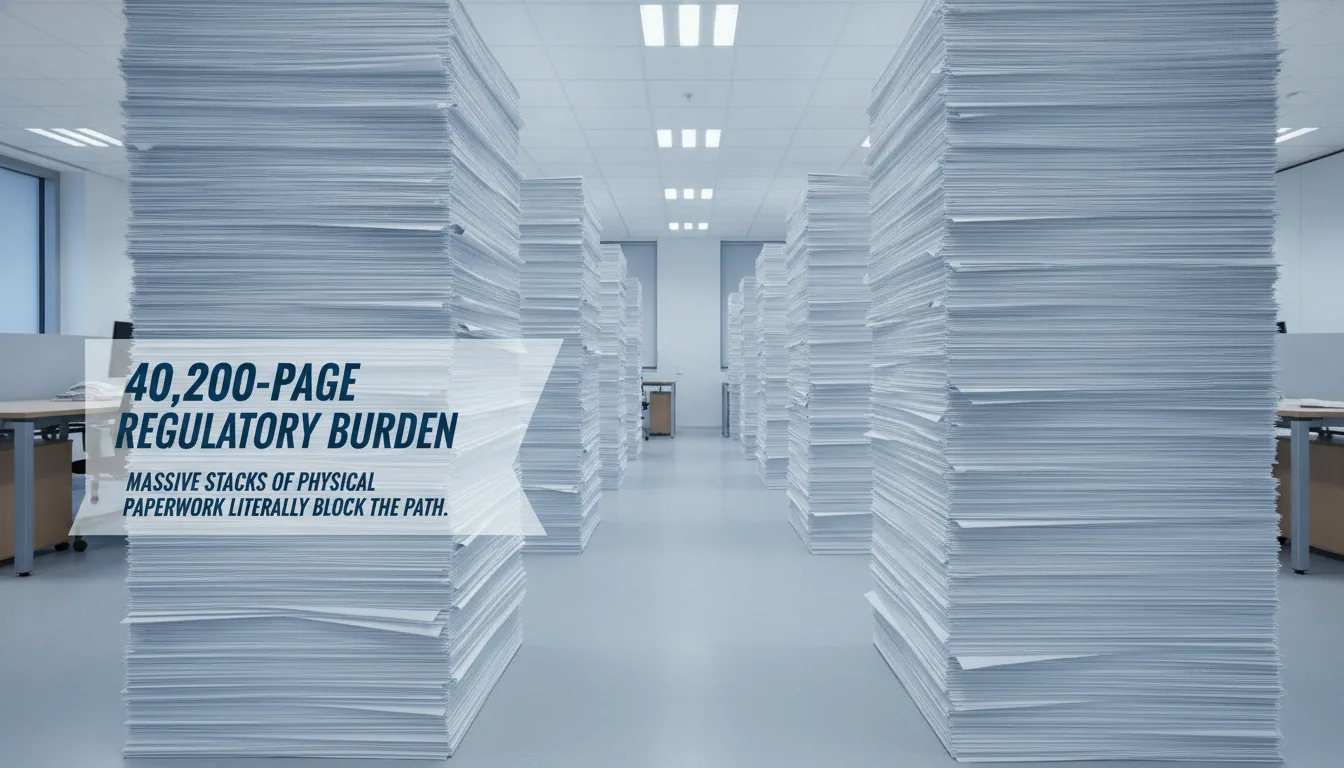
Excessive administrative requirements cost the German economy up to 146 billion euros annually. This systemic friction functions as a significant barrier, where a legal code exceeding 40,200 pages slows market entry for new technologies and forces companies to prioritize paper-based compliance over digital agility and global competitiveness.
German bureaucracy as a drag on innovation manifests through archaic administrative architectures that stall market entry despite world-class engineering. The Ifo Institute reports that this systemic failure causes the very precision that once defined German industrial success to calcify into an impenetrable barrier.
We are witnessing an institutional behavior that favors rigid, paper-based compliance over the agility required by the global digital economy. This disconnect highlights a socio-economic blueprint mismatch between 20th-century regulatory habits and the requirements of modern innovative actors. Rewriting the old order is a fundamental necessity for survival in a hyper-competitive global landscape.
The federal government’s 2026 economic report admits that matching the digitalization standards of Scandinavia or East Asia remains a slow-moving goal. If the continent’s industrial heart cannot embrace a paradigm shift toward digital fluency, the future of European competitiveness on the world stage remains uncertain.
Quantifying Friction: The 146 Billion Euro Innovation Barrier
A global industrial leader prides itself on precision, yet it squanders more capital on friction than many sovereign nations generate in annual wealth. The Ifo Institute estimates that this systemic stagnation results in a loss of 146 billion euros in economic output annually as of 2026. Such a deficit represents the stifling of potential through administrative weight.
The National Regulatory Control Council (NKR) highlights a correlation between regulatory density and declining competitiveness. Direct annual costs for companies now reach between 65 billion and 67 billion euros, driven by a legal code exceeding 40,200 pages. For the average firm, this weight translates to a permanent loss of economic momentum.
Research from IW Köln indicates that German companies now spend one full working day per week on purely bureaucratic obligations. If a pharmaceutical employee must handle 12 times more paperwork than an average worker, the socio-economic blueprint for innovation is compromised. This forces a diversion of resources away from research toward the maintenance of legal standards.
If the state continues to mandate complexity while companies require agility, the resulting friction will permanently block any hope for a competitive paradigm shift.
Dorothee Bär, Federal Minister of Science, has noted that bureaucracy reduction functions as a "free economic package," yet the necessary shift remains slow. In the Estonian context, the German struggle with record-keeping highlights a profound and growing digitalization gap. We must ask if a state built on traditional institutions can pivot fast enough to stop its own machinery from consuming its future.
The Expanding Labyrinth: 40,200 Pages of Stagnation
A nation celebrated for structural efficiency now finds itself paralyzed by an overwhelming surplus of its own definitions. By late 2025, federal law texts exceeded 40,200 pages, marking a 62% increase since 2010 according to ESMT Berlin. This expansion prioritizes rigid procedure over actual economic progress.
As regulatory density exceeds corporate processing capacity, the failure to contain legal inflation shifts institutional behavior toward defensive compliance. We observe a clear correlation between this sustained legal inflation and the visible slowing of industrial velocity. Agility is sacrificed at the altar of procedural volume.
In the Estonian context, this German trajectory serves as a cautionary tale of institutional decay where textual volume stifles the private sector. The state's demand for complexity creates friction that blocks any hope for a competitive paradigm shift. Can a leading power recover its velocity if its operational manual grows faster than its output?
Sectoral Erosion: Pharmaceuticals and the Defense Shift
A scientist in Marburg might be sequencing life-saving medicine, yet they spend more hours clutching a pen than a pipette. This friction, where elite research meets an archaic administrative load, is stifling the engine of German industrial dominance. Progress is increasingly measured in forms rather than formulas.
Saksa bürokraatia kui innovatsiooni pidur is clearly visible in the pharmaceutical sector, where bureaucratic costs have doubled since 2012, now reaching 2.5 billion euros per year. This represents a massive diversion of capital away from active research and development. It remains a staggering imbalance when a single pharmaceutical employee handles 12 times more paperwork than the average worker.
If the laboratory represents a loss of momentum, the hangar illustrates a total breakdown in institutional behavior and regional trust. The collapse of the joint German-French fighter jet project serves as a concrete manifestation of sectoral erosion through regulation. Shared innovation was effectively strangled by a labyrinth of divergent requirements and slow procurement protocols.
Berlin is now exploring agile partnerships with Japan, the United Kingdom, and Italy to ensure its defense blueprint remains viable. This pivot reflects a broader shift where traditional cross-border correlations are failing. We are witnessing an emerging paradigm where administrative friction transforms into a significant geopolitical liability.
Digitalization as a Strategic Comparative: The Denmark Benchmark
A nation that pioneered Industry 4.0 still demands physical signatures and paper trails for the most basic interactions. If Germany matched Denmark's level of public digitalization, its GDP per capita would increase by 2.7% according to the Ifo Institute. In the Estonian context, where digital identity is the norm, this correlation proves that resistance is a measurable disadvantage.
This regulatory density creates a mirrors-and-smoke effect where startups maintain a glossy facade while internal processes remain in total chaos. Liina Laas notes that these organizations often suffer from a "Schrödinger’s product" phenomenon where innovation lacks a functional, data-backed backbone. Losing a sales employee due to such internal friction costs a startup approximately 50,000 euros.
The shift required involves a fundamental rewriting of the old order of state-citizen interaction. If the state refuses to adopt the efficiency of a digital-first model, companies will mirror that systemic dysfunction in their own operations. Can a legacy power bridge this gap before the compounding cost of its own friction consumes its competitive edge?
The Internal Mirror: Institutional Chaos and Startup Survival
High-level innovation often meets a profound scarcity of internal coordination within the very firms meant to lead the recovery. Data indicates that hiring and then losing a sales employee due to poor onboarding costs a startup approximately 50,000 euros. Liina Laas, founder of Knowzilla, observes that even large organizations often lack a coherent sales process.
If institutional behavior at the state level is fragmented, then the private sector inevitably adopts this blueprint of disorder. In the Estonian context, where agility remains the primary advantage, such waste represents a barrier to scaling across the European landscape. This lack of structure translates into a quantifiable drain on capital.
Legacy systems in Germany often resemble the classic RIGA 22 moped metaphor: if it starts, it drives, but the mechanical effort to reach that point is immense. We are witnessing a paradigm where structural complexity no longer ensures stability but instead facilitates systemic inefficiency. Bureaucratic weight acts as a catalyst for organizational decay.
BEG IV and the Inertia of Reform: A Drop on a Hot Stone
The ambition of a digital-first economy meets the reality of a state still tethered to physical archives. While the Bureaucracy Reduction Act IV (BEG IV) was heralded as a milestone, its scale reveals a mismatch between political intent and economic necessity. The act aims to provide 944 million euros in relief, a figure that appears substantial only in isolation.
Industry bodies like the BDI and DIHK have dismissed these measures as a "drop on a hot stone." This skepticism is rooted in a reality where the volume of regulation grows faster than the tools designed to prune it. Only 28 out of 442 bureaucracy-reduction proposals submitted by entrepreneurs were fully adopted.
The specific changes offer some relief, such as reducing the retention period for accounting documents from 10 years to 8 years. Furthermore, the legal acceptance of digital signatures for leases and employment contracts represents a necessary step. However, the fundamental question remains whether Germany can transition from managing complexity to fostering a genuine innovative environment.
A reputation for legendary precision meets a reality of profound political alienation, with governing parties holding less than 40% support. This decline suggests that voters no longer view meticulous record-keeping as a proxy for national stability. We must recognize German bureaucracy as a drag on innovation before the nation's economic relevance erodes against more agile global competitors.