The rescue crisis in Cambodia involves thousands of trafficked survivors left homeless after government raids on scam compounds. Lacking funds for repatriation or housing, these individuals from over 66 nations are abandoned on Phnom Penh’s streets while the multibillion-dollar industry shifts to remote border regions.
The rescue crisis in Cambodia is defined by a lack of post-raid support, leaving survivors of forced labor compounds without money, shelter, or a way home.
The Rescue Crisis in Cambodia: Survival on a Foreign Curb
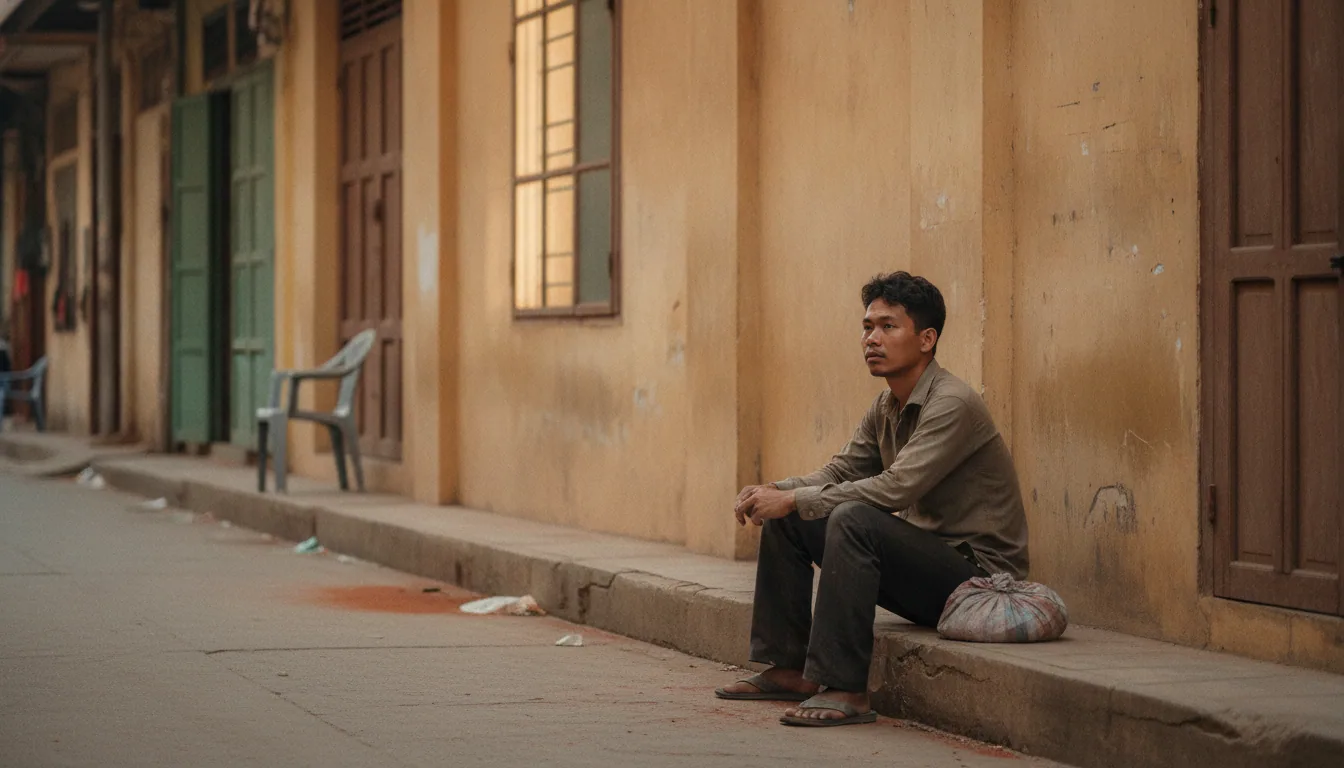
Shuiab is 24 years old and has nowhere to sleep tonight. He is a survivor from Uganda who was trafficked into a Cambodian scam compound. Now he sits on a dusty curb in Phnom Penh, "freed" by a government crackdown but left with exactly zero dollars.
There are thousands like him wandering the streets of the capital. They come from at least 66 different countries, brought here by the false promise of a steady paycheck. For many, the nightmare did not end when the compound gates opened during the July 2025 raids.
Do the arithmetic. A flight home to East Africa can cost more than a year’s wages for a working person. That’s what policy feels like when it stops at the raid and forgets the person. It turns a survivor into a loiterer.
An estimated 100,000 to 150,000 people have been held in these buildings across Cambodia. They were forced to scam strangers under the threat of beatings. Now they are abandoned on the pavement without housing or a path home.
I write so that we see the human cost behind the official headlines. A raid that leaves a survivor on a sidewalk is not a rescue. It just moves the misery from a locked room to a public gutter.
A raid that leaves a survivor on a sidewalk is not a rescue.
A Nation Where the Scam is the Economy
Do the arithmetic. The United Nations Office on Drugs and Crime (UNODC) estimates that scam operations in Cambodia generate between $12.5 billion and $19 billion every single year. For a country with a modest economy, these are not just figures on a ledger.
They represent an entire shadow infrastructure that has become the nation’s backbone. To put that in perspective, scam operations now account for approximately 35% of Cambodia’s total GDP. It is no longer just a border issue; it is a pillar of the state.
When more than a third of a country’s economic lifeblood comes from organized fraud, the industry is no longer a "glitch." It is a massive financial system that the state has become dependent upon. This is what policy feels like when a government prioritizes quick cash over the safety of its people.
It is the daily economics of survival for the powerful. The reach of this industry stretches far beyond Southeast Asia. The "pig-butchering" model defrauded Americans of over $20 billion in the previous year alone.
That is money taken from retirement funds and family savings, funneled into compounds where people like Shuiab are held against their will. I write so that we understand this is not a series of unfortunate events.
This is a calculated economic model. Criminal networks have built a factory of misery that produces billions in profit. When 35% of the nation’s wealth comes from these compounds, shutting them down is not a simple police matter.
It is a threat to the current national budget. We are looking at a system designed to survive any minor crackdown the authorities might stage for the cameras.
The Shell Game of the 2025 Crackdown
When Chhay Sinarith, head of the Commission for Combating Online Scams, announces a crackdown, the numbers tell a different story than the press releases. In 2025, there were 53 identified scam compounds in Cambodia. By April 2026, Amnesty International identified 86.
That is not a successful police operation. It is an expansion.
During the 2025-2026 raids, authorities bypassed over 70% of known scam locations. If you are a worker, you know what it means when a rule only applies to some people. It means the rule is a performance.
Amnesty International calls this "managing optics." It is a shell game where the shells are high-walled buildings and the peas are human lives.
The industry is not disappearing. It is just moving to the edges of the map. Operations are shifting to border zones like Bavet, Poipet, and Koh Kong.
These are places where the law is a thin suggestion. In the Koh Kong Special Economic Zone, the LYP Group was sanctioned by the U.S. for its involvement in forced labor.
When a conglomerate owned by a senator is linked to these sites, a "crackdown" becomes a logistical relocation. For the people trapped inside, this movement is a death sentence by miles.
Moving a compound to a remote border area makes rescue nearly impossible and escape even harder. It also keeps the reality of the industry away from the capital's prying eyes.
That’s what policy feels like when it is designed to satisfy international donors rather than save workers. We see a few deportations on the news while the number of active compounds grows.
I write so that we look past the headlines and do the arithmetic. If 70% of the problem is intentionally ignored, the industry is not being dismantled. It is being renovated.
The Cost of the Black Room
Wilson, a survivor from Sierra Leone, still remembers the "black room." He told reporters that inside that space, they can do anything to you. If he did not meet his scam quotas, he was subjected to beatings and electrocution.
This is the reality of debt bondage. You are sold between compounds like office equipment and held in solitary confinement for disobedience. If you fail to defraud enough people, you are physically broken to remind the others of the cost.
That is what policy feels like when human beings are treated as line items. Wilson was part of a machine that required specific numbers to function, or he faced the cable. When the scam quotas dropped, the torture began.
In October 2025, the U.S. sanctioned Prince Holding Group for running these forced-labor operations. Their chairman, Chen Zhi, was extradited to China in January 2026. This happened while Cambodia remained on the "Tier 3" list for human trafficking.
The Cambodian government prefers the arithmetic of optics. They reported deporting 2,695 Chinese nationals in 2024 after human trafficking investigations. It is a figure designed to satisfy international observers, but it does not dismantle the architecture of the black room.
I write so that these figures are not just ink on a page. One chairman in a Chinese cell does not heal the scars on Wilson’s back. Justice is not a press release; it is the permanent end of the debt.
When the Neighborhood Becomes a War Zone
While the government manages the optics of scam compound raids, a second humanitarian crisis has quietly hollowed out the borderlands. In mid-2025, a separate military conflict with Thailand displaced approximately one million people. This is what policy feels like.
Do the arithmetic for a family living in the shadow of the border, where average earnings have declined by 34%. For a worker already living on the edge, losing a third of their income means skipping meals. August is not a school-supply month for these households.
The social fabric is fraying just as fast as the economy. Exactly 833 schools were forced to close due to the conflict, leaving thousands of children with no classrooms. In these villages, the path to a better life is physically blocked by checkpoints.
As of June 2025, some 28,460 displaced border residents remained in temporary camps. Yi Kimthan told UCA News that fleeing an armed conflict causes deep scars. He pointed out that living in refugee camps is hard due to a lack of hygiene and nutrition.
Those who try to document this reality find the law used as a gag. Six Cambodian journalists were detained or charged with incitement between January and February 2026. They were arrested for trying to connect the dots between the scam industry and the border crisis.
When the neighborhood becomes a war zone, the truth is often the first thing to be evacuated. It is easier for officials to claim a successful crackdown than to admit a million people have lost their futures.
Building a Future Out of the Arithmetic of Justice
Cambodia remains on "Tier 3" of the U.S. State Department’s 2025 Trafficking in Persons report. This is the lowest possible grade. It tells us that the state has failed to protect its most vulnerable guests.
Government spokesperson Pen Bona says they have provided temporary housing for displaced families. He noted that expecting these shelters to be "perfect" is impossible. For a mother sleeping on a dirt floor, the distance between "imperfect" and "safe" is measured in money they do not have.
Mark Taylor, a trafficking program lead, says the government has only addressed half of this problem. They ignore the massive economic engine behind the misery.
Groups like Huione, linked to the family of the former prime minister, remain part of the landscape. An industry that generates 35% of the national GDP does not vanish because of a few televised raids. It only shifts to the shadows of the border.
Do the arithmetic. Real justice requires following the financial chains and holding global masterminds accountable for the billions stolen from people worldwide. It requires a repatriation policy that treats a survivor’s flight home as a right, not a luxury.
I write so that we see the human cost hidden behind the GDP percentages. Resolving the rescue crisis in Cambodia takes a ticket, a passport, and collective will. It is a small price to pay for a future where a home is finally a safe place to be.