
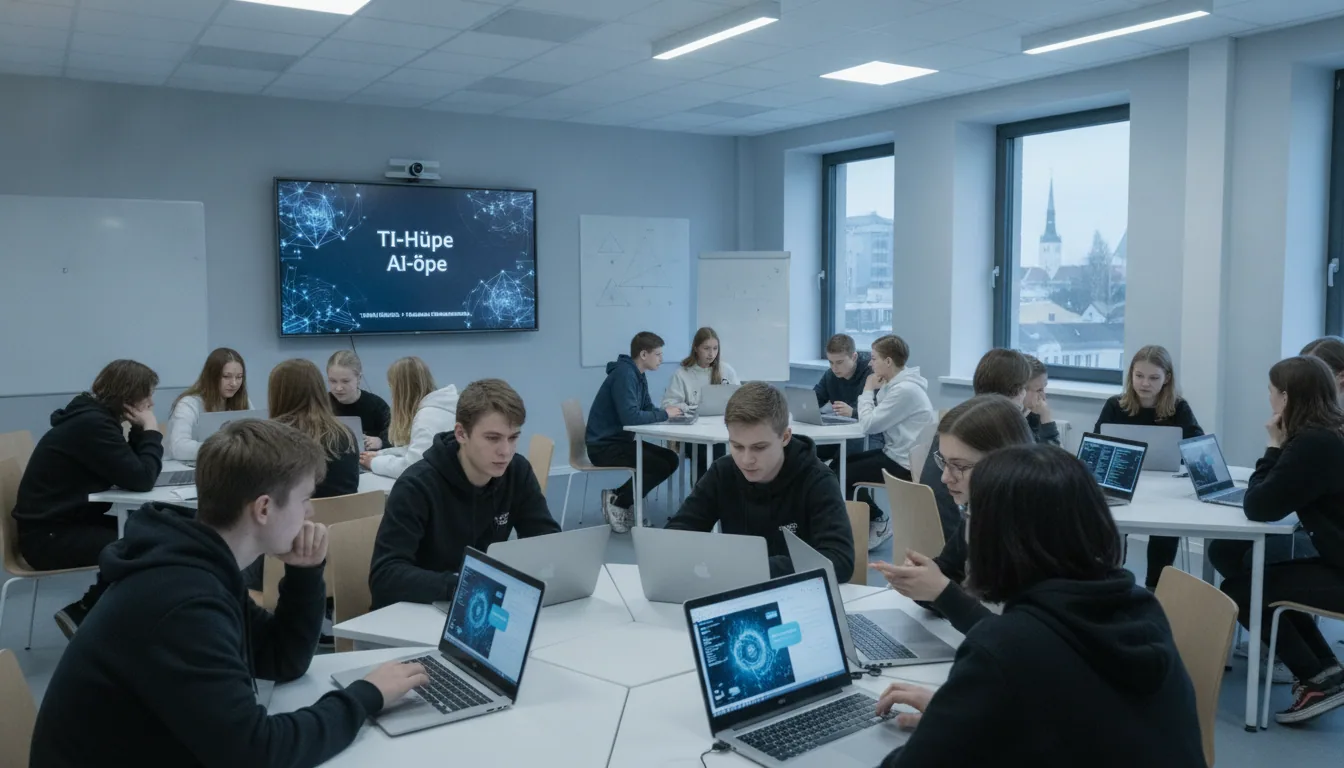
European education is witnessing a deepening divergence where advanced technical fluency meets a regulatory vacuum, forcing Estonia into a critical strategic pivot. While 75 percent of Estonian schools still lack clear institutional rules for AI usage, the state is launching a 6.5 million euro 'TI-Hüpe' initiative to standardize cognitive equity by 2026.
Institutional Inertia vs. The Digital Avant-Garde
Our current educational landscape exposes a sharp contradiction: we are rewriting the old world order in the classroom, yet we are doing so without a comprehensive socio-economic blueprint. While the Ministry of Education issued preliminary guidelines in early 2024, school leaders remain in a state of methodological paralysis. If the state continues to offer only passive consent rather than active direction, then the gap between the technological elite and the underserved will become a permanent structural fixture.
Students are currently experimenting with generative models in an environment without borders, while educators search for a professional certainty that theoretical recommendations cannot provide. This correlation between rapid innovation and legislative inertia has become a systemic bottleneck. In the Estonian context, failing to provide a strategic framework risks turning our digital success story into a cautionary tale of institutional fragmentation.
TI-Hüpe: A Socio-Economic Blueprint for Cognitive Equity
Estonia’s response to this shift—the TI-Hüpe (AI Leap)—is more than a mere renaissance of the 1990s 'Tiger Leap'; it is a calculated state intervention. With an annual budget of 6.5 million euros, the program aims to integrate 20,000 high school students and 3,000 teachers into a structured AI ecosystem by 2026. This is an essential move to ensure that high-quality AI remains a public good rather than a private luxury for the elite.
Defining 'pedagogically safe' AI requires a move beyond simply providing access to large language models. Collaborative efforts with entities like OpenAI and Anthropic are focusing on Socratic dialogue—systems designed to provoke critical thinking rather than just outputting answers. We are witnessing an emerging paradigm where technology no longer replaces the learning process but acts as a personalized, guiding tutor.
High-quality artificial intelligence must not become the exclusive privilege of a narrow elite; it must remain accessible across the entire educational spectrum to ensure social mobility.
This development is occurring in lockstep with the EU AI Act, creating a cross-border correlation between innovation and ethical accountability. For the Estonian state, the goal is to transform the school into an engine of social mobility that protects student development from 'algorithmic laziness.'
The Linguistic and Economic Correlation of the AI Divide
While technology is often marketed as a Great Equalizer, a data-driven analysis of our current trajectory suggests a more troubling dynamic. PISA 2022 results indicate that the impact of socio-economic background on learning outcomes in Estonia has risen to 13.4 percent. Digital proficiency and the meaningful use of AI are now becoming direct functions of 'home capital.'
This shift is particularly visible in the performance gap between Estonian- and Russian-language schools. It is a symptomatic correlation: the Russian-language educational space has been left vulnerable during this technological transition. A national curriculum alone cannot guarantee an equal starting position if the state fails to synchronize school readiness with this new reality.
Furthermore, we must address the linguistic hegemony of English in AI training. Most global educational tools prioritize major languages, leaving smaller languages like Estonian in a state of technological isolation. This creates a linguistic barrier that favors English-proficient students while limiting the ability of others to engage with AI as a peer-level partner.
Pedagogical Skepticism vs. Inevitable Market Demands
A quiet tension currently permeates the classroom: the teacher watches the screen while the student generates complex code or prose in seconds. According to the ARISA report, 74 percent of European students view AI as an inevitable component of their future careers. Yet, fewer than half believe their schools are providing the necessary tools to navigate this shift.
Our curricula are failing to keep pace with the behavioral mapping of the modern labor market. When the future of work is predicated on the skillful application of AI, an educational vacuum directly threatens long-term national competitiveness. The Sanoma Learning 2025 survey reveals that only 14 percent of European teachers are convinced of AI's benefit to learning outcomes. For many, the technology remains a tool for administrative convenience rather than a catalyst for deep cognitive growth.
Process-Orientation: The New Evaluative Paradigm
In a world of generative abundance, a flawless essay or perfect code no longer serves as evidence of intellectual effort; it is often merely a sign of effective prompting. The OECD warns of 'mirage quality'—the production of brilliant results that mask cognitive stagnation. If our assessment models remain static, they risk becoming a form of cybernetic theater.
European responses vary wildly, reflecting deep uncertainty regarding technological determinism. While France is moving toward total integration, Norway is debating restrictions to protect core cognitive development. In Estonia, the focus must shift from the final output to the cognitive process itself. We must transition from result-based auditing to an architectural analysis of how a student thinks.
This paradigm shift requires teachers to move from being 'evaluators of results' to 'architects of inquiry.' If we value critical dialogue and process analysis over sterile end-products, we can maintain the integrity of the educational contract.
The value of education no longer lies in the generation of answers, but in the capacity to contextualize, challenge, and verify them. If we cannot reconcile our institutions with this reality, we risk raising a generation that has outsourced its internal cognitive authority. The question for the state is simple: will we lead the transition to a process-based model, or will we watch the AI divide rewrite our social fabric from the outside in?