
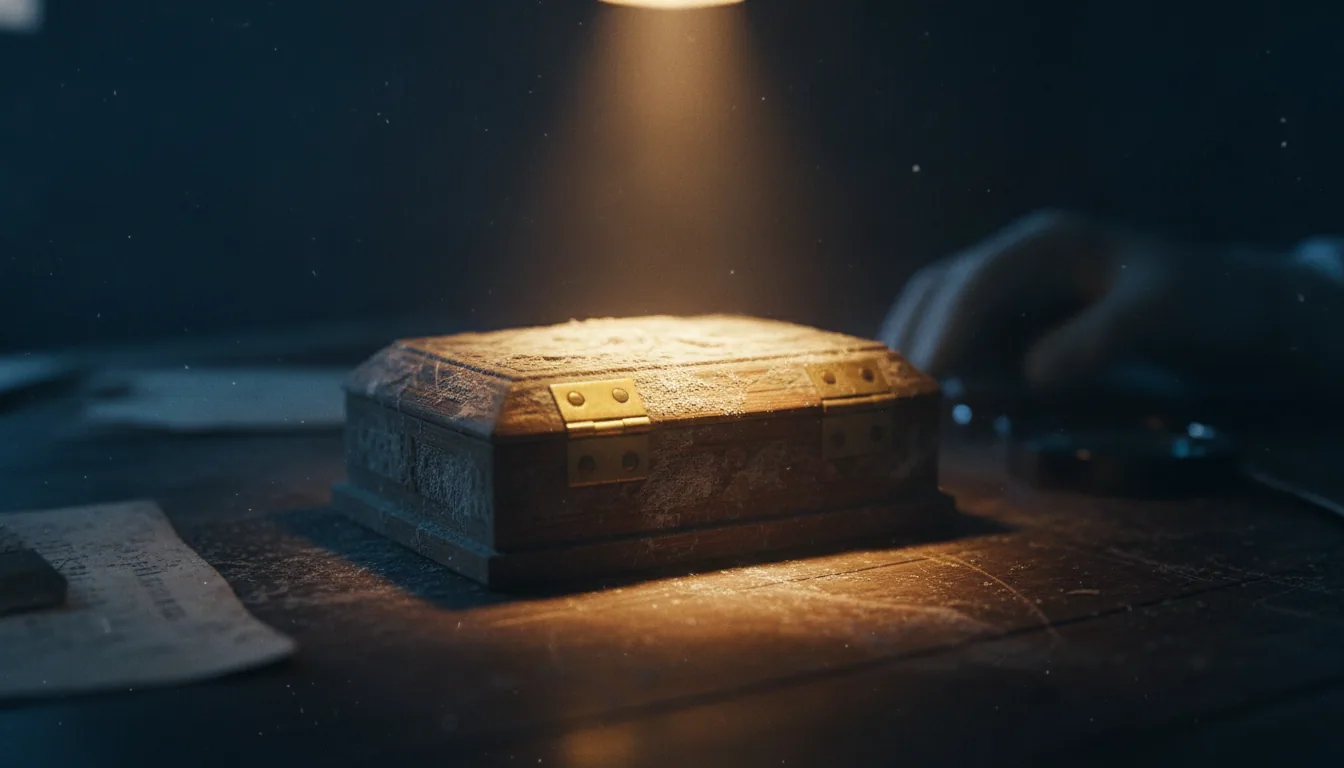
In June 2026, Estonian authorities recovered a stolen Bulgarian reliquary that had been missing for nearly 30 years. This discovery follows the 2024 repatriation of a 10th-century gold medallion, marking Estonia as a critical gateway in the international effort to intercept smuggled cultural heritage.
In June 2026, a small, intricate box appeared in the custody of the Estonian police, waiting for the National Heritage Board to confirm what the investigators already suspected. This object is a survivor of a theft from a Bulgarian monastery decades ago. Finding a Balkan treasure in the quiet, northern air of Estonia is a physical anomaly; it is roughly as expected as finding a tropical seashell buried in the sand of a Baltic garden, thousands of kilometers from its home in the Black Sea.
Here is the strange part: this box didn’t arrive via a standard courier. It is a ghost of the chaotic smuggling routes that flourished at the end of the last century. We are looking at an object that belongs to a land bordered by Romania, Serbia, and Greece, yet it has surfaced here, in our northern silence.
Currently, authorities are waiting for the results of a rigorous expertise to confirm its authenticity. In the world of antiquities, a healthy dose of skepticism is a tool, not a burden. History is littered with stories that were simply too beautiful to be true, only to be revealed as clever forgeries.
Now hold that thought, because this find is not a solitary accident. If the experts confirm its origins, this wood-and-metal container ceases to be a piece of evidence and becomes a diplomatic mission—an act of historical justice thirty years in the making.
The Reliquary: A Vessel that Bends Time
What are we actually looking at when we examine an ancient reliquary? At its simplest, it is a specialized container designed to hold the physical remains—the relics—of a saint or a historical figure. To a modern observer, it might look like an antique jewelry box.
But here is the strange part. To someone standing before this object in the year 1610, it would have been indistinguishable from magic. It wasn’t just a box made of precious metals; it was a physical bridge between the mundane world and the celestial sphere. It was a technology of the soul, meant to connect the believer to the divine through the physical presence of the past.
This specific piece was stolen in the late 1990s, a time when security in remote monasteries was often fragile. That theft wasn't just a loss of property; it was a wound in a nation’s collective memory. Today, we view it through the lens of archaeology and law, but that original sense of awe remains embedded in its craftsmanship.
For the investigators, the most vital piece of evidence is the provenance—the documented history of the object’s ownership. It is the invisible thread that connects a police lab in modern-day Tallinn back to the incense-heavy silence of an old Bulgarian monastery. When we return these objects, it is a rare victory for both science and diplomacy.
Gold in a Truck Cab: The Lessons of 2024
Here is the strange part: history rarely reappears in the sterile hall of a museum. It often shows up amidst the smell of diesel and mud.
In May 2023, a common freight truck stood at the Luhamaa border crossing, traveling from Russia toward Europe. When customs officials inspected the driver’s cabin, they found something that did not belong among the sandwich wrappers and road maps. It was an enkolpion—a small, wearable medallion that functioned as a portable shrine.
Now hold that thought. This wasn't a souvenir. It was a golden artifact from the reign of Bulgarian Tsar Peter I, who ruled between 927 and 969. While this medallion was being worn in the 10th century, the city of Tallinn didn't even have a name yet, and the Vikings were still testing the limits of their longships.
That medallion was officially returned to Bulgaria in January 2024 during a ceremony at the Great Guild Hall in Tallinn. Archaeologist Mauri Kiudsoo, who performed the expertise, noted it was a find of global rarity. That case set the precedent for the reliquary we are looking at in 2026.
The Detective Work of the Archaeologist
When an archaeologist like Mauri Kiudsoo leans over a new find, he isn't looking for shine. He is looking for wear patterns and the "fingerprint" of a specific master hidden in microscopic cracks.
Here is the strange part: the authenticity of an object doesn't lie in the purity of the gold, but in its "biography." The National Heritage Board examines how time has sculpted the surface. They bridge the gap between a muddy truck cab and a master’s workshop from a millennium ago.
Knowledge is a much more effective filter against the black market than any padlock. Without rigorous scientific analysis, these objects remain anonymous curiosities. It is the "aha" moment of identification—grounded in decades of experience—that transforms a piece of metal back into a piece of history.
The Shadowy Logistics of Memory
Estonia is not a random destination for these finds; we function as a highly sensitive filter on the route between Russia and the European Union. Our eastern border is a geographical necessity where the international shadow economy meets strict regulatory control.
This flow is part of a larger, finely tuned machine. Recently, in France, six individuals were imprisoned for systematically stealing rare books from European libraries to sell on the black market. These were not random thefts; they were precision strikes based on orders placed in the darker corners of the internet.
Now hold that thought. The Bulgarian reliquary found in 2026 is likely one link in that same invisible logistics chain, where history is reduced to anonymous cargo. Every object intercepted at the border is a rare win against a system that treats cultural heritage as a commodity. We are likely only seeing the tip of a very large, very old iceberg.
An Open Horizon
We have the object, but the most compelling chapters of its story are still blank. We still don't know exactly which monastery it was taken from, or the path it took through the shadows for thirty years.
As the police await the final expertise, that lack of knowledge isn't a failure—it's the engine of the investigation. History is not a dusty museum to us; it is a mirror reflecting our desire to keep something permanent in a vanishing world.
Even when the reliquary is returned, a larger question remains: what does our obsession with these fragments say about our need to repair the broken past? It reminds us that sometimes, the pieces of a shattered history can find their way home, even from the places we least expect. We still don't know the whole story. That, honestly, is the best part.