
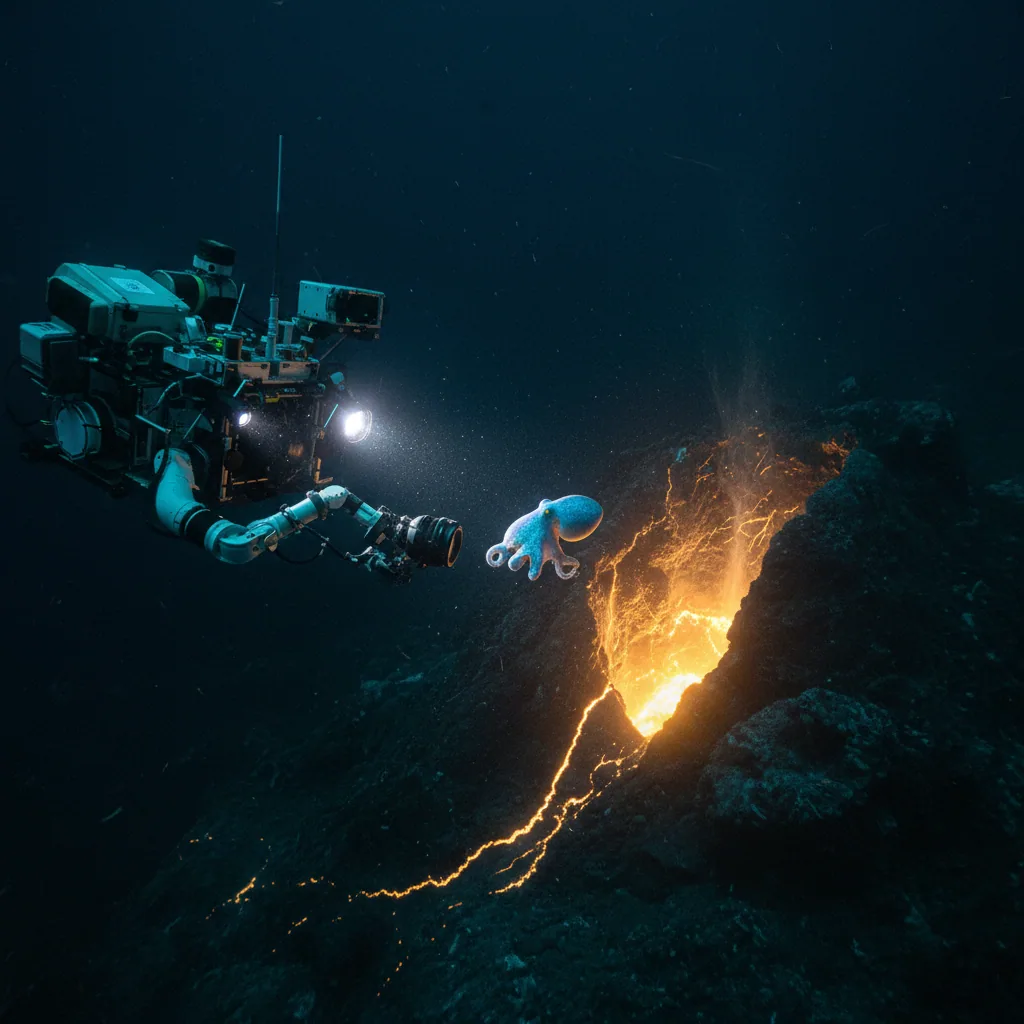
Marine researchers near the Galápagos Islands have identified a new species of octopus, Microeledone galapagensis, living 1,773 meters below the surface. This tiny, blue cephalopod utilizes low-temperature hydrothermal vents as deep-sea nurseries, where volcanic heat accelerates the incubation of eggs in the otherwise freezing abyss.
Imagine you are sitting in a darkened control room, watching a monitor feed from nearly two kilometers beneath the waves. Down here, the sun is a myth, and the water pressure is enough to crumple a steel car into a ball of scrap metal in seconds. It is a world of crushing silence and eternal night.
Then, something moves in the floodlights of the submersible. It isn't a leviathan or a jagged monster of the deep. It is a tiny, luminous blue orb, no larger than a golf ball, drifting through the gloom with an impossible sort of grace.
Here is the strange part. At a depth of 1,773 meters, color is usually a wasted investment; no sunlight ever reaches this far down. Deep-sea octopuses are typically transparent or a dull, muddy red. Yet here was a creature of vibrant, smooth blue, living where the volcanic slopes of the Galápagos rise from the seafloor like gargantuan pillars. To someone standing here in 1610, this would have been indistinguishable from magic. To us, it is a riddle in need of a ladder.
The anatomy of a secret
If you held this creature in your hand—assuming you could survive the trip down to pick it up—its arms would only reach three or four centimeters. It would fit comfortably inside a matchbox. But when researchers looked closer, they noticed something that didn't fit the standard blueprint.
Most octopuses carry two rows of suckers on each arm. This little blue pioneer has only one. In the world of taxonomy—the way we sort the chaotic library of life into neat folders—that single row of suckers is a flashing neon sign that we are looking at something entirely new.
Now hold that thought. Usually, describing a new species involves a scalpel and a microscope, a process that is, by definition, one-way for the specimen. But Janet Voight and her team at the Chicago Field Museum chose a different path. They used micro-computed tomography—essentially an ultra-high-resolution X-ray—to build a 3D digital ghost of the octopus. They could rotate its brain, its heart, and its digestive system on a screen, studying the fragile architecture of its body without ever making a single cut. It is a new, ethical era of discovery: understanding the visitor without destroying the guest.
Seafloor Radiators: The deep-sea nursery
We often picture the deep ocean as a barren, frozen desert. But in June 2023, the research vessel R/V Falkor found something that shifts that perspective. They discovered what we might call "deep-sea nurseries"—warm pockets of life tucked into the freezing dark.
At these depths, the water is normally near freezing. However, in spots where tectonic plates are pulling apart, warmth from the Earth’s interior seeps upward. We call these low-temperature hydrothermal vents, but you can think of them as the seafloor radiators—the seafloor’s own radiators.
The octopuses gather here for a very pragmatic reason: heat. In the deep, cold water, incubating an egg can take years. By huddling near these volcanic vents, the mothers use the Earth’s internal energy to speed up the process, giving their offspring a fighting chance. It is a life fueled not by the sun, but by the slow, radioactive cooling of our planet's core.
The ghost of Darwin
In 1835, Charles Darwin stepped onto the black lava of the Galápagos and realized that isolation breeds uniqueness. Nearly two centuries later, we are finding that his rule holds true even two kilometers down. These underwater mountains act as islands in the abyss, where evolution has been tinkering in the dark for millions of years.
This new species, officially named Microeledone galapagensis in May 2026, is just one of five new octopus species recently found in the area. It reminds us that our maps of the seafloor are still mostly sketches. We are currently in a race to understand these fragile ecosystems before climate change and shifting ocean temperatures rewrite the rules of their survival.
We still don’t know how these tiny blue creatures find each other in the pitch black, or what their daily lives look like in the shadow of the vents. That, honestly, is the best part. Every time we think we have the universe measured and filed away, it shows us a golf-ball-sized anomaly that proves we’ve barely turned the first page.