Google Search is undergoing its most significant transformation since its inception, moving from a system that provides a list of links to an ecosystem of AI agents that synthesize information and act on your behalf. Powered by technologies like AlphaEarth’s geospatial analysis and the Spreadsheet-RL framework, this shift turns search from a passive directory into an active participant in your workflow.
Imagine you are standing in a library where the shelves stretch into the clouds and the corridors never end. This is our digital world. Twenty years ago, to find anything in this infinite stack, you needed to know the exact title or the author’s name. You gave the librarian a keyword, and they pointed a finger toward a distant shelf. Finding the book, opening it, and extracting the answer was entirely up to you.
Now, the library is changing. Google’s "AI Mode" recently hit its first anniversary, and it marks the moment the librarian stopped pointing and started reading. Search is no longer about generating a list of websites; it is a massive, ongoing attempt to map the meaning of the world itself.
The Ladder of Understanding: What Lies Beneath the Data
To understand this shift, we have to look at how we ourselves categorize the world. When I say the word "apple," your brain doesn’t flip through a dictionary for a definition. Instead, it instantly navigates a web of associations: the color red, the crunch of the first bite, the smell of a kitchen in autumn.
AI does something remarkably similar through a concept called embeddings. Think of these as coordinates on a gargantuan, multi-dimensional map. In this space, words or ideas with similar meanings aren't just related; they are neighbors.
Here is the strange part: the system doesn't need to see the word "doctor" to know a text is about medicine. By using Gemini Embeddings, the AI calculates the "location" of a query in this meaning-space. When you search for something complex, like e-health literacy, the system isn't just looking for matching letters. It can analyze, say, 132 different research papers and map the invisible threads connecting them.
We have reached the point where the librarian is no longer content to show you the book; they have begun to read it for you.
From Looking to Doing
The most profound change isn't just that Google "understands" more; it’s that it has begun to act. We are moving from simple information retrieval to agentic workflows. In the old world, you asked Google how to build a budget spreadsheet. In the new world, the AI simply builds it.
This is where a framework called Spreadsheet-RL comes in. Using reinforcement learning—a process of trial and error—this system allows AI agents to perform multi-step tasks within environments like Google Sheets or Excel. Now hold that thought. This isn't just a script; it’s strategic action. The machine tries a solution, sees if it works, and learns from the result, much like a human would.
| Feature | Traditional Search | AI Mode (2025-2026) | The Agentic Future |
|---|---|---|---|
| Output | Blue links | Generated summary | Completed task |
| User Role | Filtering info | Reading the answer | Reviewing the result |
| Technology | Keywords | Gemini Embeddings | Spreadsheet-RL / Agents |
| Focus | "Where is the info?" | "What does it mean?" | "How do I use it?" |
AlphaEarth: Seeing the World with New Eyes
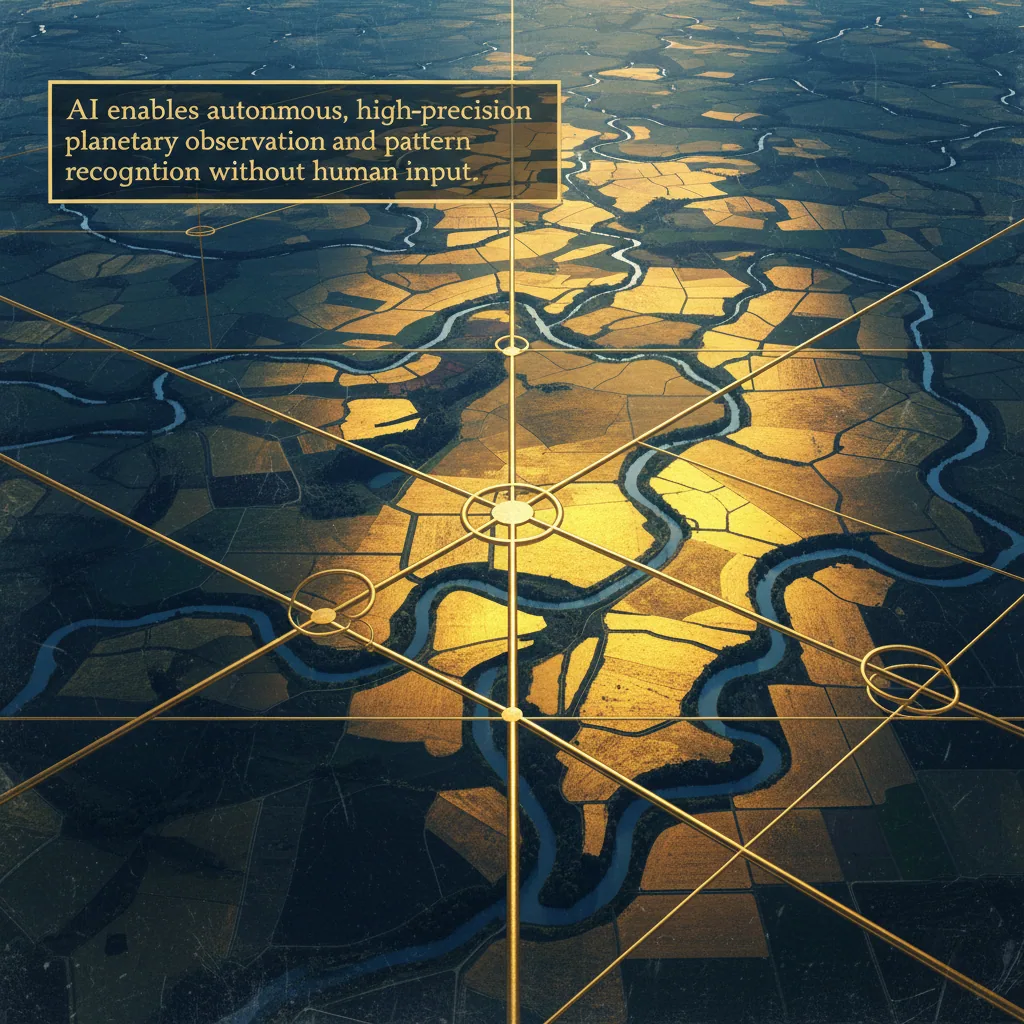
Perhaps the most vivid example of this new power comes from Google DeepMind’s laboratories. Their AlphaEarth technology uses geospatial embeddings to do something that, to someone standing here in 1990, would have looked like pure sorcery.
AlphaEarth can identify crops from satellite imagery with 99.19% accuracy. It doesn't need a human to explain what a wheat field looks like in infrared; it recognizes the patterns on its own. This isn't just bookkeeping for farmers; it’s a fundamental shift in how we monitor the pulse of the planet.
But we must maintain our rigor. When we hand over the interpretation of the world to a machine, we have to be certain of its lens. This brings us to a very human flaw the machine has inherited: bias.
The Distorted Mirror
Code is never neutral. A study called AMEL, which analyzed over 75,000 API requests, found that models like GPT-5.2 and Gemini are incredibly sensitive to the "vibe" of a conversation.
A negative conversation history can skew an AI’s subsequent judgments by up to 1.62 times more than a positive one. If you interact with an AI with hostility or aggression, the machine begins to reflect that tone back at you. It is like talking to a mirror—if you scowl, the reflection scowls back. In the world of search and advertising, this means that if we fall into a negative information bubble, the system might push us deeper into it, simply because it thinks that is what we want.
The Value of "I Don't Know"
Researchers are now working on "Uncertainty Estimation"—teaching the machine to recognize its own limits. Using a method called Evidential Deep Learning (EDL), they are trying to get the AI to say the three most important words in science: "I don't know."
Compiling these agent workflows directly into the model’s internal weights could drop costs by 100 times. But without the ability to measure uncertainty, it’s just a very fast and cheap way to be wrong. The goal is a machine that defines the borders of its own knowledge.
The Transformation by the Numbers:
1. 99.19% — The accuracy of AlphaEarth in identifying crops without human input.
2. 1.62x — How much more a negative tone influences AI responses compared to a positive one.
3. 23.4% — The success rate of the Qwen3 model in solving complex spreadsheet tasks.
4. 100x — The potential cost savings of moving agent workflows into the heart of the model.
Ultimately, we are left with a question of agency. For years, we have been building the web for machines so that machines can serve it back to us. While we have tools to manage our privacy, the underlying logic of the system is shifting beneath our feet.
We still don't know exactly how this will affect the way we click, learn, or discover the unexpected. That, honestly, is the best part. The light in the giant library has changed, and the shelves seem to be moving on their own. The adventure of figuring out what that means is only just beginning.