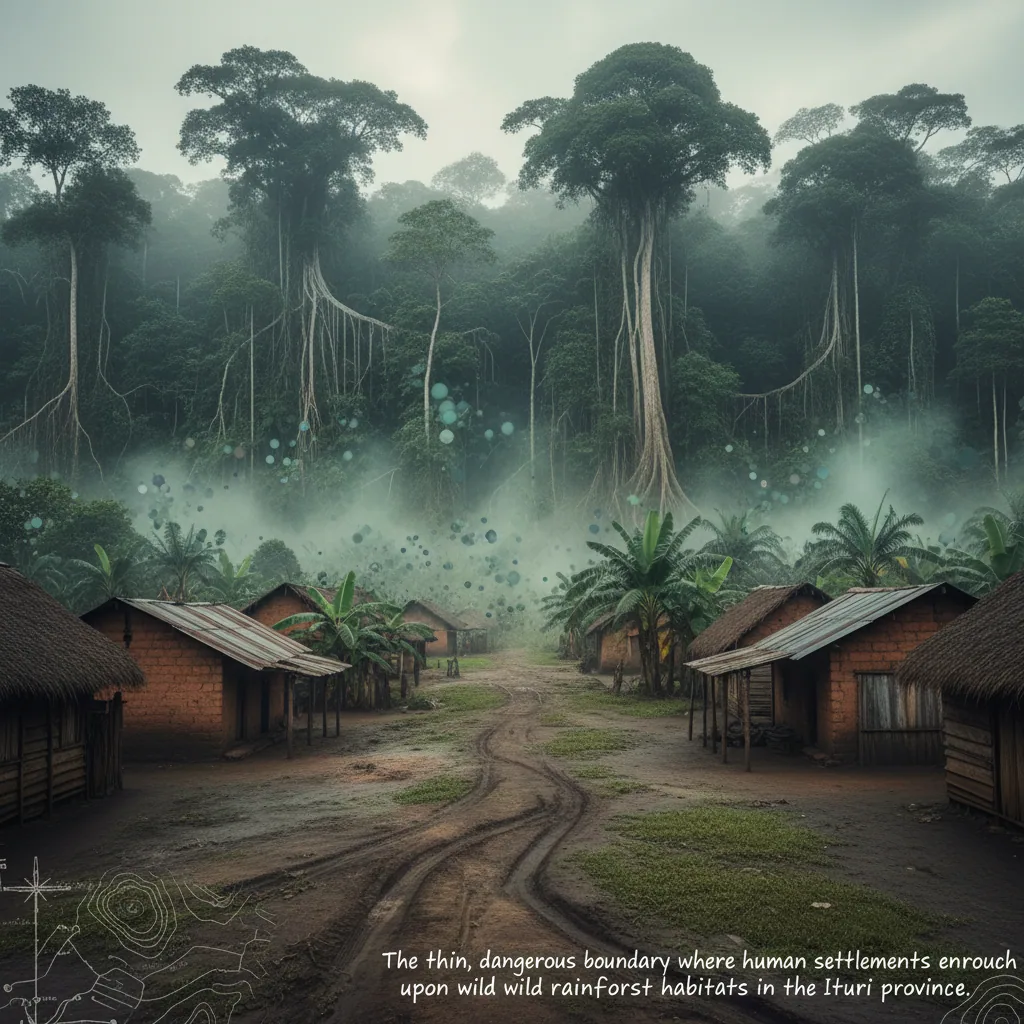
Zoonotic diseases are surging as human and animal habitats collide. This biological interface allows pathogens to cross species barriers with increasing frequency, creating global health crises. By adopting a 'One Health' strategy—treating human, animal, and environmental health as a single, interconnected system—we can move from reaction to prevention.
It is 3:00 PM in the Ituri Province, in the northeast of the Democratic Republic of the Congo. The air is so dense and humid it feels almost like a liquid in the lungs.
The temperature is a steady 31 degrees Celsius. In the shade where the rainforest edge meets the settlement, there isn’t a whisper of a breeze. It is the silence that precedes a molecular storm. In this heat, something is happening that the eye cannot see, though the consequences will soon be legible in a dozen different mortality reports.
A single contact, the rupture of cell walls, and the quiet rewriting of genetic code.
Zoonotic spillover is not a dramatic event. It is a biochemical inevitability that occurs when two worlds are pressed too tightly together.
Crossing the Invisible Frontier
On May 18, 2026, the World Health Organization (WHO) declared the Ebola epidemic caused by the Bundibugyo virus in the DRC and Uganda a Public Health Emergency of International Concern (PHEIC). In the Ituri Province alone, the outbreak has already claimed at least 87 lives. The number of infections is outstripping the local public health infrastructure's ability to respond.
This event is not an isolated incident; it is part of a broader pattern. Pathogens are jumping from animals to humans with an unnatural frequency. Our way of life—built on the destruction of wild habitats and accelerated global trade—has created the perfect conditions for the migration of pathogens.
Zoonosis is a two-way street. Viruses and bacteria travel from wild or domestic animals to humans, and occasionally back again. When deforestation pushes reservoir species into our living spaces, the jump becomes statistically unavoidable.
The mechanism is elegant and merciless
A virus does not "want" to kill us. It is simply searching for a new environment in which to replicate. In the case of the Bundibugyo strain, the process is efficient. The virus enters the body, hijacks the immune system, and begins to dismantle the integrity of the blood vessel walls.
It is a collision of physics and chemistry.
Virulence—the capacity of a pathogen to cause severe disease—determines how a species survives in a new host environment. The mechanism is elegant and merciless.
Further north, in the cold waters of the Atlantic, a similar biological drama unfolded in a different theater. In 2026, an outbreak of hantavirus was detected on the cruise ship M/V Hondius. It served as a cold reminder that animal-borne infections are not exclusively a problem of the tropical rainforest.
"We do not have the luxury of choosing between environmental health and human health; they are the same story."
— Lukas Marsh
Cruise ships are, by their nature, closed ecosystems. The density of people and the speed of global movement make them ideal distribution hubs. As hantavirus found its way into the narrow corridors of a luxury vessel, it proved that species barriers can be crossed in the middle of the open sea.
The Kitchen Table and the Global Chain
We tend to believe we are insulated from the natural world by sterile supermarkets and vacuum-sealed packaging. The data suggests otherwise. In Europe, the incidence of zoonotic infections is rising, with a particularly concerning spike in listeriosis cases.
In Estonia, the map of infection does not stop at the national border or the species barrier. The most common zoonoses diagnosed in Estonians, such as campylobacteriosis and salmonellosis, arrive directly through the food chain.
| Pathogen | Primary Source (Estonia/Europe) | 2026 Trend |
|---|---|---|
| Bundibugyo (Ebola) | Wildlife contact (Ituri Province) | Critical Growth |
| Salmonella | Pork and Poultry (2023 monitoring data) | Persistent Pressure |
| Listeriosis | Ready-to-eat and fish products | Rising Trend |
| Hantavirus | Rodents (including cruise ships) | Sporadic Outbreaks |
According to 2023 monitoring data, pork was the most frequent source of Salmonella contamination in Estonia. This is not merely a failure of kitchen hygiene; it is a systemic issue in how we raise and process animals. The Agriculture and Food Board (PTA) is implementing increasingly stringent controls, but the pressure on the system remains high.
One Health: Integrated Resistance
We have spent decades treating medicine, veterinary science, and environmental protection as separate islands. This was a mistake. The PTA, alongside international bodies like EFSA and the ECDC, has begun to implement the 'One Health' principle.
This approach integrates the health of people, animals, and ecosystems into a single framework. The Agriculture and Food Board operates on a simple premise: it is impossible to keep a human healthy in an environment that is sick. When we poison water or clear forests, we create the pressure that sets pathogens in motion.
Monitoring climate impacts—such as tracking blue-green algae in drinking water—has become a pillar of modern disease prevention. During the Ebola outbreak in Ituri, the Africa CDC convened an emergency meeting to apply these principles in real-time. A systemic approach is the only way to manage risk in regions where resources are finite.
Climate as a Catalyst
Climate change is redrawing the map of disease in real-time. Shifting temperatures and rainfall patterns are moving the goalposts for reservoir species. Rodents, mosquitoes, and tips are migrating into territories where they were previously unknown.
These species bring viruses to which local populations have no prior immunity. Preventing zoonotic outbreaks requires us to limit contact between humans and wildlife, yet this is difficult in a world where physical space is shrinking. We see this in the increasing frequency of hantavirus cases and the appearance of exotic diseases in the heart of Europe.
When you add heat to a system, pathogens move faster and more chaotically. Nature always adapts, but our human-made systems—our economies and our food chains—are brittle. Climate change is a pressure test for every joint in our societal infrastructure.
Translating Science into Action
The gap between what we know and what we do remains our greatest vulnerability. The CDC is currently working to standardize scientific language to make data more accessible to the public. This is a democratic necessity.
Precise coding of sepsis in the ICD system according to the specific pathogen might seem like a bureaucratic detail, but it is the foundation of global statistics. Accurate data collection is the only way to see patterns before they become catastrophes. A virus does not recognize a border.
The dusty air of the Ituri Province is connected to the food safety of an Estonian dinner table through a thousand global threads. Waiting is not a public health strategy. The Bundibugyo outbreak in the Congo is a reminder that the timescale of a pathogen is frighteningly short.
Zoonotic diseases have moved between animals and humans for millennia. But we have never exerted this much influence on the planet’s ecosystems. We have become the dominant environmental force, and the environment is responding with its own biological arsenal.
I think back to the Ituri Province, where the sun stains the forest edge a deep, bruised red. People gather for dinner, unaware of the microbial war being waged in the air around them. The river still flows in the same direction, despite the declared emergency. The world has changed, and the rise of zoonotic disease has turned it into a quiet battlefield where the next spillover is only a matter of time.