EU Economic Prognosis for May 2026: Navigating the Calculus of Uncertainty
The EU economic prognosis for May 2026 indicates a period of deceleration, with GDP growth cooling to 1.1% as inflation rebounds toward 3.0% amid energy shocks and shifting trade policies.
As of May 2026, the Eurozone economy is decelerating toward a projected GDP growth of 1.0%–1.1%, while inflation is rebounding toward 3.0% due to energy shocks and shifting US tariff policies. The ECB maintains interest rates at 2.0%, balancing defense obligations against a fiscal landscape that is becoming increasingly precarious.
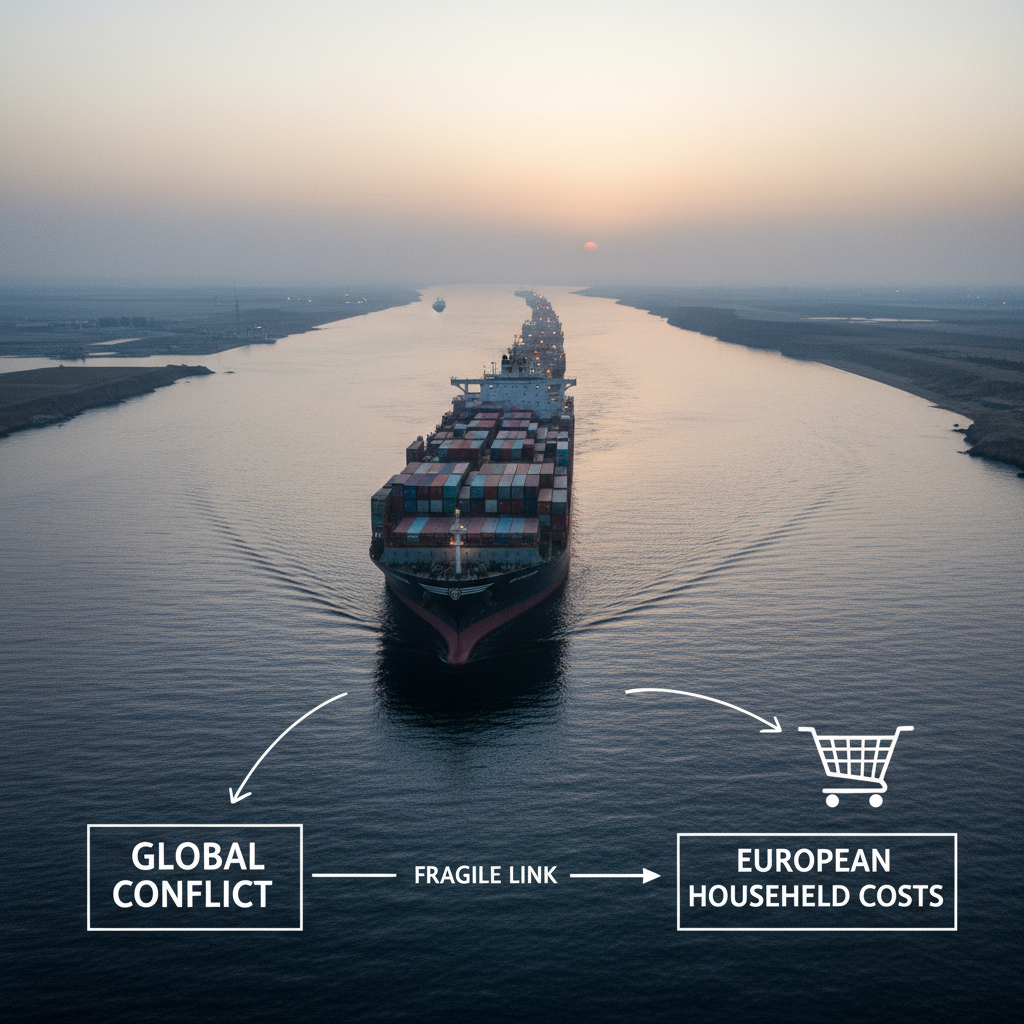
On May 4, 2026, a single freighter sitting idle at the entrance to the Strait of Hormuz tells you more about the future of the Eurozone than any press release. If that ship moves, the price of a kilowatt-hour in a German manufacturing plant stays manageable; if it remains anchored, the entire European economic engine begins to knock. The distance between a Middle Eastern ceasefire and a French household’s grocery budget has never been shorter.
The Geography of the Slowdown
The International Monetary Fund (IMF) has recently downgraded the Eurozone’s outlook, signaling a retreat from the 1.5% expansion we saw in 2025. This isn’t merely a cyclical dip; it is the physical manifestation of a supply chain stretched to its breaking point by geopolitical friction. Economic growth is expected to cool significantly throughout 2026 before a modest recovery in 2027, provided current energy-driven shocks subside.
The April 2026 Regional Economic Outlook from the IMF highlights a sharp deterioration in both investor and consumer confidence. When a retired teacher in Milan looks at her heating bill, she isn't thinking about "macroeconomic volatility." She is realizing that her fixed income can no longer stretch to cover both energy and the quality of life she was promised.
The Economic Research Nowcasts suggest growth could dip as low as 1.0% this year. This retreat from 2025's expansion represents a fundamental shift in how European firms view the cost of doing business in an unstable world. While activity currently withstands the worst of the energy shock, that resilience is largely buoyed by heavy state-led investment in specific corridors.
Comparative Economic Indicators: The 2025-2027 Horizon
| Indicator | 2025 (Actual) | 2026 (Forecast) | 2027 (Projected) |
|---|---|---|---|
| GDP Growth | 1.5% | 1.0%–1.1% | 1.3% |
| Inflation (HICP) | 2.1% | 3.0% | 3.3% |
| ECB Interest Rate | 2.5% | 2.0% | 2.0%–2.25% |
| Business Confidence | Moderate | Subdued | Improving |
The Inflation Rebound and the ECB’s Dilemma
The European Central Bank confirmed on May 4 that it would maintain interest rates at 2.0%. The Governing Council’s language was careful, noting that upside risks to inflation and downside risks to growth have intensified. This hawkish pause comes as the Harmonized Index of Consumer Prices (HICP) shows signs of a stubborn rebound across the 20-nation bloc.
Inflation is now forecasted to climb back to 3.0% this year, reflecting the reality of energy-driven supply shocks. Prolonged fiscal spending on energy support programs is further complicating the inflation trajectory, creating a difficult balancing act for monetary policymakers.
The ECB’s Economic Bulletin Issue 2, 2026, emphasizes the need to stabilize inflation over the medium term. In May, the year-on-year inflation rate was recorded at 1.9%, yet underlying pressure from energy remains the primary concern for EURIBOR forecasts. Policymakers are essentially betting that a temporary ceasefire in the Middle East will do the work their interest rate hikes couldn't.
"The search for stability is the driving force behind both consumer sentiment and the strategic autonomy policies being crafted in Brussels."
EU Economic Prognosis for May 2026: Tariffs and the Heartlands
The headwinds aren't just coming from the East; they are blowing across the Atlantic as well. The Economist Intelligence Unit (EIU) has identified shifting US tariff policies as a primary threat to European manufacturing. The threat of increased trade barriers is forcing EU exporters to recalibrate supply chains already struggling with the green energy transition.
In the manufacturing centers of Germany and northern Italy, this is referred to as "strategic uncertainty." It is the reason why business confidence, measured by the Eurochambres Economic Survey 2026, remains so subdued. If the United States pivots toward a more aggressive protectionist stance, the European export-led model will face its most significant existential challenge.
Internal EU dynamics are shifting, with reports that Germany may move to end certain EU veto powers. This systemic change is intended to allow Europe to respond more rapidly to external pressures without being paralyzed by internal disagreement. The ability to move quickly on the Multi-annual Financial Framework (MFF) is now a requirement for survival.
The Pivot: Defense, AI, and Electrification
The EU is currently undergoing a "Defense-AI-Electrification" pivot that is decoupling industrial growth from traditional consumer demand. This transition is a long-term strategy to ensure what Brussels calls "Strategic Autonomy." Increased defense spending is no longer just a budgetary burden; it is acting as a massive stimulus for high-tech manufacturing.
Europe is focusing on AI for industrial automation to offset shrinking labor pools and rising costs. Additionally, massive investments in the power grid are beginning to insulate the Single Market from the volatility of global fossil fuel prices. This pivot explains why the Eurozone is expected to avoid a technical recession in 2026 despite the 3.0% inflation rebound.
The energy shock of 2026 is being met with a much more robust domestic energy infrastructure than in previous years. This internal resilience is the story the markets are missing. European industrial bases are transforming into a more self-contained system to weather global instability.
Fiscal Warnings and the Human Cost
The fiscal landscape in May 2026 is characterized by what analysts in Brussels are calling "serious fiscal warnings." Governments are struggling to balance energy support programs with rising debt levels and slowing growth. Total gross public debt remains elevated in several member states, prompting calls for a return to strict fiscal discipline.
Persistent uncertainty regarding energy costs and productivity has led to a stagnation in private sector investment. This has left the burden of economic stimulation largely on national governments and EU-level funding initiatives. The diagnosis for the Single Market from the Eurochambres Economic Survey remains far from reassuring.
Social platforms show that boardroom data points translate into immediate frustration with the cost of living. Individual narratives contribute to a sense of social fatigue that political leaders cannot ignore. The interesting question is whether the current political structure can survive the social strain of such low growth.
Sectoral Shifts and Media Influence
The technology sector remains a bright spot, particularly in Central Europe where the European Economic Congress in Katowice is a major forum. Central Europe is positioning itself as the laboratory for the EU’s industrial AI strategy. This region leverages a highly skilled labor pool and lower cost base to drive innovation.
Deloitte’s 2025-2026 Digital Media Trends report indicates that social platforms are now the dominant force in European media. This change in information flow contributes to the rapid shifts in consumer sentiment observed by the ECB and IMF. When a viral post can move market sentiment faster than a central bank communique, the nature of economic stability changes.
As we move through the remainder of May 2026, several milestones will determine if the year ends in recovery or stagnation. The markets will watch for the first 90 billion euro loan tranche to Ukraine and the July ECB meeting. This EU economic prognosis for May 2026 remains contingent on the stability of the Middle East and the reopening of key trade corridors.
Written by Priya Chandran