
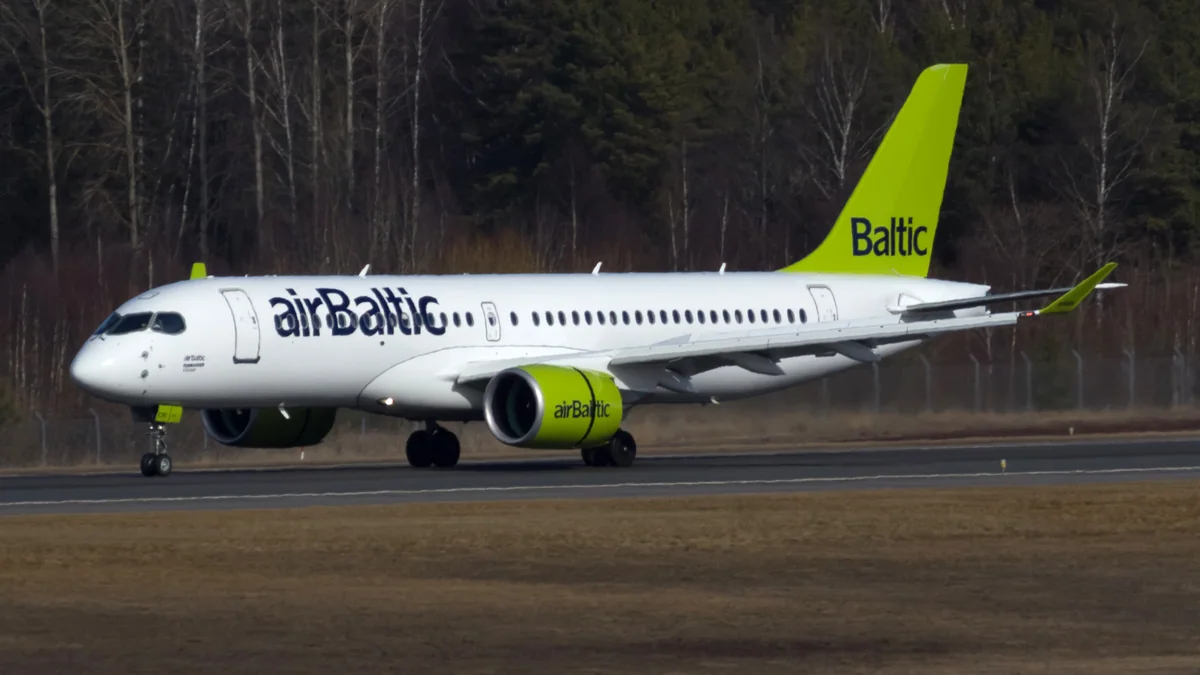
In an era defined by gray-zone aggression, Baltic aviation safety maintains a paradoxical stability. By 2026, airBaltic has secured the 7th spot globally for safety, leveraging predictive maintenance via the Airbus Skywise platform and NATO-backed aerial security to neutralize Russian GPS interference and emerging drone threats.
On a cold tarmac in March 2026, the charred remains of a state-of-the-art Airbus A220 served as a stark reminder of the frailty of material assets. This image—high-level European engineering meeting sudden, unexpected destruction—perfectly encapsulates the current regional landscape: a high-stakes collision between technical perfection and geopolitical chaos. If we are to understand why our skies remain safe, we must look beyond the wreckage to the data; Airline Ratings recently ranked airBaltic the 7th safest airline in the world, a testament to an emerging paradigm where safety is no longer a static standard, but a test of dynamic institutional resilience.
The Hull Loss Paradox and Institutional Behavior
The destruction of the airBaltic A220 on March 17, 2026, marked the first "hull loss" for the aircraft type in aviation history. For the uninitiated, it seems contradictory that a carrier could lose a flagship vessel to fire and simultaneously ascend the global safety rankings. However, in the Estonian context and across the wider Baltics, we recognize this as a triumph of institutional behavior over isolated incidents.
Airline Ratings maintained airBaltic’s perfect safety score because the fleet remains one of the youngest globally, supported by a low incident rate and aggressive risk management. As instructors at the Baltic Aviation Academy (BAA Training) suggest, safety has evolved into a collective intelligence exercise. When Finnair or airBaltic shares data, they aren't just managing engines; they are building a socio-economic blueprint for survival in a region where the threat is often external and invisible.
Mapping the GPS War: NATO and the New Normal
When we shift our gaze from technical failures to strategic interference, we see the Russian Baltic Fleet actively rewriting the old order. The navigation safety exercises conducted in April 2025 were not merely drills; they showed a direct cross-border correlation with the GPS jamming that has plagued civilian corridors.
NATO has responded by treating the airspace as a frontline. Since the 2022 pipeline disruptions, maritime and aerial surveillance has reached a fever pitch. In early May 2026 alone, NATO jets scrambled three times in a single week to intercept Russian assets over the Baltic Sea. This is the new normal: a reality where the civilian pilot must navigate a "poisoned" electronic environment, as evidenced by the total shutdown of Vilnius Airport in May 2026 due to asymmetric drone interference.
"We have reached a point where aviation safety has become an inextricable component of national defense."
Data as the Strategic Currency
To counter this uncertainty, the industry is turning to heavy-duty data synthesis. Enter Palantir Technologies and their Foundry platform, which powers Airbus’s Skywise ecosystem. Currently, over 50,000 users utilize this interface to predict failures before they manifest.
Palantir’s role as a guardian of Western democratic infrastructure is now tangible in our hangars. By analyzing the real-time behavior of the Airbus A220-300 fleet, Skywise allows operators to distinguish between a mechanical fluke and a systemic vulnerability. Yet, we must remain sober: AI error rates in complex political contexts can fluctuate between 6% and 47%. In an environment where an adversary actively seeks to mislead navigation, over-reliance on a single algorithm is a risk we cannot afford.
The Human-Machine Symbiosis: Managing Cognitive Load
The next frontier of safety lies in the cockpit’s ability to adapt to the pilot’s mental state. The MambaGaze framework, which monitors a pilot’s cognitive load via eye-tracking with 77% accuracy, represents a significant paradigm shift. Running on a mere 7.5 watts, this technology is now a practical tool for the modern flight deck.
If a system can detect in real-time that a pilot is overwhelmed by GPS spoofing or a landing-gear malfunction, it can adjust the flight deck assistance to prioritize critical data. Regional hubs like the Baltic Aviation Centre of Excellence (BACE) are already integrating these insights into training, preparing pilots for "blind" corridors where traditional instruments may falter.
| Technology/Focus Area | Aviation Function | Strategic Outcome |
|---|---|---|
| Palantir Foundry / Skywise | Big Data & Predictive Maintenance | Prevents technical failure; optimizes fleet uptime |
| MambaGaze Framework | Cognitive Load Monitoring | Reduces human error in high-stress scenarios |
| Dynamic Lane Allocation (DLA) | Airspace Management | Reduces unused airspace 5x; cuts travel time by 21.6% |
| Multi-agent Reinforcement Learning | Autonomous Coordination | Enhances safety in high-density drone corridors |
Efficiency Amidst Geopolitical Friction
Innovation is driven as much by economic necessity as it is by safety. Dynamic Lane Allocation (DLA), currently being tested in urban mobility corridors, has the potential to reduce unused airspace fivefold. In a market where fuel costs and insurance premiums are dictated by regional volatility, a 21.6% reduction in travel time is a critical competitive edge.
However, every technological gain remains vulnerable. If the maneuvers of the Russian Baltic Fleet are a response to Western presence, then civilian aviation is the primary conductor of that tension. We possess some of the world’s safest airlines, yet they operate in a sky that is electronically compromised. Success in this environment requires investment that goes beyond procurement; it requires the building of total resilience—from redundant navigation systems to drone mitigation at every major hub.
The Synthesis: Can Technology Outpace Chaos?
The future of Baltic aviation depends on the speed at which we can integrate military-grade data processing into the civilian sector. With Palantir’s 2025 revenues surging 56% to $4.475 billion, it is clear the market trusts data-driven security. The question remains whether that trust can be sustained by the traveling professional.
As we analyze the behavior of airBaltic and Finnair, we see a definitive shift from closed institutional silos to open data exchange. The old world's bureaucratic delays are no longer tenable when a drone swarm can halt a capital's air traffic in minutes. Our airspace has become a laboratory for hybrid resilience. The results of this experiment will determine if the Baltics remain a global aviation hub or a risk zone to be bypassed. Will we build a system where technology stays one step ahead of political chaos, or will we allow the complexity of the new world order to ground us?